SEO (Search Engine Optimization) is the process of improving a website’s visibility in search engine results pages (SERPs) to increase the quantity and quality of organic (non-paid) traffic.
The goal of SEO is to make a website more attractive to search engines, ensuring that it ranks higher for relevant queries that potential visitors are searching for. To achieve this, SEO involves optimizing various elements of a website to align with how search engines like Google, Bing, or others evaluate and rank web pages. It focuses on improving aspects like site structure, content, technical performance, and user experience, ensuring that a site provides valuable, relevant, and easily accessible information.
Sounds familiar? You probably have seen variations of this definition many times over at reputable sources like Ahrefs, Semrush, Moz, Search Engine Land, Search Engine Journal, and more. They already do an excellent job defining what SEO is and introducing anyone to this process. So I will not bore you with more of the same, and instead take on a different angle.
How I See SEO
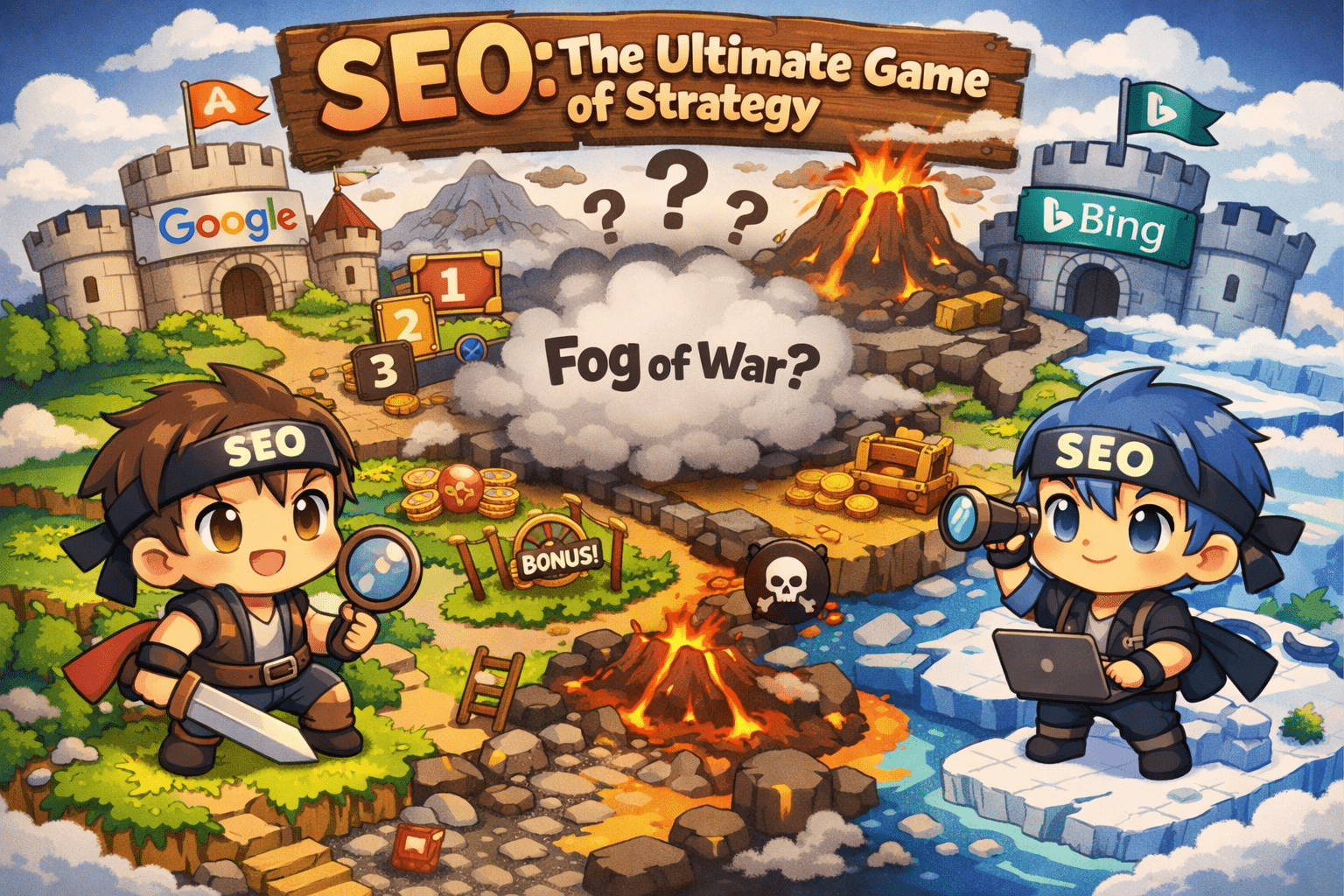
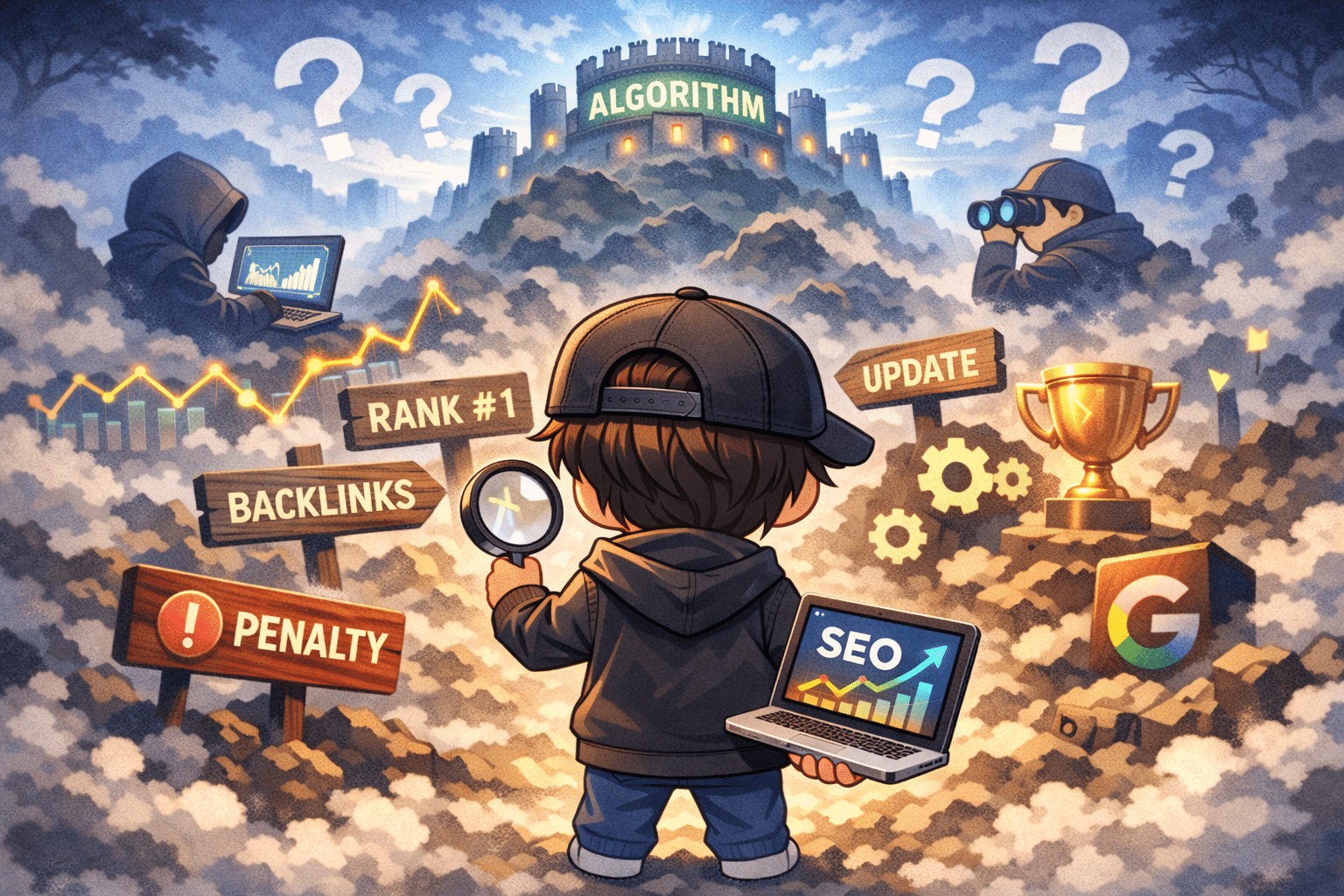
I have been doing SEO in Singapore for 7 years at this point. To me, SEO is a “pretty sick game”. A competition that captivates its competitors and sucks many of us in with its unpredictability. Every SEO is trying to outdo the rest and rank their chosen website higher, yet they do so in a “fog of war”. Not only do they not have direct intel of what the competition is doing, but they don’t fully know their “terrain” either. By “terrain”, I mean the current search engine algorithm; think of the current actions that the search engine rewards or penalises. And you can bet that no SEO knows for sure all the SEO factors and their individual weightages/importance.
This makes SEO both really simple and complicated at the same time. At its heart, SEO is all about pattern recognition. Can you spot what patterns and commonalities the top ranking pages/websites have and what you don’t. With some knowledge of the SEO factors, and the ability to perceive these common denominations, you basically can do SEO without extensive tools and knowledge.
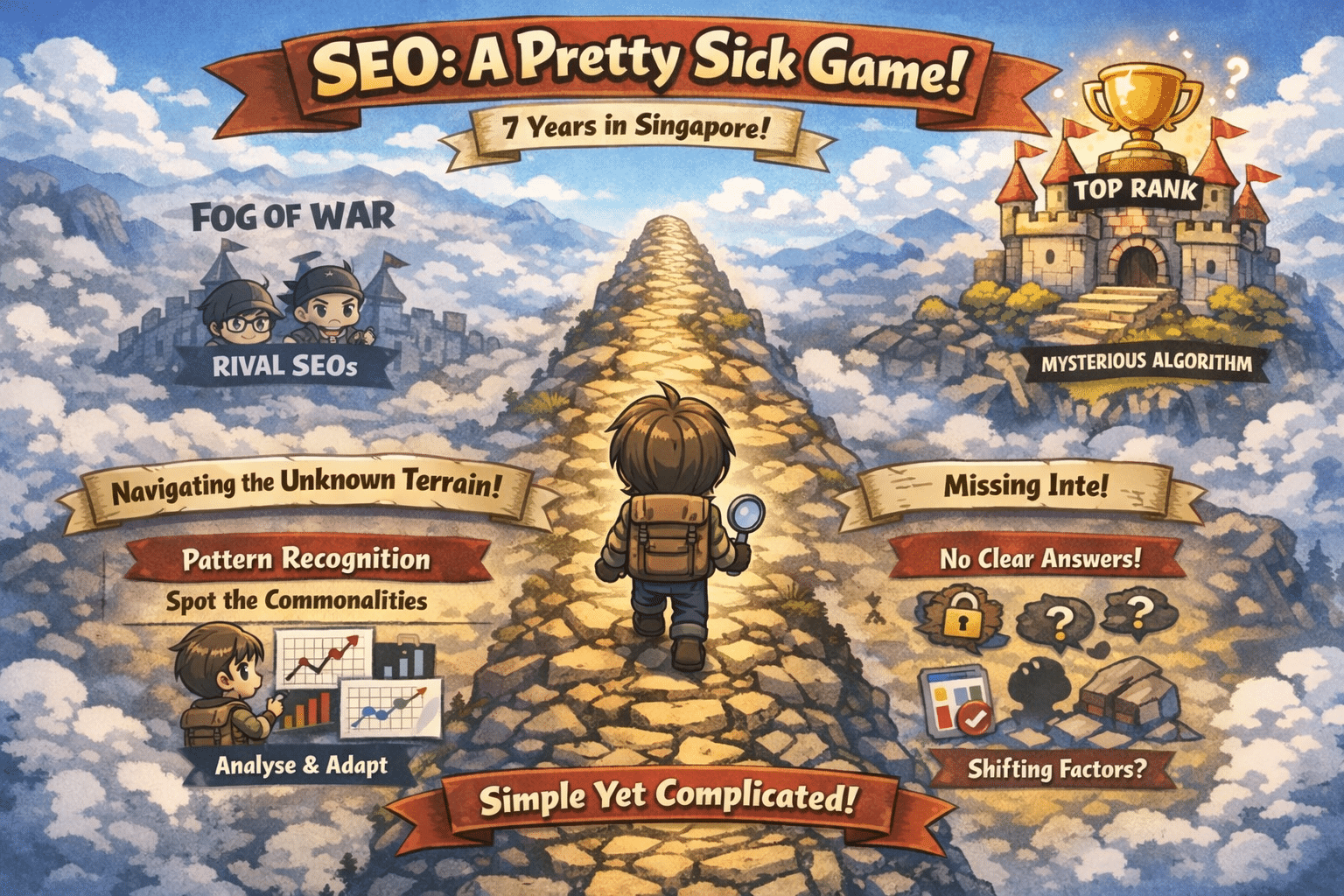
Having saving that, given that competitors are also doing SEO (leading to ever changing webpages) and a search algorithm that is also shifting beneath your feet, you will find it tough to ever deliberately pinpoint or confirm a factor for success or failure. Most of the time, you will be doing analysis and trying to implement several items at once, but not being able to isolate and confirm any of their impacts. At best, you get a set of data that correlates with your original analysis.
Having set the tone of what this article is going to be about, we can get started introducing you to how SEO practitioners see SEO and how it will influence your thinking about this process.
*Note: since I have mostly practiced in an SEO agency in Singapore, much of the context provider will be specific to the Google search engine and localised to Singapore’s Search Engine Results Pages (SERPs).
The Google SEO Timeline
Before we get into the thick of things, it’s important to understand that SEO has evolved a ton over the past 2 decades. In order to understand how to think of SEO, we need to first look at its evolutions.
The Base Of Google Search Algorithm
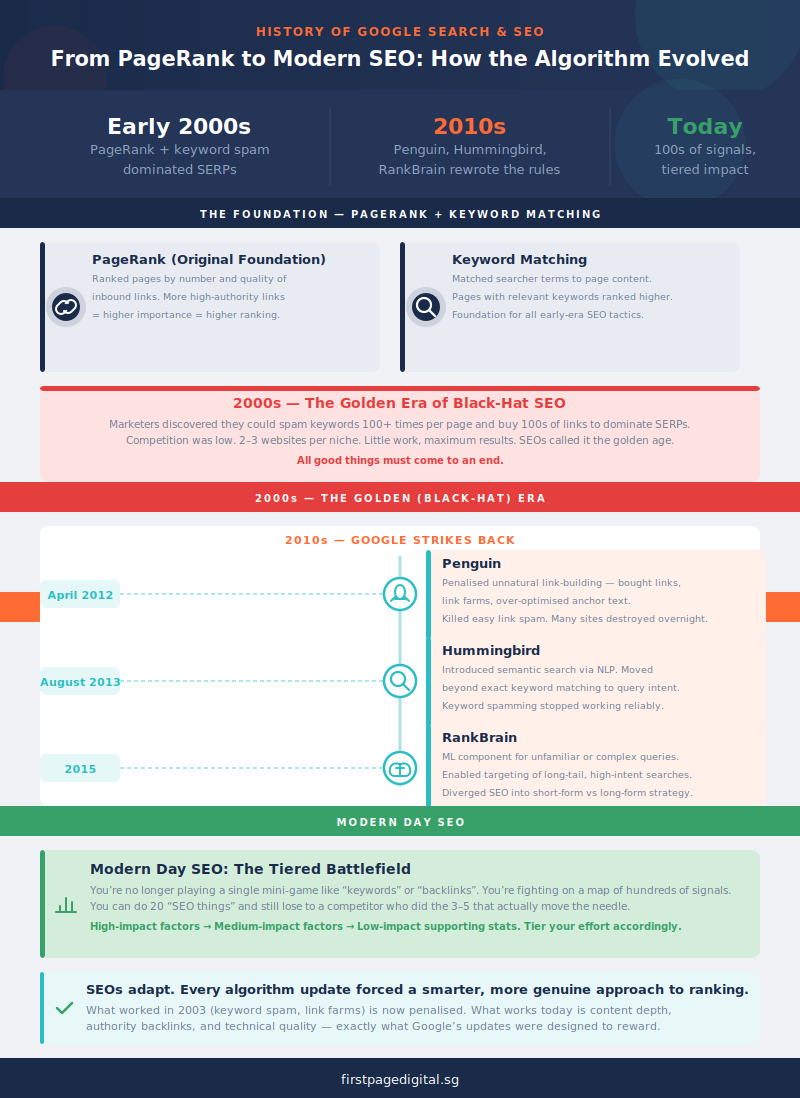
While not the first search engine, the Google search engine began to surge in popularity around the early 2000s, replacing earlier leaders like AltaVista and Yahoo! Search. This was due to its clean user interface (UI) and its ability to recommend relevant and trusted websites (relative to the competition). This ability was built on Google’s original ranking system: PageRank.
PageRank was designed to rank web pages based on their importance or “authority” on the internet. It worked by counting the number and quality of links to a page to determine a rough estimate of the website’s importance. The underlying assumption is that more important websites are likely to be linked to more frequently by other websites. The more high-quality links a page has, the higher its PageRank, which in turn affects its ranking in search engine results.
In the Google Search algorithm, PageRank was paired with another already popular mechanism: keyword matching. Keyword matching refers to the process of matching the words or phrases used by a searcher (the keywords) to the content on a webpage. The Google Search algorithm would use keyword matching to assess how closely a page’s content aligns with a user’s search query. Pages that contain relevant keywords were more likely to rank higher.
2000s: Early Days SEO (a.k.a. A New Hope)
Having seen that Google Search was heavily relying on keyword matching and PageRank (i.e. links), marketers and soon to be SEOs realised they could take advantage of this knowledge.
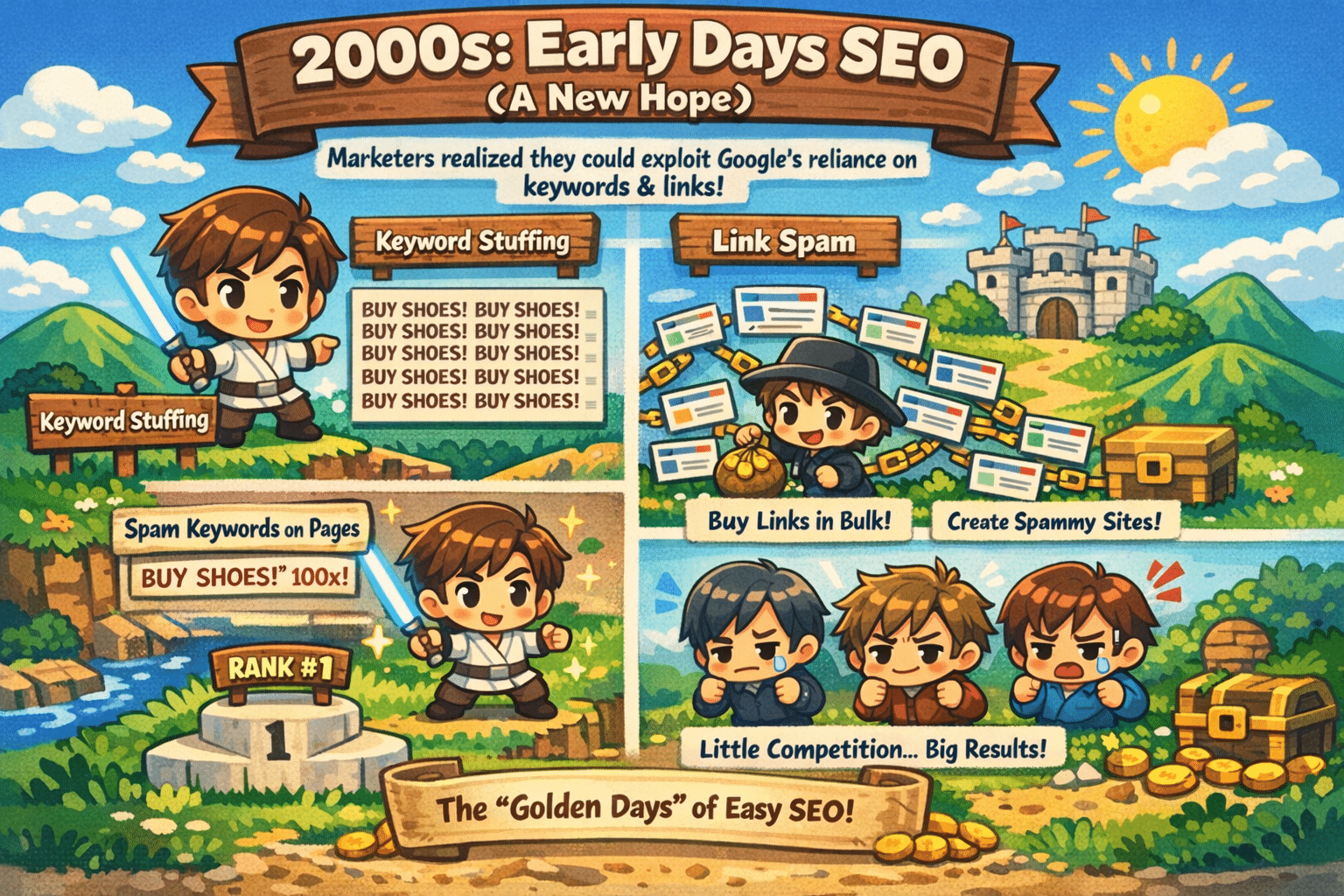
For starters, they could spam targeted keywords on their webpages. Imagine putting a keyword phrase 100 times or more on a page. Basically screaming at Googlebot that their page was highly relevant for a user’s query.
Next, they could create or buy websites then spam 100s of links back to the target website. Do this in bulk and Googlebot will see that. As a bonus, you did not even need to care about what content was on these pages. You could drop a simple comment with just your link and it would work.
And just like that, you would have a website that ranked well ahead of the competition. Of course, back then, SEO was hardly heard of and thus the competition was low. Indeed, if you were doing SEO, you likely had at most 2-3 websites competing with you in your area’s SERP. Many SEOs from this period refer to it as the golden days, of little work, and max results. Yet all good things must come to an end, and so we move on to the 2010s.
2010s: Google Penalties Incoming (a.k.a The Empire Strikes Back)
| Algorithm / Update | Date | Purpose | Impact |
|---|---|---|---|
| PageRank | 1998 | Core ranking based on link importance | Became the foundation of Google’s ranking algorithm, rewarding authoritative and high-quality content |
| Panda | 2011 | Penalized low-quality, thin, or content-farm pages | Improved content quality on the web by de-prioritizing low-value pages |
| Penguin | 2012 | Targeted manipulative link-building practices | Encouraged better link-building practices and reduced spammy backlinks |
| Hummingbird | 2013 | Improved interpretation of search intent and query context | Allowed Google to return more relevant results even for long-tail and conversational queries |
| RankBrain | 2015 | Introduced machine learning to handle unfamiliar queries | Improved Google’s ability to process and rank long-tail, complex, and ambiguous queries |
| BERT | 2019 | Improved natural language understanding, especially for context and grammar | Enhanced the accuracy of search results by better understanding user intent in conversational language |
| MUM | 2021 | Handle complex, multimodal queries involving text, images, and video | Improved search experiences by providing more comprehensive answers across various media |
| Helpful Content Update | 2022 | Rewarded content created to help users rather than ranking high for SEO tactics | Encouraged content creators to focus on quality and usefulness rather than keyword optimization tricks |
| AI Overview / AI Search Era | 2024+ | Integration of AI-generated answers into the search results | Shifted focus towards direct answers via AI, changing how users interact with search results |
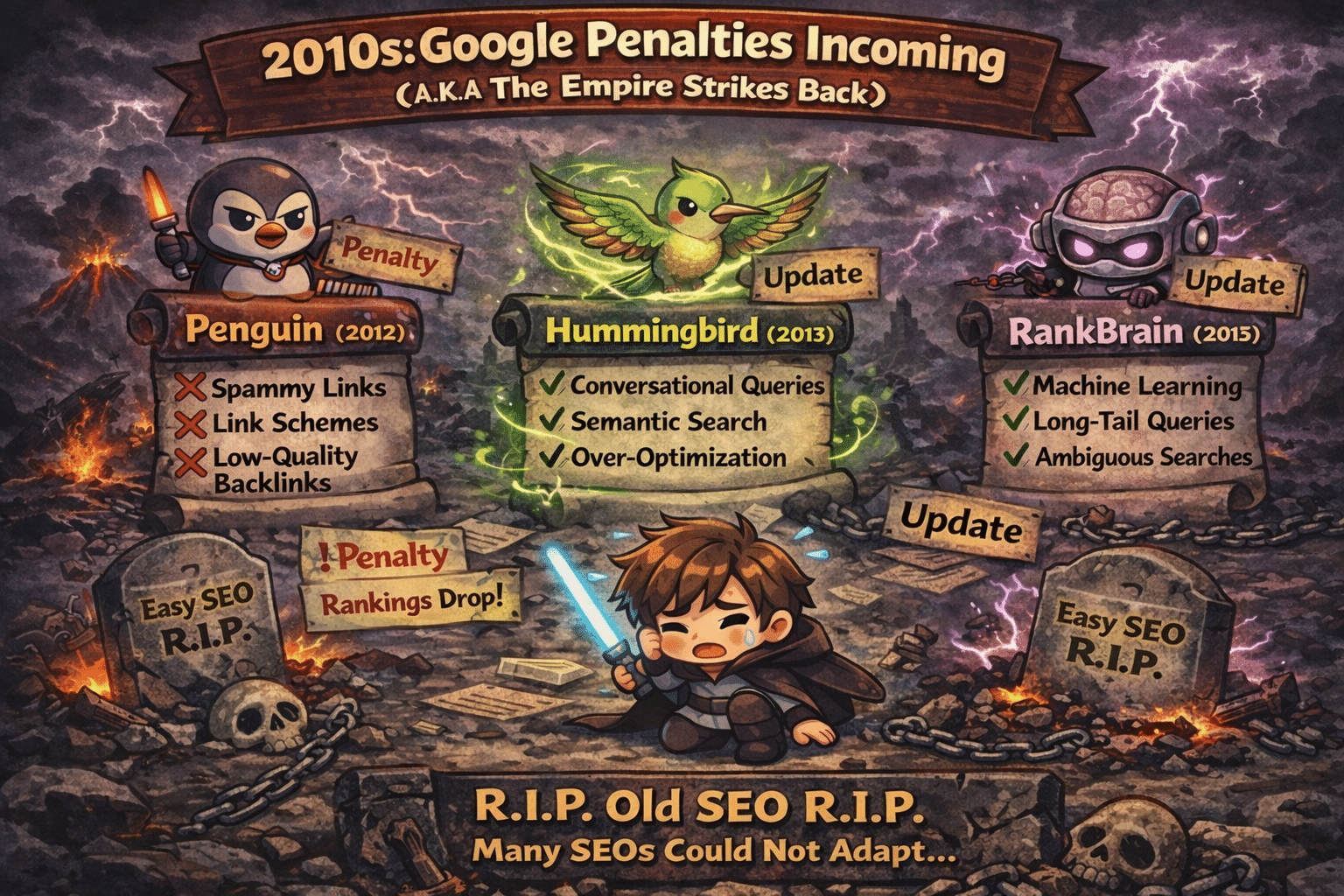
Penguin
Penguin is a Google algorithm update first launched in April 2012, designed to penalize websites that engaged in manipulative or spammy link-building practices. Specifically, Penguin targeted websites that used unnatural or low-quality backlinks to artificially boost their rankings in search engine results.
More specifically, Penguin was primarily focused on unnatural link-building practices, such as:
- Buying links or participating in link schemes to manipulate rankings.
- Excessive link exchanges or over-optimization of anchor text.
- Low-quality backlinks from irrelevant or spammy websites, often referred to as “link farms”.
In essence, Penguin was Google’s way of striking down all the over zealous SEOs who had being taking advantage of RankBrain to easily spam links to rank their websites. This helped to correct the SERPs that were previously rampant with inferior webpages that were simply powered by thousands of poor backlinks. Many websites died during this algorithm update and SEOs took much time to pivot their efforts and relearn SEO.
To this day, Penguin continues to operate in the Google Search Algorithm, particularly in the frequent link spam updates.
Hummingbird
Hummingbird is a significant Google algorithm update that was officially launched in August 2013. It was designed to improve the way Google processed and interpreted search queries, particularly those with long-tail keywords and conversational language.
Prior to Hummingbird, Google focused largely on keyword matching to rank pages. Hummingbird, however, moved towards semantic search, meaning it aimed to understand the meaning behind words rather than just matching exact phrases.
Hummingbird leveraged Natural Language Processing (NLP) techniques to understand not just individual keywords but the context of the entire search query. It could better interpret conversational queries, such as those asked in a natural language or voice search, to provide more relevant answers. For example, a search like “Where can I buy the best shoes near me?” would return results based on the intent of the user’s query, rather than just matching specific keywords.
Similar to Penguin targeting link spammers, Hummingbird indirectly nerfed keyword spammers. Suddenly, simply putting keywords in mass amounts on a page was made redundant. SEOs had to actually create content that made sense for the user’s search queries in order to be shown for it.
RankBrain
RankBrain is a machine learning-based component of Google’s search algorithm that was introduced in 2015. It was designed to help Google better understand search queries, particularly those that are unfamiliar, complex, or ambiguous, and to provide more accurate, relevant search results based on the intent behind those queries.
At this point, Google realised that the majority of search queries were completely new (never seen before). As such, it needed machine learning capabilities to better process long-tail queries or searches that have never been seen before. For example, if someone types in a completely unique or rare search term that Google has never encountered, RankBrain can infer what the user likely meant and return relevant results, even if the exact search term hasn’t been indexed before.
RankBrain was interesting for SEOs as it form a divergence amongst SEOs who could now target longer form and high intent queries from their target audience. This was as opposed to previously only having main short form keywords to reliably target.
How Was SEO At The End Of The 2010s
Following the introduction of Penguin, Hummingbird, and RankBrain, first generation SEOs were probably stunned and punched in the jaw by Google. Essentially, these 3 algorithms combined to totally annihilate the initial SEO techniques. Yet SEOs are a bit like (and pardon my language), cockroaches. We survive and adapt like no other. We simply studied the new algorithm, found its new loopholes or “rules of the game” then adapted our prior techniques to tackle the new reality.
If you initially counted the number of years in reverse when i said I had being doing SEO for 7 years, then you would know that this is the period that I begin my SEO journey. So yes, I was lured in by the many tales of easy work but found a different landscape by the time I started SEO.
We can now enter the main portion of the article, that looks at modern day SEO.
Modern Day SEO
In modern SEO, you’re not playing a single mini-game like “keywords” or “backlinks” anymore. You’re fighting on a map filled with hundreds of signals, and not all of them carry the same weight. That’s why ranking can feel messy: you can do 20 “SEO things” and still lose to a competitor who did the 3-5 things that actually move the needle. A practical way to think about it is a tiered battlefield: a few factors are high-impact, a bunch are medium-impact, and the rest are supporting stats that rarely win the war on their own.
Here are the most agreed on SEO factors:
| Ranking Factor | Brief Explanation |
|---|---|
| Content Helpfulness & Intent Alignment | How well your page satisfies the searcher’s real intent (and leaves them “done,” not still searching). People-first, complete answers tend to win. |
| Backlinks & Referring Domain Authority | Links act like votes, but not all votes count equally—links from credible, relevant sites carry far more weight than spammy volume. |
| Keyword Usage in Title Tags and H1s | Still a relevance signal, but modern SEO is less about exact-match obsession and more about clarity + intent alignment. |
| User Engagement Metrics | Signals like CTR, time on site, and pogo-sticking hint whether users found your result useful; often influences performance indirectly through satisfaction. |
| Content Depth & Semantic Variation | Covers the topic comprehensively (subtopics/entities), using natural language variation instead of repeating the same keyword 50 times. |
| Technical SEO & Site Structure | Crawlability/indexability and clean architecture. If Google can’t reliably access/understand your pages, everything else gets nerfed. |
| Trust Signals (E-A-T) | Demonstrates credibility: expertise, authoritativeness, trustworthiness—especially important where accuracy matters. |
| Local SEO | Geo signals (GBP/GMB, NAP, local relevance) that decide who shows up for “near me” or location-modified searches. |
| Content Freshness | For topics that age quickly, updated content is more likely to rank because it matches “current” intent. |
| Exact-Match Domains (EMDs) | Once powerful, now mostly de-emphasised; can still help with relevance perception, but rarely a deciding advantage. |
| Domain Age | Older doesn’t automatically mean better anymore; what you do with the domain matters far more than its birthday. |
| Social Signals | Likes/shares aren’t direct ranking factors, but social can amplify reach/traffic/brand searches which may help indirectly. |
| Image Optimization | Properly sized/compressed images improve UX and speed; can also support image search visibility. |
| Page Speed | Faster pages generally reduce friction and bounces; it’s a legit ranking factor, just not the only one that matters. |
| Structured Data / Schema Markup | Helps search engines understand content types and can unlock rich results (FAQ, reviews, breadcrumbs, etc.). |
| URL Structure | Clean, descriptive URLs help users + crawlers understand page context; messy parameters can hurt usability/crawl efficiency. |
| Title Tag | Your SERP headline. Impacts relevance and CTR; should be descriptive, compelling, and not stuffed. |
| Heading Tags | Clear H1/H2/H3 hierarchy improves readability and helps Google interpret page structure and key sections. |
| Domain History | Past spam/penalties can drag a domain; a clean history can make trust-building smoother. |
| 404 Pages | Not a direct ranking hit by itself, but unmanaged 404s waste crawl budget and create a poor user journey. |
| Meta Description Tag | Not a direct ranking factor, but strongly affects CTR (which can influence outcomes indirectly). |
| Website Hosting | Poor hosting can mean slow speed and downtime—both hurt UX and crawl reliability. |
| Duplicate Content (Internal) | Can confuse search engines, dilute signals, and waste crawl budget when many pages compete with near-identical content. |
| Bounce Rates | Google says bounce rate itself isn’t a direct factor, but it’s a symptom—high bounce can indicate intent mismatch or poor UX. |
| Rich Media Content | Useful images/video/graphics can improve engagement and satisfaction (indirect SEO upside). |
| Keyword in URL | Lightweight relevance signal; helpful when used naturally, harmful when stuffed. |
| Image Alt Tags | Accessibility + image context. Helpful for image SEO and a small on-page relevance/support signal. |
| Breadcrumbs | Improves navigation + clarifies site hierarchy; can also appear in SERPs when paired with schema. |
| Click Depth | Pages buried too deep often get less internal equity and can be harder to crawl/index consistently. |
It is important to note that different industries and SERPs prioritise SEO factors differently. As such, 1 SERP might reward you more for the inclusion of engaging videos embedded on your webpage. While you might not see any visible differences in rankings when doing the same for a different SERP.
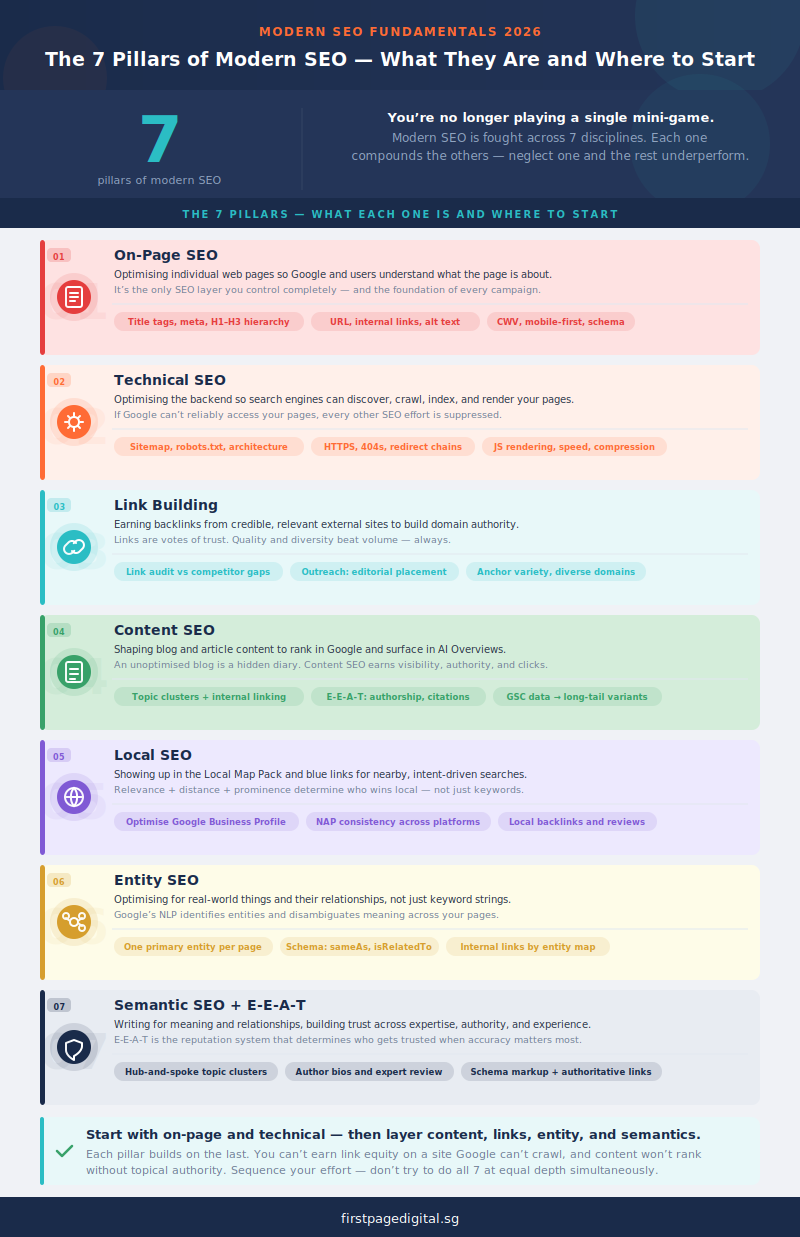
Next, let’s explore the various types of SEO pillars.
On-page SEO
If SEO is a “fog of war” game, then on-page SEO is you fortifying your own base. It’s the backbone of a search strategy because it’s the layer where you get complete control over how your page communicates with both Google and humans.
By definition, on-page SEO is the practice of optimising individual web pages to improve search engine rankings and enhance user experience by refining things like content, meta tags, URLs, and internal links. And unlike off-page SEO (which leans on backlinks and external signals), on-page SEO is the part where you can directly shape how your content performs.
What makes modern on-page SEO different from the “old world” is that it’s WAY more than sprinkling keywords. The work is about user-first content, tightening up technical elements, and delivering a seamless experience across devices because search engines assess signals like keyword relevance, content structure, and technical elements when deciding whether you deserve a top spot. Here are the core on-page SEO elements:
| On-Page Item | What It Does (and why it matters) |
|---|---|
| Title tags | The first thing people see in search results. Clear, engaging, and keyword-aligned titles help both search engines and users understand what the page is about and can be the difference between a click or a scroll-past. |
| Meta descriptions | The “mini sales pitch” under your title in the SERP. While it doesn’t directly affect rankings, a compelling description can increase click-through rates and pull users onto your page. |
| Header tags (H1–H6) | Structures your content so it’s easier to scan and read. It also gives search engines a clearer hierarchy of what matters on the page, which supports relevance and comprehension. |
| URL structure | Short, clean URLs make it easier for both users and search engines to understand the page topic. A well-structured URL improves discoverability and user-friendliness. |
| Internal links | Creates pathways between pages, improving navigation and keeping visitors engaged longer. It also helps search engines understand site structure and pass authority between pages. |
| Images | Not just for aesthetics—images improve user experience, break up heavy text, and support SEO when optimised correctly. |
| Mobile-friendliness | With mobile traffic dominating search, responsive design is essential. A mobile-friendly page adapts across screen sizes, reduces friction, and supports mobile-first indexing. |
| Core Web Vitals | Measures real-world UX around loading speed, interactivity, and visual stability. If a page loads slowly, shifts unexpectedly, or lags on interaction, rankings (and conversions) can take a hit. |
| Schema markup (structured data) | Adds structured context so Google can understand your content better and show rich results (e.g., star ratings or price ranges), which can increase visibility and click-through rates. |
Technical SEO
At its core, technical SEO is about optimising the backend structure of your website so it’s search engine-friendly, specifically improving crawlability, indexability, and overall performance in search rankings.
In other words: technical SEO is the discipline of making sure search engines can discover, crawl, index, and correctly render your pages, so your content is actually eligible to compete. When done right, it helps search engines crawl and rank your site efficiently, while improving site speed and user experience (which is basically how you stay alive in modern SERPs). Here are the core technical SEO elements:
| Technical SEO Element | What It Does |
|---|---|
| Website architecture optimisation | Optimises site structure to facilitate easy navigation and indexing. |
| XML sitemap setup | Sets up an XML sitemap as part of improving site architecture and crawlability. |
| Menu links | Sets up menu links to support navigation and site structure signals. |
| Breadcrumb navigation | Implements breadcrumb navigation to support site architecture and crawlability. |
| Robots.txt (crawlability + crawl budget) | Uses robots.txt to ensure crawlability and optimise crawl budget. |
| Schema / structured data (research + implementation) | Researches and implements schema/structured data to help search engines understand your pages. |
| Schema markup (core types) | Adds schema markup for organisation, local business, products, reviews, and events. |
| Schema markup (industry-specific) | Adds industry specific schema for industries such as finance, real estate, and education. |
| Find + validate 404 HTTP status pages | Finds and validates 404 HTTP status for broken/removed pages. |
| Redirect 404 pages | Redirects 404 pages to retain link equity and ensure a smooth user journey. |
| Fix internal links that point to 404 URLs | Changes internal links that were previously linked to 404 URLs. |
| JavaScript-rendered content checks | Checks for JavaScript-rendering-dependent links and content to ensure they can be crawled and processed. |
| JavaScript indexing checks | Checks if JavaScript elements have been indexed. |
| JS rendering solutions (SSR / dynamic rendering / prerendering) | Implements server-side rendering (SSR), dynamic rendering, or prerendering techniques for JavaScript-rendered content. |
| HTTPS + SSL implementation | Implements SSL certificates and ensures all pages are served over HTTPS. |
| HTTP to HTTPS redirects | Ensures that HTTP URLs are redirected over to their HTTPS counterparts. |
| Mobile responsive check | Checks that the website is mobile responsive. |
| Image compression + next-gen formats | Optimises images via compression and conversion to next gen formats such as WebP or AVIF. |
| Server-side + client-side caching | Implements server side and client side caching as part of website speed optimisation. |
| Minification of JS + CSS | Minifies JavaScript and CSS files to improve performance. |
| Defer + async loading (JS + CSS) | Defers and async-loads JS and CSS files to improve website speed. |
| Preloading resources | Preloads frequently requested resources to improve performance. |
| Lazy loading (below-the-fold) | Lazy loads content below the fold as part of speed optimisation. |
Linkbuilding
Backlinks have been a core pillar of Google’s algorithm since the beginning, because they’ve historically been a pretty reliable proxy for trust and value almost like how influencers get judged by followers.
And here’s the part most people get wrong: link building isn’t “collect links until Google likes you.” There’s no universal number that guarantees page 1, and link quantity alone doesn’t rank pages anymore. What you need depends on the specific SERP, link quality, your domain strength, and the fact that the competition is still building links while you’re trying to catch up.
That’s why the only sane way to play this is to treat it like a moving target:
- Top-ranking pages keep gaining new referring domains over time (one cited range is roughly +5% to +14.5% monthly), meaning “matching the leader” is often already behind.
- Sites with zero backlinks rarely crack the top 10 (the guide references longitudinal analysis to make this point).
- Industry averages can help set expectations (e.g., ~203 DR-weighted backlinks for page 1, ~521 for top 3), but they’re not strict quotas.
So what does link building look like when you’re not playing it like a casino? It starts with a link audit: compare authority vs competitors, run link-intersect analysis to find competitor links you don’t have, audit spammy/malicious links, and sanity-check anchor text ratios so your profile looks natural. Then comes link acquisition: identify relevant sites and do outreach to secure backlinks. Consider topical relevance, editorial in-content placement, anchor variety, diverse referring domains, and links from pages with real visibility/traffic plus pairing it with strong internal linking.
Content SEO
Blogging isn’t just “write good stuff and hope for the best” anymore. In modern SEO, content SEO is the discipline of shaping your blog content so it can rank in Google and get surfaced in AI Overviews, meaning your writing needs to be structured, valuable, and aligned with user intent, not just keyword-stuffed.
If your blog isn’t optimised, it’s basically a hidden diary that nobody reads. Content SEO is what turns “a great article” into something that actually earns visibility, authority, and clicks (and therefore leads/opportunities).
The AI era adds another twist to the game: AI Overviews can answer the query directly on the SERP, which changes how people click (or don’t). So content SEO now also means formatting content in a way machines can digest (clear headings, concise answers, and high-quality, trustworthy information) while still making the human reader want to click through and continue the journey on your site.
Here is what you can do when starting content SEO:
- Use GSC query data to uncover long-tail variants you wouldn’t find in paid tools, then turn them into secondary keywords (same cluster) or new articles.
- Don’t neglect E-E-A-T: add credible author signals + cite reputable sources, use article/person schema, and earn credible niche backlinks.
- Build topic clusters + internal links intentionally: supporting posts link back to the pillar and to related subtopics (don’t spam—make it useful).
- Map all keyword variants of the same intent into the same cluster, and weave them naturally into metadata, headers, and content.
- Use external links to credible sources to strengthen trust and “well-researched” signals.
- Optimise images: descriptive filenames, keyword-relevant alt text, compression, structured data, relevant placement, and ideally unique visuals.
Local SEO
Local SEO is about showing up when someone nearby is actively searching with location intent: the “near me”, neighbourhood, and “in [area]” queries where people are usually ready to act.
Local SEO is what helps your business surface in the two most valuable pieces of local real estate on Google: the Local Map Pack (the map + 3 listings) and the classic “10 blue links” below it. And if you’re not showing up in those spots, you’re basically handing your competitors the calls, foot traffic, and bookings.
Here’s how the “rules of the local map” work. Google decides who ranks using a mix of signals pulled from your Google Business Profile (GBP), your website, local citations, and reviews, then evaluates you through three core lenses: relevance (do you match the query?), distance (how close are you to the searcher?), and prominence (how strong is your reputation across the web?).
Here is what you can do when starting local SEO:
- Claim and fully optimise your Google Business Profile (GBP): fill every field, add high-res photos, and write a strong description with local keywords (naturally).
- Keep NAP (Name/Address/Phone) consistent everywhere (site, directories, social profiles). Inconsistency confuses Google.
- Choose the right GBP business categories (primary + additional where relevant), and review them over time as priorities shift.
- Actively collect reviews and respond to every review; avoid fake reviews (the guide frames them as a long-term risk).
- Use local keywords in GBP (description, service areas, Q&A), but don’t stuff.
- Post GBP updates regularly (offers, blog posts, updates) to keep the profile fresh and active.
- Do local keyword research properly: include neighbourhood/street modifiers, blend service + hyperlocal terms, then weave them into key pages (homepage/service/location pages).
- Build localised website content: create dedicated service-area/location pages and localise supporting blog content (including local entities).
- Add LocalBusiness structured data and verify it (the guide mentions using Rich Results Test).
- Earn high-quality local backlinks: local events/community involvement + listings in reputable local directories/newspapers/community sites (relevance > volume).
Entity SEO
Entity SEO is the practice of optimising for real-world things and their relationships (people, places, organisations, products, concepts) rather than just keyword strings. The goal is to make your primary “thing” crystal clear, describe its attributes, and explicitly connect it to related entities so search systems can read your intent reliably.
Google’s systems don’t just match words anymore, they use NLP to identify entities, disambiguate what you’re referring to, extract relationships, and reinforce meaning across the page/site. That entity clarity can unlock broader query coverage and richer SERP features.
Here is what you can do when starting entity SEO:
- Choose one primary entity per page and name it unambiguously in the title, H1, and lead (add aliases if needed to reduce ambiguity).
- Map supporting entities: list the primary entity’s key attributes and closely related entities (e.g., for places: neighbourhoods/landmarks/transport lines; for products: materials/standards/sizes/compatible parts).
- Draft for meaning, not repetition: write sections covering definitions, attributes, relationships, use cases, steps, comparisons, and evidence, avoid padding and “keyword spam.”
- Add structured data: use the correct Schema.org type and fill rich properties (e.g., sameAs, isRelatedTo, partOf, areaServed, etc.). Link out to authoritative IDs (e.g., Wikipedia or official pages) and validate with Rich Results Test.
- Build internal links by entity: create an entity and URL map, then link entity mentions to the strongest entity page using varied, natural anchors (avoid anchor spam).
- Validate and measure: confirm entity coverage, schema is error-free, and internal links connect the right nodes; track query breadth, rich result wins, and engagement with entity-rich sections.
Semantic SEO
Semantic SEO is writing for meaning, not just words: you focus on user intent and the relationships between entities within a topic, then organise content so it resolves the task end-to-end (instead of padding for word count). Do it well and you become discoverable across an entire query space, not just one keyword.
Here is what you can do when starting semantic SEO:
- Build topic clusters (hub-and-spoke) so your pages cover the topic ecosystem, not just one keyword.
- Use internal linking strategically to connect related pages and reinforce topical relationships.
- Identify and include key entities (people/places/brands/concepts) and explain how they relate within the topic.
- Write for user intent and cover the full search journey (definitions, comparisons, steps, costs, alternatives, next steps).
- Use SERP research (e.g., top results and People Also Ask) to understand what Google expects a “complete” answer to include.
- Structure content clearly with descriptive headings and sections that make meaning easy to extract.
- Add relevant structured data (schema markup) where it fits the page type and validate it.
- Avoid near-duplicate pages for the same intent; consolidate and strengthen instead.
- Don’t chase “LSI keywords” as a tactic; focus on meaning, topical coverage, and entity relationships.
Google E-E-A-T
If SEO is a game where nobody fully sees the terrain, E-E-A-T is the reputation system that determines who gets trusted when accuracy actually matters. Google E-E-A-T stands for Experience, Expertise, Authoritativeness, and Trustworthiness; originally E-A-T, with “Experience” added in December 2022 to reinforce first-hand knowledge and people-first usefulness.
Google also makes it clear this isn’t a neat “single ranking factor” you toggle on. It’s a quality framework that influences how content gets evaluated. This is especially so for YMYL topics (finance, healthcare, legal, news/current events), where bad information has real-world consequences.
Here is what you can do when starting E-A-T:
- Demonstrate first-hand experience with case studies, real-life applications, and original media (photos/videos/screenshots), plus testimonials/interviews where relevant.
- Make authorship undeniable: include clear author attribution, a detailed author bio, and links to profiles/credentials (e.g., LinkedIn).
- For sensitive topics, use “Expert Verified / Medically Reviewed” style review signals and show who reviewed it.
- Back claims with authoritative sources (research, white papers, credible publications) and data-driven insights (stats, reports).
- Start content planning from user intent (not keywords)—use sources like People Also Ask, Search Console, and real user discussions to map what people actually need answered.
- Structure content for readability: clear H1/H2/H3 hierarchy, short paragraphs/bullets, and add supporting visuals/interactive elements where useful.
- Build authoritativeness off-site: earn high-quality backlinks/mentions, do digital PR (features, podcasts, authoritative blogs), and use PR-style outreach like HARO for press mentions.
- Strengthen “who we are” trust signals: improve About Us and team pages (history, team roles, credentials) and display proof like partnerships/awards/testimonials.
- Lock in trustworthiness basics: HTTPS, clear privacy/data practices, visible contact info, and transparent policies.
- Keep content fresh and accurate: refresh outdated pieces, fix broken links, and show “last updated” info where appropriate.
- Use structured data to reinforce credibility and understanding: Author/Article schema, plus Review/FAQ schema where appropriate.
- Manage reputation signals: encourage reviews on trusted platforms, respond to negative feedback professionally, and keep brand naming + NAP consistent across platforms.
- Avoid the big credibility killers: mass AI content without expert oversight, keyword stuffing/search-first writing, anonymous “admin” authorship, and missing security/legal pages.
How to learn beginner SEO
SEO gets much easier once you understand what search engines actually do: crawl pages, index them, then rank them by comparing relevance, quality, and page experience against competing results.
A simple starter roadmap to learn SEO:
- Learn core concepts early: relevance, authority, user satisfaction, and the basic building blocks like SERPs, snippets, title tags, meta descriptions, canonical tags, and robots rules.
- Start with Google’s own starter guidance, then practice making your pages easier to find (internal links, navigation, XML sitemaps), easier to understand (descriptive titles, structured data), and easier to control (robots.txt, noindex, canonical).
- Learn by doing on a real site: set up a small “lab” site (WordPress, Wix, Shopify, Squarespace, etc.), build a mini content cluster, apply on-page basics, improve speed and mobile usability, and track the impact.
Learn SEO From Courses In Singapore
Our “best SEO courses” guide lists a mix of globally recognised certifications and locally relevant options, so you can choose based on how you learn best.
A simple way to choose an SEO course for you:
- If you want structured learning with a certificate: HubSpot Academy offers a free SEO certification course, covering keyword research to website optimisation, with an official certification on completion.
- If you want a broader list of places to learn: the page provides an overview that includes Heicoders Academy as its top pick, plus options like Ahrefs Academy, Yoast, Semrush, BrightLocal, Moz, Udemy, Coursera, and more.
- If you want subsidised learning routes: it also highlights SkillsFuture, noting that Singaporeans aged 25 and above can use SkillsFuture Credit on courses listed on the MySkillsFuture portal.
If you are deciding between DIY vs courses: the learning guide notes courses can help when you want structure, accountability, or a recognised credential, but you still need hands-on practice to build real skill.
Now Start Doing Your First SEO Project With Keyword Research
Keyword research is framed as identifying and analysing search terms to understand intent and behaviour, so you can create content that aligns with what users need and improve visibility.
A clean first-project process:
Step 1: Define your goal, because it changes how you choose keywords (traffic vs revenue means different intent priorities).
Step 2: Brainstorm core keywords based on what the brand offers and the audience pain points.
Step 3: Evaluate metrics and intent together, not in silos, and pressure test competitiveness with context like competitor DR.
Step 4: Prioritise by business goals, then group by intent (commercial and transactional terms usually lead if revenue is the goal).
Step 5: Map keywords to pages to prevent cannibalisation and to shape internal linking logically.
Step 6: Monitor and refine regularly, treating keyword research as ongoing, not a one-time checklist.
Is SEO worth getting into in 2026?
If you asked me before 2025, I would often have nudged people toward the paid side of digital marketing. Not because SEO was useless, but because the SERP was clearly being engineered to monetise attention. Ads sat in prime real estate, Google kept adding new placements, and organic visibility regularly felt like it was being pushed further down the screen. That makes perfect business sense when ads are the revenue engine.
The 2025 to 2026 twist: AI search put SEO back in the spotlight
Then AI came in hot.
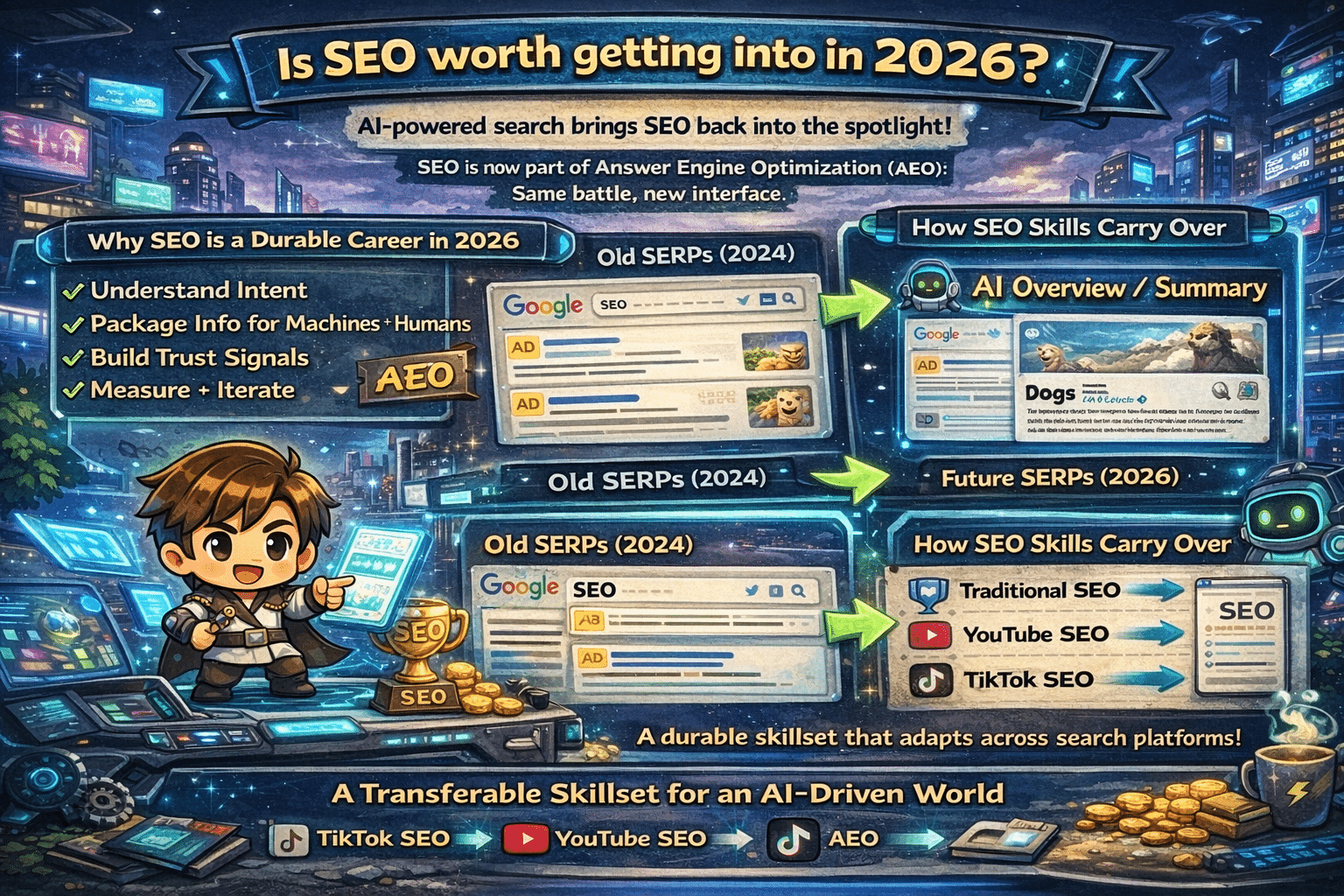
Google’s AI Overviews expanded globally (more than 200 countries and territories, more than 40 languages), which tells you this is not an “experiment” anymore. Now ads can also show above, below, and within AI Overviews, so the SERP is evolving again, but this time the big fight is about being the source that the AI summary pulls from and links to.
Google is even actively tweaking how links appear in AI Overviews and AI Mode to make sources more visible and clickable, which reinforces the point that “earning the link” still matters in an AI-first SERP.
So yes, SEO is back in focus, with a subset that many people now call Answer Engine Optimisation. Same battle, new interface.
Why SEO is a durable career in 2026
The bigger reason I’m bullish is not “Google will be nice to organic again.” It’s that SEO is a highly transferable skillset.
When you learn SEO properly, you learn how to:
- Understand intent
- Package information so machines and humans can parse it fast
- Build trust signals
- Measure what worked and iterate
Those skills carry into AEO, and they also carry into other search surfaces that people actually use. For example, Adobe says nearly half of US consumers use TikTok as a search engine, and that usage has risen sharply in the last two years.
So the career durability is real, as long as you stay adaptable. Traditional SEO to AEO. Traditional SEO to YouTube SEO. Traditional SEO to TikTok SEO. Same player, different map.
In 2026, SEO is worth getting into if you are willing to evolve with where “search” happens. The people who treat SEO like a fixed checklist will struggle. The people who treat it like an adaptable strategy for earning visibility in algorithmic feeds will be very hard to kill.