


Partner With Us For Ecommerce SEO
First Page Digital is Singapore’s largest SEO agency. Since 2011, we’ve grown organic product sales and business revenue for Singapore ecommerce stores. When it comes to ecommerce SEO, we offer comprehensive strategies for on-page SEO, technical SEO and off-page SEO. This allows your audience to efficiently find relevant products for them and a smooth buyer decision process after to checkout.

From start-ups to Fortune 500 companies, we work with brands to grow their revenue.

Ecommerce SEO Services
Product Page Entity Setup
We ensure that your ecommerce product pages have the standard product information in order to satisfy customers' information needs. This includes entities such as price, name, specifications, warranties, delivery, features, and setup. These details allow search engines to easily understand and compare products to serve the right ones to customers.
Collection Page User Experience
We work with you to set up product collection pages with user-centric features and content such as in-depth product listings, crawler friendly price code, search based filters, links to related collections, product comparison tables, shopper required information (warranty, delivery), and structured data for crawlers.
Structured Data Setup
E-commerce websites provide the biggest opportunity for structured data setups. This is because within a product category, there are standard parameters that buyers compare products on. As such, using schema and friendly on-page code, we optimise such data points to be fully conveyed to search crawlers and used in their ranking criteria for buyers.
Off Page Product PR & Linkbuilding
Products are often sourced for in comparison with other products from the same store or from competitors. We assist to do PR and linkbuilding outreach to place your products in favourable comparison content articles. This grants greater credibility to your products and gives your brand an edge against the competition when researched upon.
Product Related Guides
To enrich the buyer's experience on your website, we created product related guides that give users greater confidence in the product. We then carefully link product collection pages, product pages, and product guides to give a smooth product discovery experience for your buyers.
Google Merchant Centre Integration
We advise and assist to setup Google Merchant Centre (GMC) accounts for your store. Integration is typically done via official CMS API routes, while alternative third party sitemap setups are also available for custom websites. This ensures accurate, up to date, and scalable infrastructure to getting your products featured on Google.
Recent Ecommerce SEO Awards.
Clutch
Top SEO Company Singapore 2025
Clutch
Top SEO Company Ecommerce Singapore 2025
Clutch
Top SEO Company Business Services 2025
Clutch
Top Link Building Company Singapore 2025
How We Dominate Ecommerce On Google Search
E-commerce SEO services focus on proven niche strategies that drive traffic to your product collection and product listing pages. We help your brand and products appear for product related searches on Google, thus leading to a high potential of a new sale. To empower your brand, our Singapore SEO agency provides:
Identifying Key Collections And Categories:
- Using GSC and GA4, we identify key products and categories to focus on. These are selected based on potential traffic and revenue for the brand.
Suggesting Proven Sections For SEO:
- We audit and suggest ideal page sections and layouts for product collection and product pages.
- These suggestions have been thoroughly tested across e-commerce websites of varying niches.
Ensuring Strong E-A-T Signals:
- We ensure that your website’s products and content meet Experience-Expertise-Authority-Trust (EEAT) signals
- This is done by including strong product technical info, clear delivery and warranty info, brand about us info, and credible user reviews
Recommending Programmatic Internal Link Structures:
- We recommend ideal internal link sections that can be implemented throughout the website at once by working on their templates.
- This creates excellent user pathways on the websitethat massively boost the internal link equity of the pages.
Tracking E-commerce Events In GA4:
- We assist to set up tracking of e-commerce events such as view item, add to cart, and purchase.
- This allows you to understand individual product and marketing channel performance based on their traffic and sales.
Applicable for any e-commerce website CMS, be it Woo Commerce, Shopify, Magento, or any others.
Optimising Product Pages
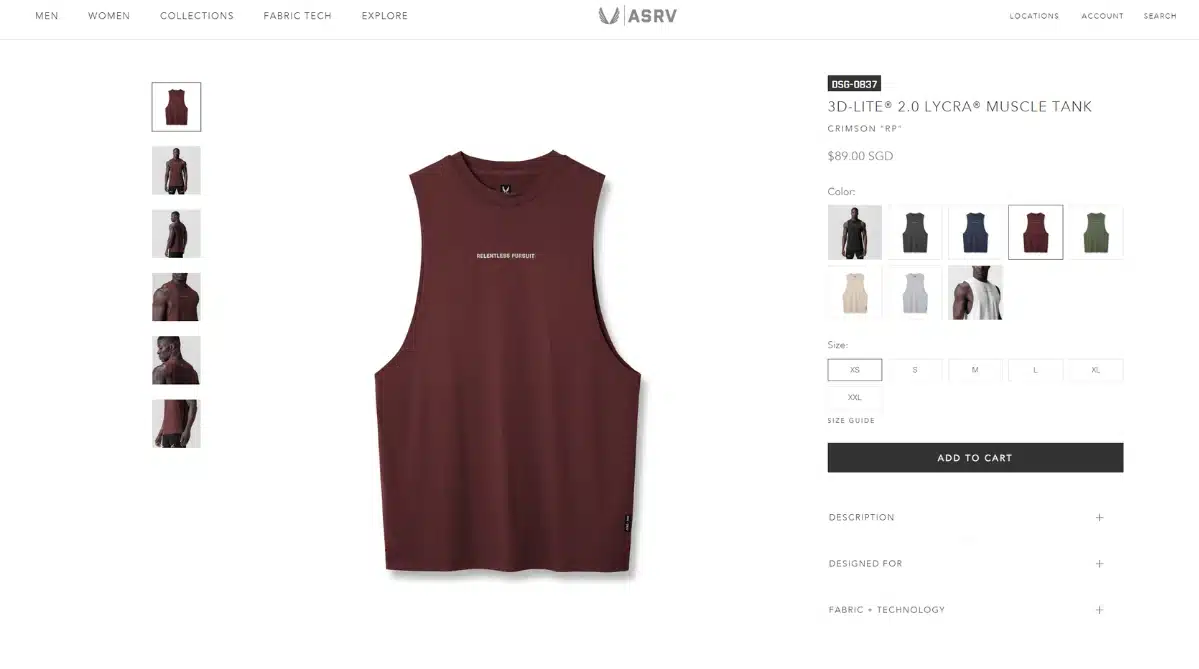
Most product pages in Singapore are a manufacturer description and a buy button. Here is what the ones that rank and convert carry instead:
The decision layer
- A descriptive product title that matches how buyers actually search for the item, not the internal SKU name.
- Price, stated clearly and without a click.
- Multiple product images with zoom. Online, magnification is the closest a shopper gets to handling the product. Stores that ship a single low-resolution image are asking buyers to take a risk they will usually decline.
- Delivery, warranty and returns information on the page itself. These are the three objections that stall a purchase, and burying them in a separate policy page means the shopper leaves to find them.
- A unique product description. Manufacturer copy is identical across every retailer selling the same item, which gives Google no reason to rank you over any of them.
- Full product specifications. The attribute set buyers compare on, which is exactly what our programmatic work populates at scale.
- Product features, framed as what the specification actually does for the buyer.
- Uses of the product. This is the most commonly missed element and often the most valuable. It captures the “what is X used for” and “best X for Y” searches that sit one step earlier in the buying journey, and it answers the question an AI assistant is most likely to be asked about the product.
- Breadcrumbs, giving both the shopper and the crawler a clear position in the site hierarchy and reinforcing the collection page above.
- Product schema, so price, availability and reviews can surface as rich results, and so AI systems and agentic browsers can identify the product without guessing.

Optimising Product Collection Pages
Most collection pages in Singapore are a heading, a product grid, and nothing else. That page has almost nothing for Google to rank on and almost nothing to help a shopper decide. The collection pages that win are built as decision-making tools.
We benchmark our client layouts against the retailers that dominate product searches globally. IKEA is the clearest example, and the pattern holds across categories:
- Short SEO copy at the top. Enough to establish what the collection covers and for whom, without pushing the products below the fold.
- Internal links to sub-collections. Lets a shopper narrow by the way they actually think about the category, and passes authority down to the pages that convert.
- A filter set built from real user behaviour, not from whatever attributes the CMS happened to expose.
- Product tiles carrying the full decision set: price, review score, delivery offer, colour and variant options, and any active promotion. A shopper who has to click into a product to learn the price is a shopper who leaves.
- Imagery showing the product in context, not only on white. Environment shots answer the question a spec list cannot.
- Internal links to complementary collections. The customer buying a desk is often buying a chair.
- Delivery, warranty, returns and payment information on the page itself.
- Clear selling points covering why buy this category from you specifically.
- Customer reviews, both for conversion and for the review signals that support rich results.
The point is not that IKEA does these things. It is that each element answers a question the shopper would otherwise leave to answer elsewhere, and each one gives Google and AI crawlers something concrete to understand the page by.