Competitor keyword analysis is where my keyword research actually starts to make sense.
After years of doing SEO, I’ve learned that guessing keywords based on search volume or keyword difficulty alone leads to wasted effort. What works is studying who already wins in the SERPs and understanding why.
When I break down competitor data, I’m not just looking for rankings. I’m looking for patterns, intent, and opportunities that connect content to real demand, whether I’m supporting full scale seo services or tightening up a focused local SEO campaign.
This approach turns competitor insights into clear direction and removes much of the uncertainty that usually comes with planning SEO growth.
What Is Competitor Keyword Research
Competitor keyword analysis involves identifying your rivals, using SEO tools to discover keywords they rank for, finding keyword gaps (terms they rank for, you don’t), analysing metrics (volume, difficulty, intent), and prioritizing high-value, relevant terms to build your content strategy around, outperforming them with better content.
I’m talking about reverse engineering what’s already working in your niche.
This saves time because you’re not starting from zero, you’re starting from proof.
What Types of Competitor Keyword Research are There?
Content Gap Analysis
I do this when I need ideas for brand-new topics. That could be for a client’s blog, a new service page, or a product page.
Basically, if you’re looking for opportunities to create new pages and fresh content, this is where I’d start.
Some SEO tools, like Ahrefs, have a straightforward feature built specifically for content gap analysis.
For example, if I wanted new topic and keyword ideas for the First Page Digital Singapore blog, I’d take our domain URL, add a few competitor domains, and drop them into the tool.
Keyword Analysis of decided topic
I usually do this when I already have a clear direction on what I want to publish, but I need keyword data to validate the idea.
Let’s say I’m the SEO specialist for a car insurance company and I want to publish blog posts to raise awareness of the product. A few topic ideas might be:
- road accident statistics in singapore
- road accident frequency in singapore
- how to buy car insurance in singapore
To validate whether there’s real search potential behind those topics, I’ll search each one in Google exactly as written and review the search engine results page (SERP).
From there, I’ll activate the Ahrefs Chrome extension to check whether the top-ranking pages are actually ranking for relevant keywords.
Why Competitor Keyword Research is Important for Your SEO Strategy
You’re Tapping into What Already Works (Reverse-Engineer Success)
When I run competitor keyword research, I’m not trying to “copy” anyone.
I’m trying to understand what Google is already rewarding in my niche, and why.
Which topics keep showing up on page one, what angles the top pages take, and what the searcher clearly expects to get when they type that query in.
Once you can see that pattern, you stop guessing and start building content that fits real intent, not just your own hunch.
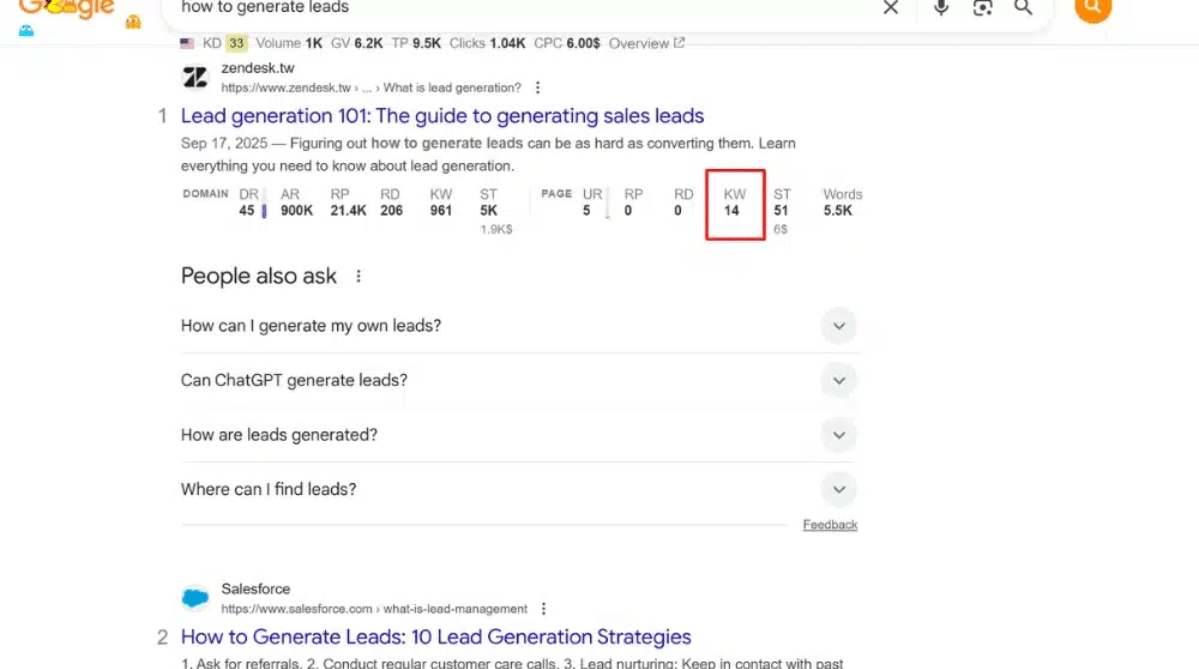
Ahrefs’s Chrome extension is my favourite tool for that. I just search the keyword I want to target and immediately, I’m able to see what other keywords my competitors are ranking fro
Find Low-Hanging Fruit
Here’s the fun part: competitor data often hands you quick wins on a plate.
If you use a keyword gap or content gap tool and compare your site with a few rivals, you’ll usually find keywords they rank for that you do not, and some of those terms are genuinely doable.
I’ve seen newer sites make serious progress simply by targeting more specific, lower-difficulty queries first, then building up authority over time.
Do that, and you create momentum instead of picking a fight with the biggest domains on day one.
Target Your Audience Better
Competitor keywords basically offer insights as to what your audience is asking for at each stage of the journey.
So I look beyond volume and check what those queries reveal: are people researching, comparing, or ready to buy?
Better still, many tools let you sort competitor keywords by estimated traffic share, which makes it obvious what pulls in visitors versus what just looks impressive on a spreadsheet.
When you map those insights to your own offers and expertise, your content stops being generic and starts meeting people exactly where they are.
Why Competitor Keyword Analysis Is Critical for SEO?
Spotting Gaps and Opportunities
Many real opportunities don’t live in high-volume keywords everyone already fights over, especially if you’re running a low authority site.
Opportunities live in gaps. When I analyze competitors, I often find keywords they rank for with thin content or outdated pages. That’s usually where I step in and win.
These gaps show up in different ways. Sometimes it’s a missing comparison page. Other times, it’s a guide that never answers follow-up questions users clearly have.
Finding these opportunities consistently is one of the fastest ways I’ve helped sites grow without relying on aggressive link building.
Getting Ahead of Competitor Content Strategies
Competitors don’t innovate and refresh content as often as you think they do. Most follow patterns that worked once and slowly fall behind. Or they just publish content thinking that just because it is an evergreen topic (e.g. how to lose weight in 30 days), they don’t need to update the article.
By tracking their keyword footprint over time, I can see where they’ve stopped updating content or where new keywords are emerging without strong coverage.
That’s how you get ahead instead of catching up.
You publish earlier, go deeper, and answer questions competitors haven’t touched yet. After years of doing this, I’ve learned that SEO rewards those who anticipate demand, not those who react to it six months late.
Step-by-Step Guide to Competitor Keyword Analysis
Step 1: Identify Who Your Real Competitors Are
I start by separating real search competitors from business competitors. That means Googling my core keywords and seeing who consistently shows up, even if I’ve never heard of them before.
In SEO, the sites stealing your traffic are the ones that matter, not always the brands you think you’re competing with.
In the case of First Page Digital, our top competitors would be other agencies like MediaOne, Mediaplus Digital
Step 2: Gather Their Top-performing Keywords
Once I know who I’m up against, I pull the keywords actually driving their visibility. I’m not looking for every keyword under the sun.
I focus on those bringing steady traffic and ranking on page one or two because those tell me what Google already rewards in that space.
Step 3: Analyze Keyword Performance Metrics
Here’s where experience matters.
I don’t just glance at volume and move on.
I compare rankings, difficulty, and how competitive the SERP looks in real terms. A keyword might look easy on paper and still be dominated by strong pages that won’t budge without serious effort.
Step 4: Find Keyword Gaps Between You and Competitors
Keyword gaps show me where competitors are winning conversations I’m not part of yet. I look for overlaps where I’m close and missing terms where my site has no coverage at all.
These gaps often become my fastest growth opportunities when handled with the right content angle.
I typically use Ahrefs’s Content Gap Analysis for this.
Step 5: Prioritize Keywords Based on Intent and Value
Not every keyword deserves attention, even if they have a high search volume. I prioritize based on what supports business goals and matches search intent.
If a keyword attracts the wrong audience or leads to low-quality traffic, I leave it alone even if competitors rank well for it.
Best Competitor Analysis Tools
Ahrefs Chrome Extension
I use the Ahrefs Chrome extension when I want quick context without opening a full report. It’s perfect for checking a competitor page’s estimated traffic, top keywords, and backlink strength while reviewing the SERP in real time.
Ahrefs Content Gap Analysis
This is one of my go-to tools for spotting missed opportunities.

By comparing my domain against competitors, I can instantly see which keywords they rank for, and I don’t. From there, it’s easier to decide whether to build new pages or improve existing ones.
Semrush Overview
Semrush gives me a broader strategic view. I rely on it to understand keyword overlap, ranking trends, and competitive positioning over time. It’s especially useful when working with larger sites where patterns matter more than individual keywords.
KWFinder by Mangools
KWFinder shines when I want clarity without noise. I use it to validate difficulty and uncover long tail variations competitors rank for. It’s simple, fast, and helpful when narrowing down realistic targets.
Common Mistakes to Avoid in Competitor Keyword Research
Focusing Only on Search Volume
I’ve seen teams chase big numbers and end up disappointed more times than I can count. High search volume doesn’t guarantee relevance or conversions. Competitor analysis works best when volume is balanced with intent, competition, and actual business value.
Some of the most profitable keywords I’ve worked with looked unimpressive at first glance. They worked because they attracted the right people at the right moment, not because they showed off big numbers in a tool.
Ignoring SERP Features
SERP features change everything. If a keyword triggers featured snippets, maps, tools, or ads that dominate the page, organic clicks might be limited.
I always factor that into whether a keyword is worth pursuing.
Competitors ranking below heavy SERP features often struggle too.
Recognizing this early saves time and helps me redirect effort toward keywords where organic visibility still has room to grow.
Not Aligning Keywords With Your Audience
Just because competitors rank for a keyword doesn’t mean you should target it. I’ve learned to filter keywords through audience relevance first. If the searcher’s problem doesn’t match what my client or site actually offers, I move on.
Good competitor keyword research sharpens focus. Bad research dilutes it. Staying aligned with audience needs keeps SEO efforts grounded and effective.
Turning Competitor Insights Into Sustainable SEO Growth
Competitor keyword research is where SEO stops being guesswork and starts becoming repeatable growth.
By reverse-engineering what already wins in the SERPs, including topics, intent, content structure, and the gaps competitors have not covered well, you get a clear roadmap for what to create, what to improve, and what to ignore.
Pair that with real SERP analysis, realistic difficulty checks, and smart prioritization based on intent and business value, and you turn keyword data into content that earns visibility and brings in the right traffic.
If you want to do this properly without chasing vanity volume or fighting unwinnable battles, First Page Digital Singapore can help.
Sign up for a FREE strategy call with us worth $2000 today!
FAQ About Competitor Keyword Research
What is competitor keyword research in SEO?
Competitor keyword research is the process of identifying the keywords your competitors rank for and analyzing how they attract traffic from search engines. I use it to understand what already works in a niche and where new opportunities exist.
How do I find my SEO competitors?
I find SEO competitors by searching my core keywords in Google and noting which sites consistently appear. These are often different from direct business competitors and usually provide better insights for keyword analysis.
Are competitor keywords worth targeting for a new website?
They can be, but I’m selective. For newer sites, I focus on competitor keywords with lower competition and clearer intent. That approach builds traction without taking on unrealistic battles early on.
How often should I do competitor keyword analysis?
I revisit it every few months or whenever rankings stall. Search behavior and competitor strategies change, and keyword research needs to keep pace with that reality.