In 2025, Google confirmed three core updates and one spam update. This our review of each of the updates as well as other unconfirmed updates where SERP volatility was high.
Confirmed 2025 updates
| Update (official name) | Type | Rollout window (US/Pacific) | What it meant for SEOs |
|---|---|---|---|
| March 2025 core update | Core | Mar 13 to Mar 27, 2025 | Broad re-ranking. Expect winners and losers across many niches, often tied to intent match and content usefulness. |
| June 2025 core update | Core | Jun 30 to Jul 17, 2025 | Another broad recalibration. If pages dropped, the usual cause is “Google found a better match” for the query, not a single penalty. |
| August 2025 spam update | Spam | Aug 26 to Sep 22, 2025 | Policy enforcement. If you were hit, investigate spam patterns first, especially scaled content and reputation abuse risks. |
| December 2025 core update | Core | Dec 11 to Dec 29, 2025 | A major year-end reshuffle. Sites often feel this as a “trust and quality consistency” check across key topic areas. |
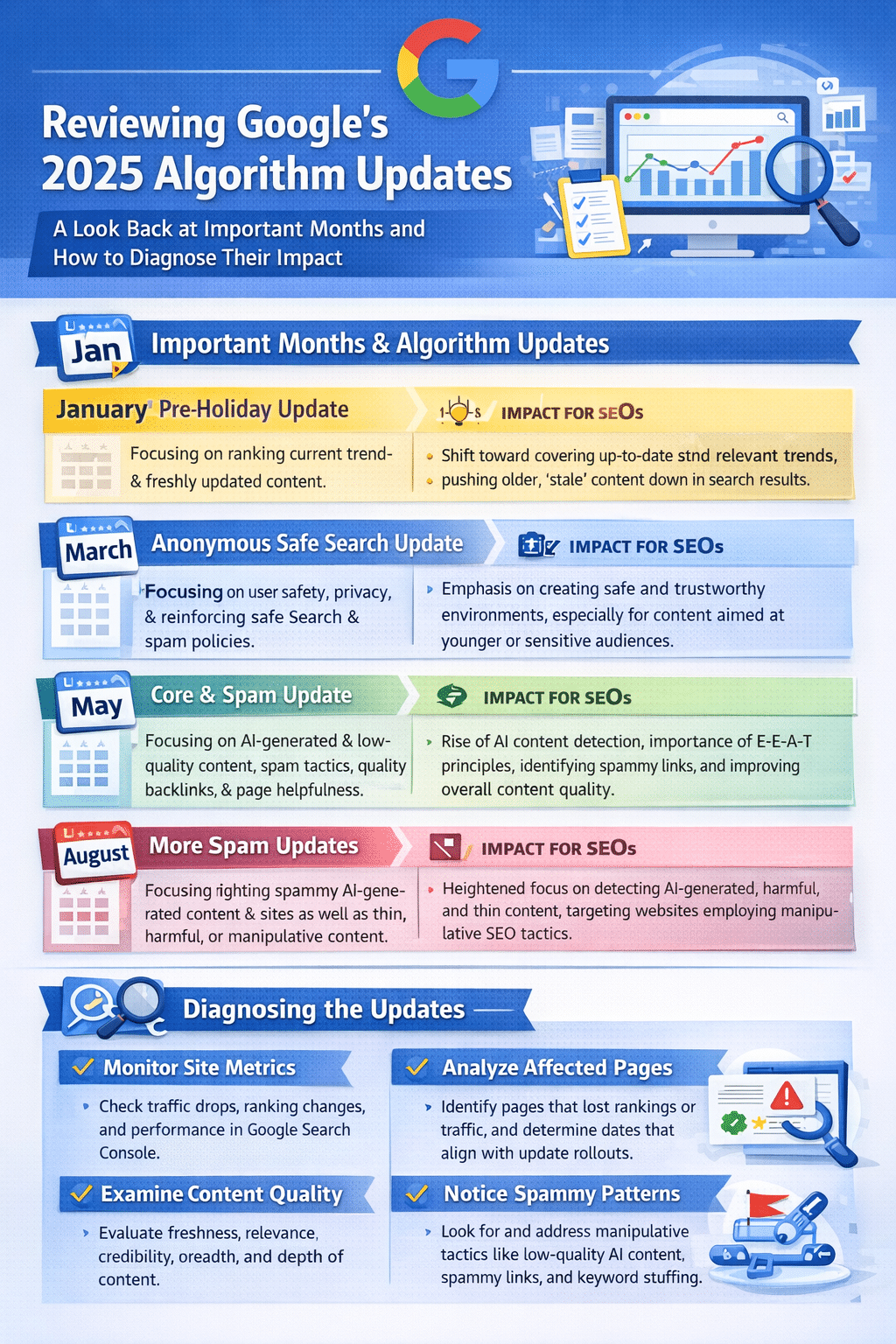
How to interpret core updates vs spam updates
Core updates
Core updates are broad changes to Google’s core ranking systems. So, when March, June, or December rolled out, you should expect wide movement across many industries. That includes sites that did nothing “wrong.”
Because of that, the most useful way to treat a core update is as a re-evaluation of relevance and quality at scale. In practice, that means:
- Intent match gets tested harder. If the SERP shifts toward a different format, like product pages replacing blog posts, your content may fall even if it is “good.”
- Topical completeness starts to matter more. Pages that answer only part of the journey often lose to sites that cover the whole decision path.
- Weak clusters can drag down strong pages. If a topic area has a lot of thin or repetitive URLs, you can see quality dilution across that theme.
Spam updates
Spam updates are different. They are enforcement events tied to Google’s spam policies. So, when the August 2025 spam update rolled out, the correct question was not “How do we make content better?” It was “Do we have patterns that look like spam, even if the intent was not malicious?”
Spam-driven drops tend to be sharper and more uniform. You will often see:
- Large sections losing visibility together, especially template-driven directories
- Sudden declines across many keywords, not just a few query groups
- Faster deindexing signals, depending on the footprint and severity
What changed in 2025: the helpful content label is no longer the signal
Some SEOs still look for a “Helpful Content Update” in 2025. That is not how Google presented it. Helpful content evaluation has been incorporated into core ranking systems, so you feel it through core updates and ongoing ranking changes.
So, instead of asking “Was there a helpful content update?”, ask this:
- Is this page meaningfully better than what already ranks, or is it a rewrite of the SERP?
- Does the page demonstrate real experience, or does it read like a generic summary?
- Would a human trust it, especially for advice-heavy decisions?
Fast diagnostic: which playbook should you use?
- If the drop aligns with March, June, or December: treat it as a core re-ranking. Start with intent match, consolidation, and quality consistency across the affected topic.
- If the drop aligns with Aug 26 to Sep 22: treat it as a spam-policy risk review. Start with scaled content patterns, third-party content, and anything that exists mainly to rank.
- If the drop happens outside these windows: treat it as normal system tuning or SERP change. Then check technical regressions, content decay, and competitor shifts.
Next, we will break down each confirmed 2025 update in order, starting with the March 2025 core update and the patterns SEOs consistently saw during that rollout.
March 2025 Core Update (Mar 13 to Mar 27, 2025)
The March 2025 Core Update was the first confirmed core update of the year. It rolled out over about two weeks, from March 13 to March 27, 2025 (US/Pacific).
For most SEOs, March felt like a “content reality check”. Not because Google announced a new rule, but because many sites sitting on thin, repetitive, or summary-only pages struggled to hold positions once the recalibration settled.
What Google confirmed
Google confirmed the rollout window on the Search Status Dashboard. Beyond that, Google did not publish a specific target or niche. That matters, because it keeps your diagnosis grounded. If you try to reverse engineer a single “March target”, you will usually waste time.
What changed in practice
Core updates are broad. So the more reliable way to interpret March is to look at what tends to lose visibility during broad re-ranking:
- Pages that repeat what already ranks without adding a clearer answer, better examples, or newer information.
- Template-driven content where hundreds of URLs exist, but most offer no unique purpose.
- Intent mismatch, where a page is technically relevant but not the format the SERP rewards.
- Topic dilution, where a site publishes across too many unrelated themes and no longer looks specialised.
In other words, March was less about “AI content vs human content” and more about effort and usefulness at scale. If a page reads like it was produced to cover a keyword, it is exposed during core updates.
How to diagnose March impact properly
Start with timing, then segment the damage. This keeps you from guessing.
- Confirm alignment: compare your GSC clicks and impressions against Mar 13 to Mar 27.
- Group by template: category pages, programmatic location pages, glossary pages, listicles, and so on.
- Group by intent: informational, commercial investigation, transactional, navigational.
- Check if losses cluster: if 70% of losses come from one template, that template is the project.
What to audit first (and why)
| Audit area | What to check | Why it matters after March |
|---|---|---|
| Intent match | Compare your page type to the dominant SERP formats for the query group | Core updates often reward the format that best completes the task, not the page with the most keywords |
| Original contribution | Add first-hand experience, examples, real steps, photos, data, or clear opinions backed by reasoning | Summary-only content is easy to replace, so it tends to lose when relevance improves |
| Template quality | Identify low-value URL sets and assess whether each page has a unique purpose | Large weak sections can dilute perceived quality across an entire topic area |
| Cannibalisation | Find multiple pages competing for the same query group and consolidate where needed | Core updates can intensify “winner-takes-more” behaviour inside a site |
| Content upkeep | Review accuracy, freshness, and whether updates are real improvements, not just date changes | Stale or superficial updates can lose trust when Google re-evaluates the topic |
Practical fixes that tend to work after March-style movement
These are safe moves because they improve user value regardless of what the algorithm did.
- Merge pages that overlap, then make the merged page the clear best answer for that intent.
- Rewrite intros and headings for clarity, so users get the answer faster and stay on the page.
- Add proof, such as screenshots, examples, methodology, benchmarks, and limitations.
- Remove or noindex dead weight, especially pages that get impressions but deliver poor engagement and no conversions.
June 2025 Core Update (Jun 30 to Jul 17, 2025)
The June 2025 Core Update was the second confirmed core update of the year. It rolled out from June 30 to July 17, 2025 (US/Pacific), according to the Google Search Status Dashboard.
June was a reminder that keyword coverage alone is not a strategy. Instead, Google kept pushing toward better relevance, better satisfaction, and better interpretation of what the searcher actually wants.
What Google confirmed
Google confirmed the rollout window. Google also described it as a regular core update designed to surface more relevant and satisfying content. Beyond that, there was no official list of targets.
What SEOs associated with this update
June came with a lot of discussion around “meaning-based matching” and “entity understanding.” Two things drove that conversation:
- Google Research activity published around the same period, including retrieval and graph-related research.
- Real-world SERP movement that looked less tied to exact-match keywords and more tied to which page best completed the task.
Still, treat any “this model was deployed in June” claim as speculation unless Google confirms it. The useful takeaway is simpler: Google keeps improving query interpretation, so thin intent coverage gets exposed faster.
What changed in practice
Across many sites, June-style movement typically shows up as one of these patterns:
- Intent upgrades in the SERP. Google starts rewarding pages that better match the job, even if they are not the most keyword-dense.
- Topic depth beats breadth. A smaller set of strong pages can outperform a larger set of average pages.
- Authority clusters stabilize. Sites with consistent coverage in a tight niche often hold positions better than generalist sites.
How to diagnose June impact properly
If you want a clean read, avoid sitewide averages. Instead, break it down by query group.
- Start with affected query themes. Group drops by topic, not by URL.
- Check the SERP makeup. Look for format changes like more product pages, more forums, more video, or more local intent.
- Compare intent completeness. List the sub-questions the top 3 results answer. Then mark what your page misses.
- Spot cannibalisation. If multiple pages swap rankings for the same queries, consolidate.
What to audit first
| Audit focus | Best practice | Expected impact |
|---|---|---|
| Query intent mapping | Map each primary query group to one page type and one clear outcome | Less mismatch, stronger relevance, fewer “wrong page” rankings |
| Topical completeness | Add the missing sub-questions users need to decide, not just extra words | Higher satisfaction signals and better competitiveness against specialist pages |
| Cluster structure | Build hub pages with supporting subtopic pages and consistent internal links | Stronger topical clarity, improved crawl efficiency, better distribution of internal equity |
| Cannibalisation control | Merge overlapping pages and set a single primary URL per query group | More stable rankings and clearer relevance signals |
| Content proof and specificity | Use examples, screenshots, steps, constraints, and “when this does not work” notes | More differentiation from generic summaries and better perceived usefulness |
Common mistakes after June updates
June-style drops tempt people into busywork. These are the most common traps:
- Rewriting everything. If the problem is intent mismatch, rewriting does not fix the format.
- Publishing more of the same. If your cluster is thin, adding more thin pages amplifies the issue.
- Chasing “models.” You cannot optimise for a paper. You can optimise for user satisfaction and clarity.
Next step
Pick one topic that dropped during Jun 30 to Jul 17. Build a simple cluster plan: 1 hub page, 6 to 10 supporting pages, and a clear internal linking pattern. Then upgrade only that cluster first. This keeps your work measurable and prevents scattered changes.
August 2025 Spam Update (Aug 26 to Sep 22, 2025)
The August 2025 Spam Update is the one confirmed non-core update in 2025. It rolled out from Aug 26 to Sep 22, 2025 (US/Pacific) and applied globally across languages.
If you only remember one thing, make it this. A spam update is not a “quality refresh” in the way a core update is. It is closer to enforcement. So, the right response is to identify the spam-policy exposure and remove it, rather than rewriting random pages.
What spam update impact looks like in analytics
Spam update drops often feel sharper than core updates. They also tend to hit in blocks. So instead of a gradual decline, you may see entire folders, templates, or content types lose visibility together.
- Pattern-based drops: specific page sets collapse, while other sections remain stable.
- Fast, broad visibility loss: many keywords drop at once, rather than slow reshuffling.
- Indexing anomalies: some sites see more URLs fall out of the index, especially in low-value templates.
What Google was effectively enforcing in 2025
Google’s spam policies are broad, but three areas mattered a lot in 2025 because they overlap with common growth tactics. They are not new concepts. However, detection and enforcement keeps improving, and spam updates are where you feel that improvement.
| Spam-policy risk area | What it looks like on a real site | What to do first |
|---|---|---|
| Scaled content abuse | Large volumes of pages created mainly to rank, often thin, repetitive, or “same page with swapped keywords” | Audit by template, then prune, merge, or rebuild with real unique purpose per URL |
| Site reputation abuse | Third-party content living on your domain to borrow authority, with weak oversight or misaligned topical focus | Remove or isolate the content, tighten editorial control, and stop publishing content you cannot own and validate |
| Expired domain abuse | Old domains repurposed into unrelated topics, or sudden topical pivots designed to cash in on legacy signals | Re-align the domain with a consistent niche, remove irrelevant legacy sections, and rebuild topical trust slowly |
Where AI content fits in a spam update
The spam update is not “Google penalised AI.” The more accurate framing is that scaled, low-effort production becomes easier to detect over time. AI can accelerate that problem because it reduces the cost of publishing large volumes of pages that add little value. So, if your AI workflow outputs generic summaries at scale, August is exactly the kind of update window where that footprint can get exposed.
A practical audit sequence for the August window
If your drop aligns with Aug 26 to Sep 22, work through this in order. It keeps you focused and avoids months of guesswork.
- Step 1: Identify the impacted footprint. Filter GSC to the period and export the biggest losing URLs. Then group them by folder and template.
- Step 2: Look for “why does this page exist?” failures. If a page has no unique job, it is a candidate for merging or removal.
- Step 3: Check ownership and oversight. If content is produced by partners, contributors, or external networks, validate your control and your standards.
- Step 4: Fix at the source. Remove risky templates, stop creating more of them, then rebuild only the pages that can be genuinely useful.
What not to do after a spam update
Spam update recovery is usually slower when you take the wrong actions. These are common mistakes:
- Mass rewriting without pruning. If the issue is scaled footprint, rewriting keeps the footprint.
- Adding “E-E-A-T blocks” everywhere. Trust signals help, but they do not override policy exposure.
- Publishing more content to “outwrite the dip.” If the system flagged a pattern, adding volume often deepens it.
December 2025 Core Update (Dec 11 to Dec 29, 2025)
The December 2025 Core Update was the final confirmed core update of the year. It rolled out from Dec 11 to Dec 29, 2025 (US/Pacific). For many sites, it also felt like the most consequential shift, because it landed after months of compounding changes across relevance, spam detection, and quality evaluation.
That said, it is still a core update. So, you should treat it as broad re-ranking rather than a penalty. The work is to identify which topics and page types lost trust or relevance, then fix the system behind them.
What December looked like in the wild
December core updates often create noisy data because of seasonality. However, there are still clean signals you can isolate:
- Sitewide trust gaps become more expensive. If your site has pockets of low-value content, they can pull down stronger pages in the same theme.
- Specialised coverage tends to hold. Sites that stay consistent in one niche often appear more stable than generalist sites.
- “Good content” is not enough if it is inconsistent. A handful of excellent pages cannot always offset a large footprint of average pages.
What SEOs often call “E-E-A-T” in practice
Google does not give SEOs a checklist for E-E-A-T. However, you can still build pages that are clearly more trustworthy and more accountable. For December, the practical interpretation is usually about content responsibility and verifiability.
These are the signals that tend to help because they reduce ambiguity for users and reviewers:
- Clear ownership: who wrote the content, who reviewed it, and who stands behind the advice.
- Evidence inside the content: examples, screenshots, calculations, methodology, and limitations.
- Honest positioning: when something depends on context, you say so and explain the conditions.
- Maintenance discipline: updates that reflect real changes, not cosmetic date refreshes.
What to audit first after December
If you only have time for one pass, focus on your highest impact pages and the clusters around them. That is where core update gains are usually made.
| Audit area | Best practice | Expected impact |
|---|---|---|
| Content ownership | Add author and reviewer info where it matters, plus a short editorial standard for advice pages | Stronger clarity and trust for users, and less “faceless content” perception |
| Cluster quality consistency | Upgrade or prune weaker supporting pages in the same topic area as your top performers | Reduces dilution and improves topical confidence |
| Proof and specificity | Add methodology, examples, screenshots, and “when this approach fails” notes | Better differentiation from generic content and improved perceived usefulness |
| Freshness that is real | Update key facts and steps, and document meaningful changes rather than just changing dates | More trust and fewer “stale advice” losses during re-evaluation |
| Reputation alignment | Ensure your content topics match what your brand is actually known for and can defend | Improves topical focus and reduces mixed signals in competitive SERPs |
A fast way to isolate December impact
Because December is noisy, keep the analysis simple:
- Compare two windows: 14 days pre-rollout (late Nov to early Dec) vs 14 days post-rollout completion (early Jan).
- Split brand vs non-brand: non-brand tells you whether relevance shifted; brand tells you whether demand or trust changed.
- Segment by topic clusters: if only one theme dropped, treat it as a cluster problem, not a sitewide crisis.
Volatility also happened outside confirmed updates
It is tempting to tie every ranking swing in 2025 to a core update window. However, Google rankings move all year. So, plenty of sites saw visibility shifts even when the Search Status Dashboard showed nothing.
In those “in-between” periods, SEOs still shared consistent observations about what seemed to get rewarded or penalised. Two unofficial labels kept coming up:
- “Helpful Content and SXO”
- “Intent and cluster”
These were not official Google update names. Still, they are useful because they describe real patterns that many SEOs saw in the SERPs. The practical play is to treat them as diagnostic lenses, not confirmed algorithm events.
Observation 1: “Helpful Content and SXO” (user journey matters more than ever)
During several volatility pockets in 2025, SEOs frequently reported that pages performed better when they were easier to consume. Not just “fast”, but frictionless. In contrast, pages that made users work harder to get the answer often struggled.
What often looked rewarded
- Clean layouts where the main content is immediately accessible
- Fast, stable pages, especially on mobile
- Content that resolves the task quickly, with clear steps and examples
- Reduced distractions around the primary answer, so users can stay focused
What often looked penalised
- Intrusive pop-ups that interrupt reading, especially early in the session
- Heavy sidebars and widgets that slow down pages or push the answer down
- Lead-gen friction that blocks the content before the user trusts it
- Generic summaries that feel interchangeable with any other result
How to use this lens
If rankings dipped outside a confirmed update, run a quick “journey audit” on the affected pages. Ask: can a user land, find the answer, and complete the next step without getting interrupted?
Observation 2: “Intent and cluster” (single pages lost power without support)
Another common 2025 theme was that isolated pages often became less reliable performers. Meanwhile, sites with clear topic clusters and internal linking systems tended to look more stable during volatility.
What often looked rewarded
- Hub-and-spoke structures, where a core page links to deeper subtopic pages and back again
- Clear intent separation, so each page owns a distinct query group
- Depth where it matters, covering sub-questions that users naturally ask next
- Consistent internal links that make the site easy to crawl and easy to understand
What often looked penalised
- Loose collections of pages with no structure, no hierarchy, and weak internal linking
- Cannibalisation, where multiple similar pages compete for the same intent
- Thin supporting content that exists mainly to “fill out” a keyword list
- Broad pages that try to rank for everything but do not satisfy any single intent well
How to use this lens
If a page dropped, do not only rewrite that page. Instead, map its cluster. Check whether there are supporting pages to reinforce depth, and whether internal links clearly guide users to the next step.
Quick cheat sheet for diagnosing “outside update” drops
| What was found | What it usually signals | First action to take |
|---|---|---|
| Drop concentrated on pages with heavy pop-ups | Journey friction and weaker engagement | Reduce intrusive overlays and make the primary answer accessible immediately |
| Drop concentrated on “summary” style content | Low differentiation and low added value | Add first-hand examples, clearer steps, and specifics competitors do not have |
| Drop concentrated on one topic with many similar URLs | Cannibalisation and weak cluster structure | Consolidate overlaps and rebuild the topic as a hub with supporting pages |
| Drop on isolated “one-off” pages | Lack of topical reinforcement | Create supporting subtopic pages and strengthen internal links both ways |
Diagnosing Rank Drops in 2025
The timeline is useful only if it changes how you diagnose problems. So here is a simple playbook you can reuse when a client asks, “Did an update hit us?”
Step 1: Anchor the drop to a window
Start by matching your decline to one of the confirmed windows. If it does not align, treat it as ongoing volatility and use the “SXO” and “intent and cluster” lenses from the previous section.
Step 2: Segment before you touch anything
Avoid sitewide averages. Instead, group losses by:
- Template (blog posts, category pages, programmatic pages, location pages)
- Topic cluster (one theme vs many unrelated themes)
- Intent (informational vs commercial vs transactional)
Step 3: Choose the right fix based on the update type
This is where most teams lose time. A core update response and a spam update response are not the same project.
| Scenario | Best practice | Expected impact |
|---|---|---|
| Core update window (March, June, December) | Run SERP intent checks, consolidate cannibalised pages, upgrade clusters with clearer answers and proof | More relevance and stability for affected query groups |
| Spam update window (Aug 26 to Sep 22) | Inventory risk templates, remove scaled low-value pages, clean up third-party content, tighten editorial control | Reduced policy exposure and fewer broad, template-based drops |
| Outside confirmed windows (ongoing volatility) | Use two lenses: reduce journey friction (SXO) and strengthen topic systems (clusters, internal links, intent separation) | Better performance during volatility and less dependence on a single page ranking |
Step 4: Make changes in controlled batches
If you change 300 URLs at once, you will not know what worked. Instead:
- Pick one cluster or one template that explains most of the loss
- Apply fixes consistently across that set
- Measure for a few weeks, then expand
Step 5: Track the right signals, not just rankings
Rankings are laggy and noisy around big rollouts. So pair them with signals that explain why a page may be losing:
- Query mix shifts (brand vs non-brand, informational vs commercial)
- SERP format shifts (are you now competing with different page types?)
- Engagement friction (slow pages, intrusive overlays, hard-to-read layouts)
- Index hygiene (thin template sets that should be merged, removed, or noindexed)
FAQs
How many confirmed Google updates were there in 2025?
Google confirmed four ranking incidents on the Search Status Dashboard in 2025: three core updates (March, June, December) and one spam update (August).
Was there a Helpful Content Update in 2025?
Not as a named, standalone update. Helpful content evaluation is baked into Google’s core ranking systems, so you will feel its impact through core updates and ongoing changes. That is why SEO chatter often used “helpful content” as a label for patterns, even when Google did not publish a specific “helpful content update” entry.
Was there a November 2025 Google update?
Not as a confirmed dashboard event. There was volatility in November, and many SEOs discussed an “intent and cluster” theme. Treat it as unconfirmed movement and diagnose it based on what shifted in the SERP, not on an invented update name.
Did Google penalise AI content in 2025?
The cleaner way to frame 2025 is that low-value content at scale was increasingly exposed, and AI makes it easier to create low-value content at scale. If AI content is generic, repetitive, or summary-only, it tends to underperform. If it is used to support real expertise, specificity, and first-hand contribution, it can still perform.
What is the fastest way to tell if a drop was spam-related or core-related?
Start with timing, then look at the footprint.
- Core update drops often look like query-by-query reshuffling across many page types.
- Spam update drops often hit in blocks, such as one template, one folder, or one content type collapsing together.
Where should I verify future updates?
Use the Google Search Status Dashboard as your first source. Then, once you know the confirmed window, layer in your own GSC data and SERP checks to understand what changed for your niche.
What the 2025 updates suggest about where Google Search is heading
If you zoom out, the 2025 timeline tells a clear story. Google is tightening two things at the same time. First, it is getting better at deciding which content genuinely satisfies intent. Second, it is getting better at identifying scaled patterns that exist mainly to rank.
So, futureproofing in 2026 and beyond is less about reacting to each rollout. It is about building sites that are hard to replace and easy to trust.
Direction 1: Search is rewarding pages that complete the task, not pages that “cover the keyword”
Across the March, June, and December core updates, a consistent pattern is that intent match gets tested harder. That usually means:
- Pages that answer the question quickly and thoroughly tend to hold.
- Pages that drift into generic summaries tend to slip.
- Pages that match the SERP format often outperform pages that fight the format.
How to futureproof
Build content around user decisions and outcomes. Then structure the page to deliver the answer early, with supporting detail that proves it.
Direction 2: Google is more comfortable re-ranking at the cluster level
Core updates in 2025 reinforced a simple idea. A site is not just a set of URLs. It is a system. When a topic area contains too many weak pages, it can dilute performance for the stronger pages around it.
How to futureproof
Move from “publish more” to “own the topic.” That means:
- Create hub pages that define the topic and route users to deeper subtopics.
- Publish supporting pages that answer specific sub-questions, not slight keyword variations.
- Consolidate overlaps so each intent group has a primary page.
Direction 3: Scaled content footprints are a bigger risk, especially after the August spam update
The August spam update is the clearest signal in 2025 that Google continues to improve detection of scaled patterns. This is not only about AI. It is about low-value content produced at volume, regardless of how it is produced.
How to futureproof
Adopt a “unique purpose per URL” rule. If a page cannot justify its existence with unique value, merge it, remove it, or rebuild it. Also, stop publishing templates that generate thin pages by default.
Direction 4: Trust and accountability are becoming table stakes
The December core update, plus the general direction of quality evaluation, suggests Google is leaning harder on signals that help it understand who is responsible for content and why it should be trusted.
How to futureproof
Add a trust layer to your most important content:
- Clear author and reviewer ownership where it matters
- Evidence, examples, and methodology inside the content
- Transparent update practices, so “freshness” reflects real changes
Direction 5: User experience that blocks content is a self-inflicted handicap
Even outside confirmed updates, 2025 volatility conversations repeatedly highlighted friction. If a page is slow, cluttered, or interrupted by intrusive elements, users do not engage, and performance suffers.
How to futureproof
Design for consumption first. Put the answer at the top, reduce distractions, and keep lead-gen elements from interrupting the reading flow.
2025 futureproofing checklist
| Priority | Best practice | Expected impact |
|---|---|---|
| Own intent | Match the SERP format and answer the job-to-be-done clearly and early | Higher relevance and better resilience in core updates |
| Build clusters | Use hubs and supporting pages with consistent internal linking and intent separation | More topical clarity and less cannibalisation |
| Reduce scaled risk | Prune thin templates and enforce a unique purpose per URL rule | Lower exposure to spam enforcement and less quality dilution |
| Add proof | Use examples, screenshots, data, methodology, and limitations to differentiate | More trust and stronger competitiveness against generic content |
| Fix friction | Reduce intrusive pop-ups, improve speed, and keep layouts clean on mobile | Better engagement and fewer self-inflicted performance losses |
Conclusion
2025 was a useful reminder that Google updates are not just “events.” Core updates and spam enforcement create the biggest waves, but rankings can still move significantly outside those windows. So, the best approach is to keep one clean habit. Anchor changes to confirmed dates first, then diagnose using patterns you can actually observe in the SERP and in Search Console.
If you want a quick way to turn volatility into action, start with two checks. First, confirm whether the movement aligns with a core update or spam update window. Then, isolate which template, topic cluster, or intent group moved. Once you have that, the fixes become much clearer.
If you need support pressure-testing your diagnosis, working through a recovery plan, or strengthening your content systems long-term, speak with a data driven SEO agency.
Or if you are in the middle of a drop right now and want a structured way to troubleshoot it, use our guide to google ranking drop to work through the most common causes step by step.