When I first started in SEO over five years ago, keyword research felt like a mysterious art.
Over time, I’ve come to see it as the foundation of every strong SEO strategy, shaping how content connects with real people and search engines alike.
In this guide, I’ll walk you through everything I’ve learned—from understanding keyword basics and practical techniques, to using tools like Ahrefs, SEMrush, and Google Keyword Planner.
Whether you’re new to SEO or refining your approach, this article gives you a clear, experience-backed roadmap to targeting the right keywords that genuinely drive traffic and conversions.
What Is Keyword Research? (Keyword Research Basics)
Definition & purpose
Keyword research is the process of finding and analysing search terms that people use on search engines like Google to find information, products, or services.
It involves identifying keywords and phrases to understand audience search intent and behaviour.
This then helps in creating content that aligns with user needs to improve visibility in search results.
Here is a quick list of the key aspects of keyword research:
- Identifying search terms: Finding specific words and phrases that potential customers enter into search engines
- Analyzing keywords: Analyse metrics like
- Search volume (how often a keyword is searched)
- Keyword difficulty (how competitive it is to rank for)
- Trends (to see what is popular)
- Understanding user intent: Keyword research helps determine the reason behind a search query. This allows you to create content that meets the user’s specific need
- Improving content strategy: The research guides the creation of content, ensuring it uses the language your audience is searching for, which increases relevance and can drive more qualified traffic to your site.
Why keyword research matters in SEO
As you can see, keyword research is a fundamental part of any successful SEO strategy as it provides the basis for content creation and targeting.
Without proper keyword research, even the best-written content risks going unseen.
I’ve seen businesses invest heavily in blogs or landing pages that never rank because they target irrelevant topics or publish content that does not match the search intent of their target queries.
Keyword research ensures every page has purpose, aligns with audience intent, and drives consistent, relevant organic traffic that converts.
Common mistakes to avoid early on
Overemphasis on search volume
People type the same idea a dozen different ways.
Even if those close-variant queries show nearly identical SERPs, each variant has its own search volume and pulls its own slice of traffic—because searchers phrase things differently.
Example: “steamed fish recipe,” “steamed white fish recipe,” and “best steamed fish recipes for family dinners” can land you on the same results page, but each query carries a different volume.
That’s the catch:
Search volume for one keyword doesn’t tell you how many other variations your article might rank for. Overemphasis on search volume as a determining metric is one of the most common SEO mistakes you’ll encounter.

Take two keywords: “SEO tips” and “submit website to search engine”.
On paper, “SEO tips” has a monthly search volume of 2,700 searches while “submit website to search engine” has 1,300. You’d assume the first brings more traffic. Not necessarily.
Why? Because “SEO tips” has fewer meaningful variants (about six), while “submit website to search engine” has more (around eight), and many of those variants each get a few hundred searches.
Aggregate potential matters.
Bottom line: you can’t lean on search volume alone.
Overemphasis on low keyword difficulty (KD)
Just because a keyword has a low KD score, it doesn’t mean you should target it.
Take a look at the keyword “inhotim”, for example.
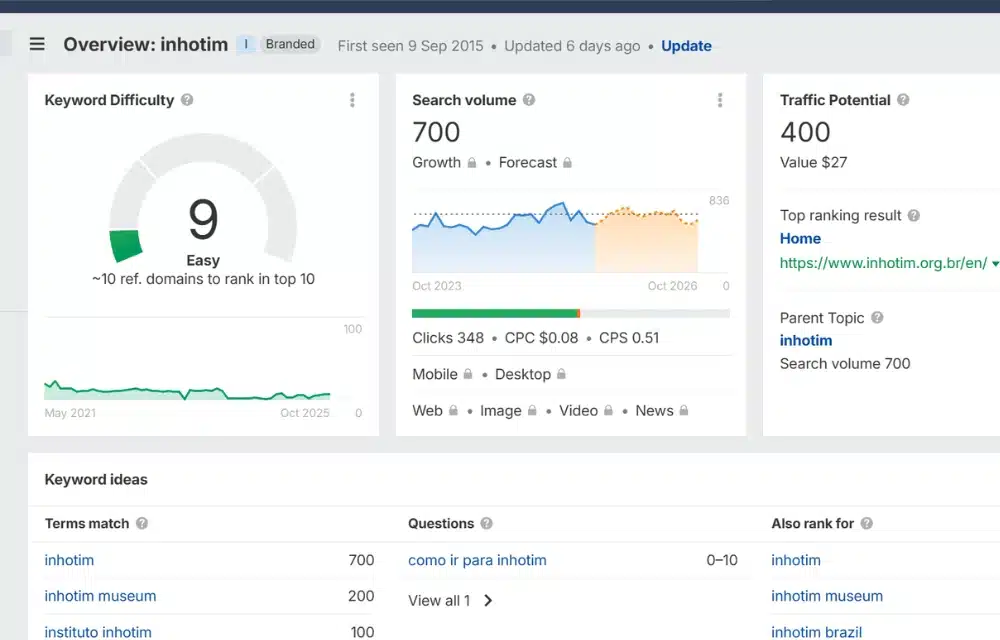
On the surface, having a KD score of 9 seems to imply that it is a keyword that’s easy to rank for. But a deeper analysis reveals that that’s not the case.
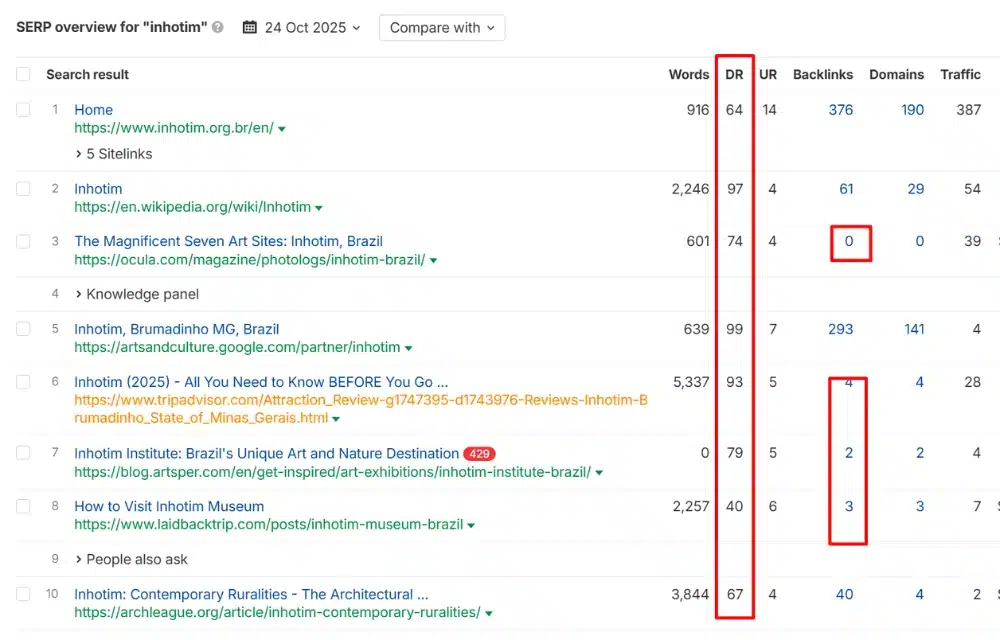
DR (Domain Rating) in Ahrefs estimates a site’s backlink strength, including how many quality domains point to it and how authoritative those referrers are.
Higher DR generally means a better shot at ranking.
Now check the top pages for “inhotim.” They sit on domains with hefty backlink profiles. Off-page 101: link equity (“SEO juice”) flows through links.
Google’s PageRank algorithm uses that flow to gauge page importance.
Since most external links hit the homepage, authority trickles down to deeper pages and gives them a boost. Ahrefs’ DR reflects that domain-level muscle.
Don’t chase a keyword just because KD is low. Pair it with context, like the DR of the sites you’re up against, before you decide to target it.
The SEO Keyword Research Process
Step 1 — Define your goal
Now this comes as a no brainer, but your SEO goal will definitely influence your keyword research efforts and how you choose keywords.
Say your goal is purely for traffic and rankings, then it does not matter if you try to rank for transactional keywords with product category pages on e-commerce sites or informational keywords using blog posts.
But, if your goal is revenue, then you should place close attention to the search intent of the keywords.
Targeting commercial and transaction keywords will make a lot more sense in this case.
Step 2 — Brainstorm core keywords
I start by identifying core keywords that reflect the heart of the brand’s offers or the fundamental pain points of its audience.

Say you’re an online florist like Floristique, look at your key offerings and come up with some basic keywords:
- buy flowers online in singapore
- buy sunflowers singapore
- same day flower delivery singapore
This stage is more about casting a wide net to target different groups of potential customers. In the case of online florists, it would be the different groups of people looking to buy different types of flower bouquets.
If you run a digital marketing agency like us, then you can look into targeting keywords like ‘seo services singapore’, ‘ppc services singapore’ or ‘content marketing agency singapore’.
Again, look at your complete set of offerings and the types of people you want to target.
Step 3 — Expand into keyword ideas
Once the seed topics are in place, I move into keyword discovery.
I use keyword research frameworks to identify potential topics before using SEO tools (whether free or paid) to validate these topic ideas with keyword metrics to see if it’s viable to target them.
A favourite keyword research framework of mine is the 5W1H framework. Let’s use Floristique’s sunflower offering as an example:
- who should i buy sunflowers for
- what is the meaning of sunflowers
- why should i buy sunflowers for someone
- where to buy sunflowers in singapore
- when to buy sunflowers for someone
- how should i arrange sunflowers in a bouquet
I like to use Semrush’s keyword filters
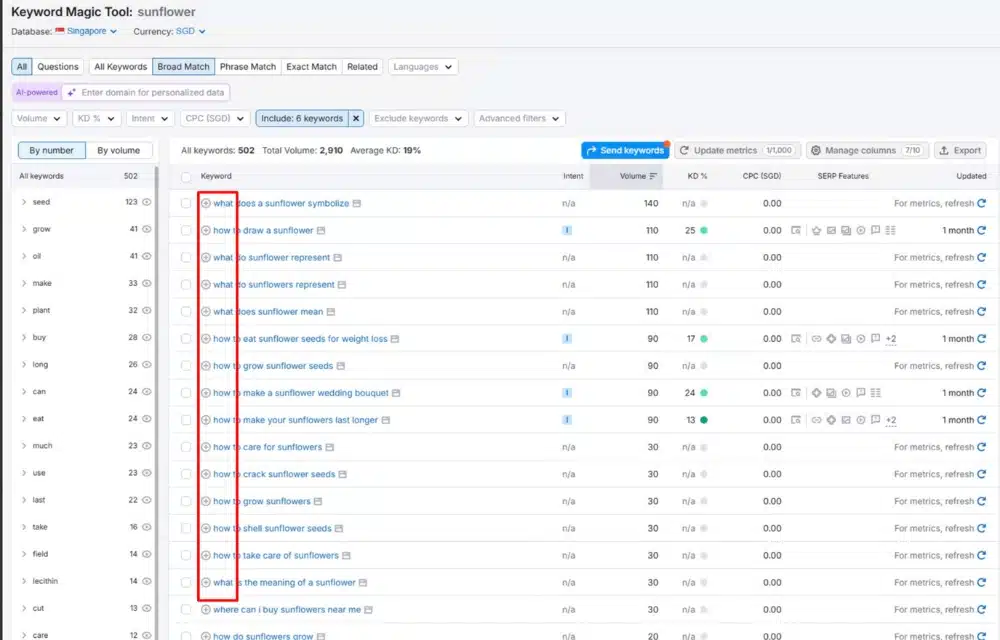
Through this process I ask myself: how might someone phrase the problem my offering can solve, how might they search for options, and how do those terms align with what we deliver?
This exploration ensures that the keyword set includes not just high‑volume terms, but phrasing that resonates with real people and aligns with where the brand can credibly deliver value.
Step 5 — Evaluate Metrics and Intent
With a broader list in hand, I then evaluate each keyword’s potential in terms of volume, difficulty, and, critically, intent.
As mentioned earlier, don’t look at metrics like search volume and keyword difficulty in silos.
Instead, look at a collection of metrics. Personally, I’d go for a combination of:
- Search volume: If traffic is my primary goal and my site’s DR is strong enough to rank for me
- Competitors’ DR scores: Assess actual competitiveness of keyword
This is the phase where I will also analyse the search intent of the keywords just so I can note down somewhere the type of content I need to product to rank for these keywords.
Step 6 — Prioritise & filter
Next comes prioritisation.
I filter the list down to terms that align with our business goals and represent realistic opportunities.
I group keywords by intent. Let’s take Floristique for example again. As an online florist, my primary goal is, of course, to generate revenue from flower sales.
So commercial and transactional keywords (e.g. buy flower online singapore, rose bouquet online singapore) are ones that I will prioritise.
My secondary goal of SEO is then to raise awareness for my brand and offerings. And blog posts are a great way to do that.
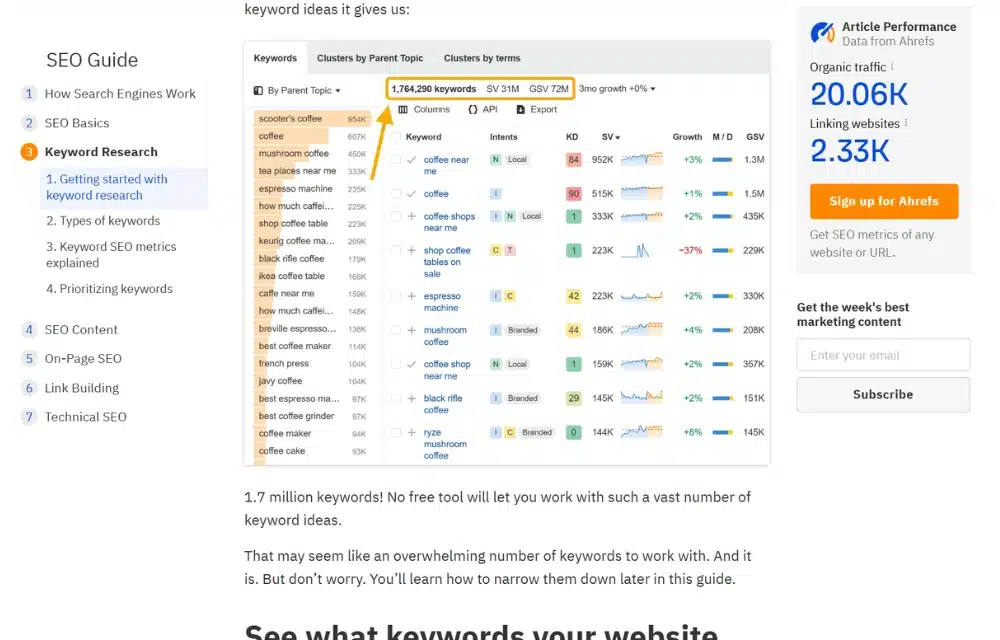
Think of the informational posts that SEO software company Ahrefs routinely push out. Their keyword research guide is essentially a HUGE ad for their product.
Just because a keyword is informational doesn’t mean it lacks business value.
Step 7 — Keyword mapping to pages
Mapping comes next.
I assign each keyword or cluster of keywords to a specific page on the site.
This prevents keyword cannibalisation (where multiple pages compete for the same term) and ensures each page has a distinct purpose.
It also helps shape internal linking in a logical way, guiding both users and search engines through the content journey.
Different SEO professionals will have different frameworks when it comes to keyword clustering (as you’ll see from all the top articles ranking for “what is keyword clustering” or “how to form keyword clusters”).
Personally, for each piece of content, I will make two clusters of keywords:
- Primary: Group of primary keywords. These are all variants of the keyword I want to rank for and they all have similar, if not identical search intent
- Secondary: Group of secondary keywords. These have topical relevance to the main keywords I want to rank for but need not have the same search intent
Step 8 — Monitor, test & refine
Keyword research is not a one‑and‑done exercise.
Once pages go live, I monitor performance and assess it based on ranking positions, impressions, clicks, and especially whether traffic is converting or engaging.
I revisit the keyword list periodically. I either remove obsolete terms or add new opportunities to account for shifts in intent or competition.
In my five‑plus years of practice I’ve found that treating keyword research as an ongoing conversation with your audience is far more valuable than treating it as a static checklist.
Keyword Research Techniques
1. Buyer-journey buckets & intent modelling
I align keywords with the buyer’s journey and search intent:
- Awareness – Informational intent
- Consideration – Commercial intent
- Decision – Transactional intent
Different stages come with keywords of different intent, which in turn require different types of content to rank for them.
Based on the different buyer stages, I can come up with some potential keywords to map to each stage of the buyer journey:
- Awareness: what to buy for mother’s day, what to buy for anniversary
- Consideration – best florists in singapore, best online florist singapore, best place to buy sunflowers in singapore
- Decision – buy flowers online in singapore, buy sunflowers online in singapore
And again, once you have a rough list of keyword ideas, always validate using SEO tools to see if it’s viable to even try ranking for them.
2. Long-tail vs short-tail strategies
Ranking for long-tail keywords tends to be easier given that they tend to have clearer intent.
Let’s look at two examples. Compare “whatsapp” and “how to install whatsapp on desktop” and observe the SERPs for each keyword:

Short-tail keywords like “whatsapp” have very unstable SERP graphs. This is indicative of Google not knowing what results to ranking top 10 for the particular keyword because it is too vague.
Are people searching “whatsapp” looking for:
- The Whatsapp homepage?
- The Whatsapp web login page?
- Or the Whatsapp help center?
When choosing keywords, avoid going for keywords that are too short-tailed.
Competitor keyword gap & reverse engineering
I analyse competitors to find keywords they rank for that I don’t. This reveals overlooked opportunities and content angles.
The goal isn’t to copy but to discover ways to outperform competitors while filling gaps.
And I do this by using Ahrefs’s Chrome extension.
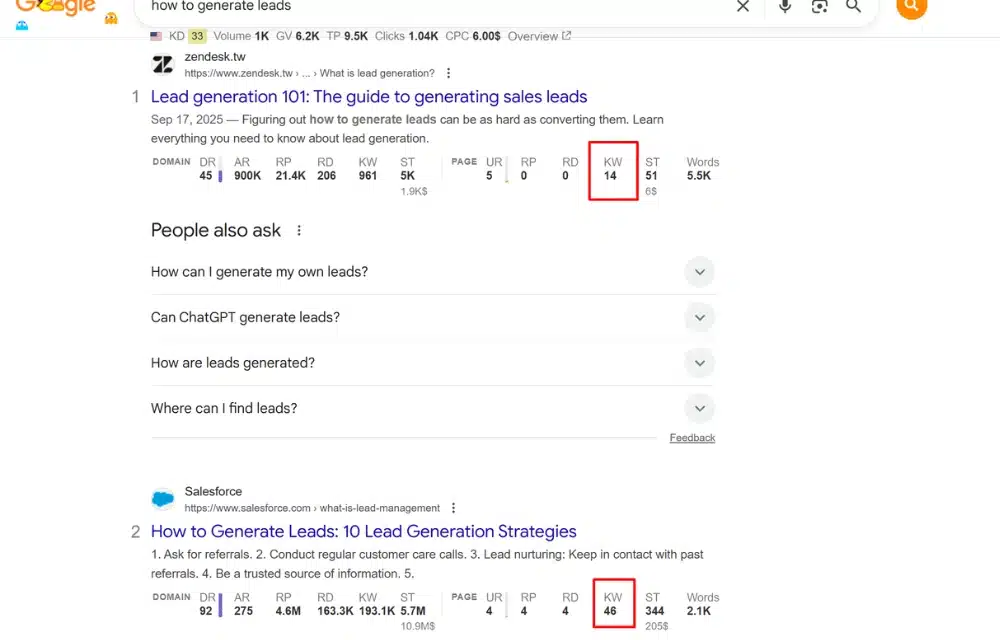
It shows the key SEO metrics tied to each competitor page.
On top of that, it even grants you easy access to the keywords your competitors are ranking for, making it super easy for you to do an in-depth competitor analysis.
Keyword Research Using Ahrefs, SEMrush, & Google Keyword Planner
How to do keyword research with Ahrefs
Start with seed ideas in Keywords Explorer, then review the Clusters by Parent Topic to group related terms you can target with a single page.
This helps you spot topical clusters, not just isolated keywords, and prioritize content that can rank for many close variants.
Next, expand and qualify your list. Use Competitive Analysis or Content Gap to find terms competitors rank for that you do not, then shortlist by potential using the metrics I discussed above.
And if you’ve not realised by now, I’m a huge fan of Ahrefs’s Chrome extension simply because of how easy and convenient it is to get essential SEO data to inform your keyword selection process.
How to do keyword research with SEMrush
Begin with Keyword Overview to benchmark metrics for multiple ideas, then dive into the Keyword Magic Tool to generate a large, filterable list from a single seed.
Explore match modifiers, questions, and intent to build out themes you can own.
Layer on competitive insights to refine targets. Use Organic Research to see what rivals rank for, then run Keyword Gap to expose opportunities you are missing.
Organise finalists into topic clusters with the Keyword Strategy Builder so you map keywords to pages with purpose.
How to do keyword research with Google Keyword Planner
Access Keyword Planner inside Google Ads, choose “Discover new keywords,” and enter seeds or a URL to get suggestions.
Apply filters for location, language, and date range, then scan average monthly searches and competition to gauge demand.
Refine your picks by sorting and narrowing with the available filters, then export candidates for deeper SEO vetting in your preferred tool.
If you are new to GKP, you will find it in Tools and Settings under Planning, which makes it quick to reach during campaign setup.
Common Challenges & How to Overcome Them
Low data for niche topics
After more than five years in the trenches, I have learned that tiny volumes can hide real opportunity.
In Ahrefs or SEMrush, I start with a seed, then step up to the parent topic to see how the ecosystem hangs together.
I look at clicks as well as volume, pull in questions and long tails, and group semantically related terms so a single guide can hoover up multiple variants.
I also sanity check with Google Keyword Planner to gauge ranges and spot close variants the SEO tools treat separately.
A quick read of the live SERP tells me whether users actually click through or find what they need on the page.
If the intent is underserved and I can offer first hand advice with clear next steps, I will build it and bank the early topical authority.
Keywords with ambiguous intent
Some keywords have SERPs of different types of pages.
For the e-commerce space, it’s common to see a mix of guides, category pages, and brand results.
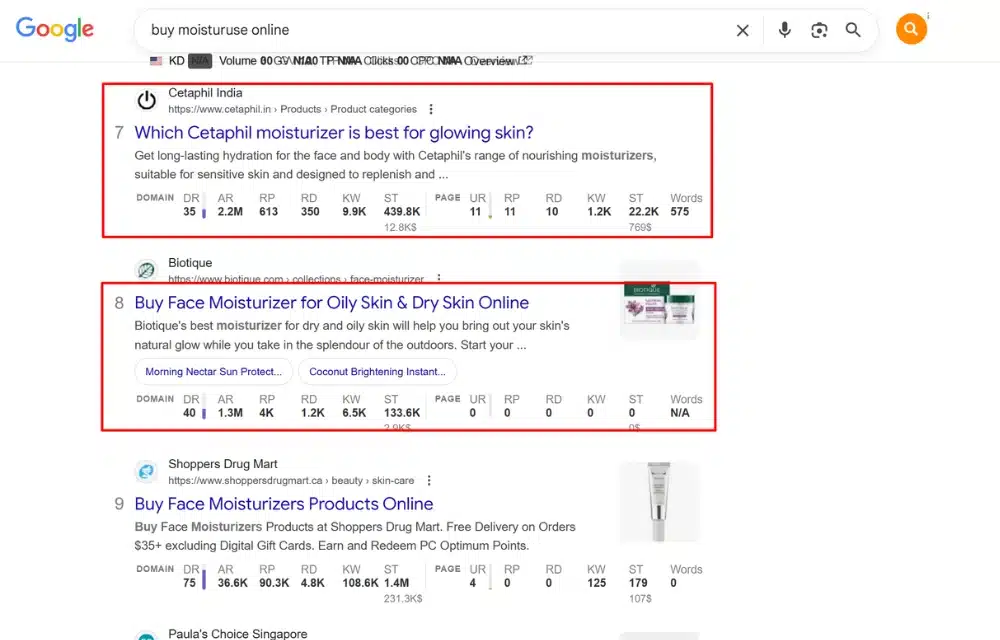
But that doesn’t mean you should not target these keywords.
Once the plan is set, I write with intent signals in mind. Titles and H2s call the shot clearly, FAQs tackle adjacent questions, and internal links steer users to comparison, pricing, or step by step content as needed.
That way each page has a crisp job to do, and searchers land on the document that matches their task without friction.
Internal conflicts / cannibalisation
Nothing sinks momentum like two of your own URLs wrestling for the same query.
I map each cluster to a single primary page, then I merge overlaps or reposition weaker pieces to sub intents such as troubleshooting or alternatives.
Canonicals, redirects, and consistent anchors help consolidate signals so authority stops scattering.
To verify I am fixing the right problem, I check Search Console for query crossover and review historical ranking URLs in my tool of choice.
After consolidation, I refresh the survivor with stronger on-page structure, add or update internal links from related articles, and monitor impressions to make sure the cluster is now routed through one clear entry point.
Tool limitations & data discrepancies
No platform owns the truth.
Google Keyword Planner (GKP) groups close variants and reports broad ranges, making volume data inaccurate.
Non-Google tools calculate volume and keyword difficulty from clickstream panels and proprietary maths. Different tools will state numbers that often aren’t the same.
My workflow is to triangulate, then test.
I compare direction across Ahrefs, SEMrush, and Keyword Planner, I eyeball the SERP to understand real competition, and I prioritise by business fit, click potential, and the number of variants a page could rank for.
I also use different tools for different purposes based on their strengths:
- Ahrefs: Chrome extension for competitor analysis
- Semrush: Most powerful keyword filters
- GKP, KWFinder by Mangools, and Low Fruits: For long-tail keywords
If you have the resources to subscribe to multiple tools, do use different tools.
Turning Research into Real SEO Results
Keyword research is the heartbeat of digital strategy.
From brainstorming and analysing intent to using AI-assisted tools, every step helps you understand your audience.
The process may seem complex, but connecting the right keywords with purposeful content makes rankings, traffic, and conversions flow naturally.
If you’re ready to see your keyword research translate into real results, First Page Digital can guide you.
Our team of SEO specialists transforms insights into sustainable visibility, driving traffic and leads with strategies tailored to your audience. Great research deserves even greater results.
Sign up for a FREE trial today!