Keyword Difficulty (KD) is one of those SEO metrics that gets thrown around a lot during keyword research, but it’s often misunderstood or used in isolation.
In this guide, I’ll walk you through exactly what KD means, how it’s calculated by different tools like Ahrefs and SEMrush, and how to interpret it alongside other metrics like search volume and intent.
You’ll learn why KD can be a helpful way to prioritise keywords and plan content resources, but also why relying on it too heavily can lead you down the wrong path.
I’ll also share a set of practical best practices I’ve developed over the years to help you use KD wisely, adapt it to your site’s unique strengths, and keep your content aligned with what actually helps users.
Now, let’s get down to business.
What is Keyword Difficulty?
Keyword Difficulty (KD) is a score that estimates how competitive it is to rank on page one of Google for a particular query.
Most SEO tools measure that competitiveness on a scale of 0 to 100. Lower figures tend to signal easier keyword opportunities and higher scores point toward SERPs dominated by strong domains with solid backlink profiles.
After working in SEO for years, I’ve learned that KD is useful for forecasting how much work may be needed to break into a SERP. But as I’ll discuss later, I never let it dictate my strategy on its own.
Context, intent, topical authority, and real user value always change the equation.
Even keywords with a low KD score can still be difficult if the search results are stacked with highly relevant content that perfectly matches intent.
So KD should guide our early filtering decisions rather than replace proper manual SERP analysis or judgement grounded in experience.
How Keyword Difficulty Is Calculated
How does Ahrefs Calculate Keyword Difficulty
Ahrefs takes a fairly streamlined approach to calculating KD.
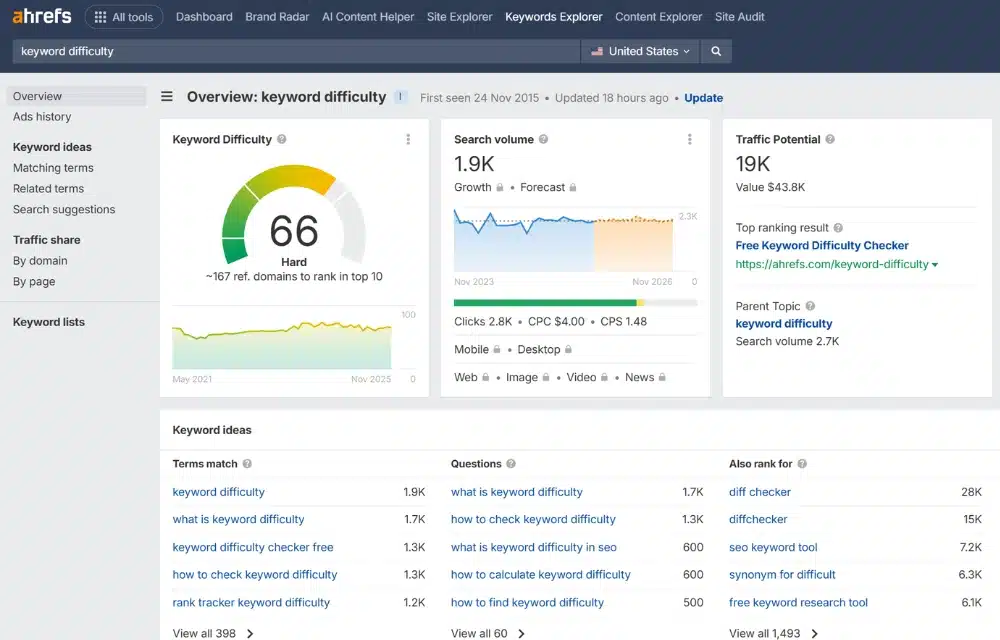
It looks primarily at the number of referring domains linking to the top 10 ranking pages for a given keyword.
The logic is that if those pages have a high volume of unique backlinks, you’ll likely need a similar backlink profile to stand a chance at ranking.
I’ve found this approach particularly useful for quick estimations when working on link-building strategy.
One thing to keep in mind is that Ahrefs uses a logarithmic scale. That means the difference between KD 10 and 20 isn’t the same as the jump from 70 to 80.
Each step gets progressively harder, and it compounds fast.
However, Ahrefs doesn’t account for other important ranking factors like content quality, SERP features, or user intent.
So while it gives a solid snapshot of backlink competitiveness, it’s not a complete picture. That’s why I always pair it with manual SERP reviews and content gap checks.
How does SEMrush Calculate Keyword Difficulty
SEMrush, on the other hand, uses a more complex formula.
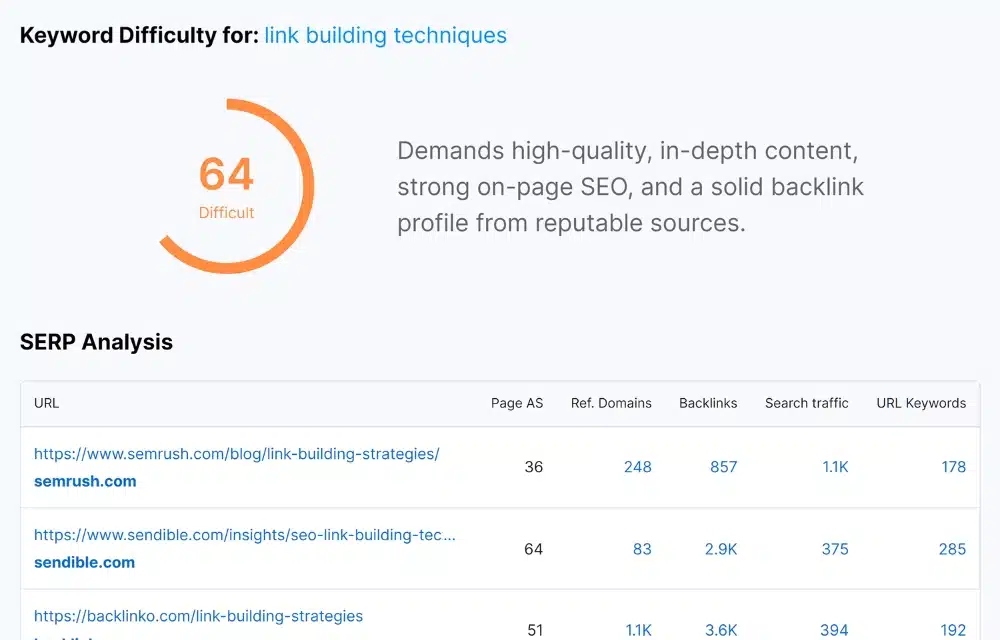
In addition to referring domains, it considers domain authority, types of backlinks, the presence of SERP features, and the competitiveness of the overall query space.
What I appreciate about this method is that it attempts to factor in real-world SERP dynamics that affect click-throughs and visibility.
They’ve also introduced something called “Personal Keyword Difficulty,” which adjusts difficulty scores based on your own site’s authority and performance history.
It’s a handy way to gauge whether a keyword is a good fit for your domain specifically, not just in general.
That said, the extra complexity can make it harder to reverse-engineer their scores, so it’s not as transparent as Ahrefs.
I usually treat SEMrush KD as a directional signal and combine it with intent matching, content planning, and competitor benchmarking.
Does Keyword Difficulty Matter in Keyword Research?
Indicative of keyword competitiveness
Keyword Difficulty absolutely has a place in keyword research, especially when I’m working with massive lists and need to prioritise where to start.
It gives a snapshot of how competitive a keyword is likely to be based on who’s currently ranking.
When you’re shortlisting hundreds of keywords across a topical cluster, a high KD score can flag that you’ll probably need strong backlinks, authority, or standout content to break into the top 10.
In contrast, spotting a keyword with decent search volume but a relatively lower KD can signal a quicker win.
But I’ve learned not to treat KD scores as gospel. It’s a directional signal, not a ranking guarantee.
There will be instances when keywords with low KD scores are highly competitive.
A low Keyword Difficulty score doesn’t always mean easy rankings.
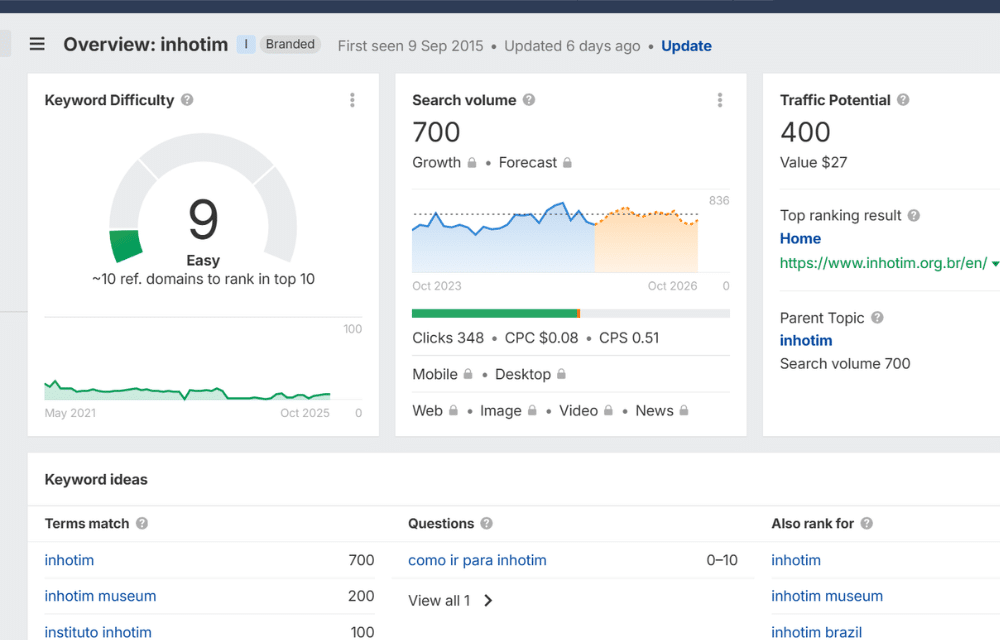
Take “inhotim” as an example—it has a KD of 9, but the top-ranking pages sit on domains with strong backlink profiles and high Domain Ratings (DR).
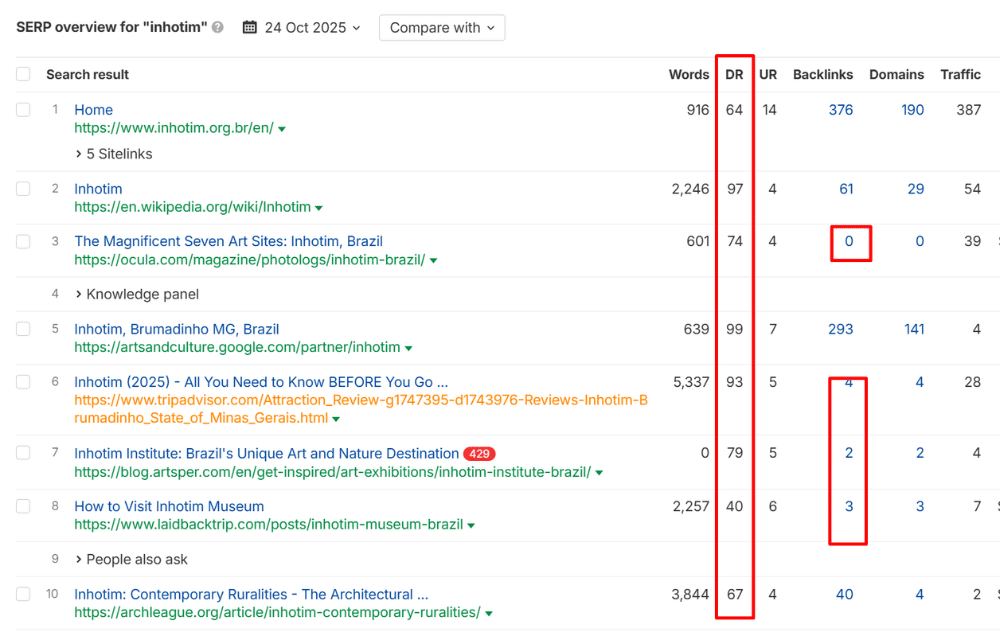
That domain-level authority passes link equity down to inner pages, making them harder to outrank.
Always consider the strength of the competition, not just the KD score, before deciding to go after a keyword.
At the end of the day, KD helps me gauge the competitive landscape. But it’s just one piece of a much larger puzzle.
Helps with resource planning
Understanding keyword difficulty also shapes how I plan content.
If I know a topic cluster contains mostly high-KD keywords, I plan for deeper content, stronger internal linking, and potentially multiple supporting pieces.
For lower-difficulty terms, a single well-structured article might do the job. KD affects not just what I write about, but how I allocate resources across the team—be it design, writing, or link-building.
Still, it’s critical to balance KD with relevance, user intent, and topical authority.
A keyword might be competitive, but if it’s core to what my client or site already ranks for, I’m far more willing to invest in it.
On the flip side, a keyword could be “easy” but totally misaligned with what users expect from the site.
So while KD influences my strategy, it never drives it on its own. It’s a planning tool, not a final verdict.
Caveats of Over-Focusing on Keyword Difficulty
Mistaking Low KD for “Easy Wins”
One of the biggest misconceptions I’ve seen is assuming that a low KD score equals low competition.
In reality, the top-ranking pages might still be incredibly strong. They could be built on solid topical authority, have a strong domain authority, and content that nails search intent.
The metric doesn’t reflect those layers, as seen with the “inhotim” example.
That’s why I always make time to audit the actual SERPs. A keyword might look like a free pass, but the quality of those existing results can tell a completely different story.
Ignoring Intent and Content Relevance
Keyword Difficulty doesn’t always capture the heart of what really makes a page rank: relevance.
A site with fewer backlinks can still outperform others if its content serves the searcher’s intent better. I’ve seen countless examples where aligning content format, tone, and structure to user expectations made all the difference.
KD might flag how strong the current pages are link-wise, but it won’t tell you if they’re answering the query properly.
Relying Too Much on One Tool’s Score
Every SEO tool has its own formula for calculating KD, and they don’t all weigh the same factors.
Some lean heavily on backlinks, others bring in domain strength or SERP features.
That means the scores aren’t interchangeable, and blindly trusting one tool can skew your judgement.
I’ve made it a habit to compare metrics across platforms and, more importantly, cross-reference them with what I see in the SERPs.
That combination gives me a more grounded view of what I’m actually up against.
Best Practice Framework for Using Keyword Difficulty
Assess Your Site’s Current Strength Holistically
Before I even start evaluating keyword difficulty, I like to take stock of where the site stands.
That includes checking the domain’s authority, backlink velocity, and the depth of existing content in the topic area.
If your site is relatively new or hasn’t built topical relevance yet, you’re going to struggle ranking for mid-to-high KD terms without some serious strategic groundwork.
Once I understand the site’s current authority, I map that against the KD ranges in my research.
This helps me avoid wasting time chasing keywords that are realistically out of reach. It’s about choosing battles wisely.
If a keyword requires hundreds of referring domains to break into the top 10, I’ll either put it on the backburner or build supporting content around it first.
There’s no shame in starting with achievable wins that build momentum.
Use KD as a Filtering Tool, Not the Final Say
Keyword Difficulty is helpful for narrowing down massive lists.
When I’m working on a site targeting multiple regions or industries, KD lets me quickly remove terms that are obviously too competitive or completely irrelevant.
That early filtering stage saves time and focuses the content plan on realistic targets.
That said, I don’t automatically bin high-KD keywords either. If I’m building out a topical cluster or trying to establish authority in a core niche, those harder keywords might be essential.
Sometimes I’ll target them indirectly through long-tail variations, supporting articles, or linkbuilding. And I do this until the domain has enough strength to compete head-on.
And again,
Analyse Search Intent Before Prioritising
Even if a keyword looks good from a KD and volume standpoint, I won’t touch it unless I know exactly what the user is looking for.
I ask myself, “Is this person trying to learn something, compare options, or buy right now?” That question shapes how I evaluate whether it’s worth creating content for that term.
Matching your content format to intent is non-negotiable.
If users are expecting a product comparison and you show up with a generic blog post, it won’t matter how low the KD is. There’s no way you’ll rank.
Over the years, I’ve learned that intent mismatch is one of the quickest ways to waste content resources.
KD can’t tell you that, but a quick check of the SERP usually can.
Do a Manual SERP Audit
I never rely on metrics alone.
One of the first things I do when a keyword makes the shortlist is plug it into Google and look at what’s actually ranking.
Is it all massive domains? Are the pages heavy on backlinks, or are they winning with structured, intent-matching content?
This gives me a clearer picture than any KD score alone ever could.
Beyond that, I look for content gaps. Maybe the top-ranking posts are outdated, thin, or missing certain formats like video or interactive tools.
Those are opportunities. When I know where the bar is, I can better assess whether it’s worth going after.
Sometimes, even a high-KD term has a weak spot just waiting to be outdone.
Target Quick Wins But Build for the Long Game
When I’m working with newer sites or those still building domain authority, I usually prioritise low to medium KD keywords.
They’re a great way to start building traction, attract backlinks organically, and show Google that your content has value.
These keywords often have less aggressive SERP competition, which means your content stands a better chance of ranking without needing a massive link-building push.
But I don’t stop there. As the site gains topical depth and credibility, I begin to layer in higher-difficulty terms as part of a longer-term strategy.
So start on the rungs you can reach, and keep climbing.
Eventually, what felt impossible six months ago becomes the next logical target. That’s when real momentum kicks in, both for traffic and rankings.
Align Content Creation with Helpful Content Guidelines
Keyword Difficulty scores might shape your content calendar, but the content itself has to stand on its own.
I always come back to a single question when reviewing drafts: does this genuinely help the user?
Google’s helpful content guidelines make it clear that real-world experience, clarity, and originality are just as important as traditional ranking factors. Having content that reflects your experience, expertise, authoritativeness, and trustworthiness (E-E-A-T) is key.
Instead of chasing keywords for the sake of it, I try to create content that reflects personal insight or practical know-how.
The best SEO content feels like it was written for a human first, not an algorithm.
Revisit and Refine Regularly
Keyword Difficulty isn’t static.
Scores change based on who’s entering the SERP, who’s dropping out, and what kinds of content are being rewarded by the algorithm.
A keyword that appeared less competitive last quarter might be harder to tank for today, especially if a few big players have entered SERP.
That’s why I revisit keyword maps and target lists every few months. Sometimes I find hidden gems I missed earlier, and other times I realise that what was once a quick win now requires a more strategic effort.
Regularly reviewing KD in the context of your site’s growth keeps your content plan sharp and adaptable. It’s part of staying ahead rather than playing catch-up.
Ready to Turn Keyword Difficulty Into a Competitive Edge?
Keyword Difficulty is a powerful tool in your keyword research arsenal, but like any metric, it only works when you know how to use it in context.
After years in SEO, I’ve found that the sweet spot lies in combining KD with real-world SERP analysis, user intent, and content that actually solves problems.
Whether you’re planning content for a new site or scaling an existing one, understanding how to read and respond to KD can make all the difference between guesswork and growth.
If you’re still unsure where to start or want a second opinion on your strategy, book a FREE strategy call worth $2000 with the team at First Page Digital. We’ll help you cut through the noise and build a roadmap that works for your business.