When I moved beyond basic keyword research and stopped obsessing over search volume and keyword difficulty in isolation, keyword clustering became a turning point in how I decide on choosing keywords that can actually rank.
In this guide, I’ll walk through what keyword clustering is, why search intent alignment matters more than raw metrics, and how grouping related terms into topic clusters helps you create stronger pages instead of scattered single keyword pages.
You’ll also learn the exact steps I follow to build clusters properly, from collecting data and analysing SERPs to mapping clusters to content, so you can create pages that are more helpful, more relevant and more competitive.
Understanding Keyword Clustering
What is Keyword Clustering
Keyword clustering is the process of grouping related queries that share similar, if not identical search intent. This means that if I were to Google every keyword in the cluster, I would see either:
- A list of similar, if not identical set of competitors ranking for said keyword
- Or a list of web pages talking about the same topic from a similar, if not identical angle
So instead of creating separate pages for every variation, you build one stronger piece that answers the topic more completely.
I’ve seen this shift outperform the old one‑keyword‑per‑page mindset because clustering removes duplication, protects you from cannibalisation, and makes your content feel more intentional for both users and search engines.
Why keyword clustering matters in modern SEO
Search has evolved into intent recognition.
Google is getting better at understanding the context of what people actually want, not just the literal words being typed.
Because of that, I now build content around semantically connected terms, and it consistently performs better.
It aligns with how modern SERPs behave: similar intent queries often return extremely similar results, which means search engines see them as part of the same topic.
Keyword clustering also helps you decide when to produce a single piece of content that’s genuinely helpful for humans while targeting multiple keywords at the same time. So instead of chasing a single exact match keyword, I focus on solving the full pain point.
That approach keeps me grounded in helpful content principles, and it naturally lifts my perceived topical authority over time.
How to Do Keyword Clustering Properly
Step 1 – Perform thorough keyword research
I always begin by gathering a broad list of keywords around a core topic.
That includes obvious seed phrases, long-tail variations, and adjacent terms with similar intent.
And how do I know that these keywords belong in the same cluster? By looking at the SERP for each of these keywords.
Using keyword tools helps me quickly spot patterns in volume, difficulty, and user intent.
Step 2 – Group keywords into clusters
Once I’ve got my keyword list, I analyse the SERPs to see which terms pull up the same or very similar results.
Let’s say I’m running a confinement nanny agency in Singapore and want to create an SEO-optimised article on the benefits of DOM Benedictine for postpartum mothers as a way to attract readers to my site.
Some of the keywords I will include in my cluster are:
- dom benedictine benefits
- how much dom to drink daily
- how much dom to drink during confinement
- dom confinement
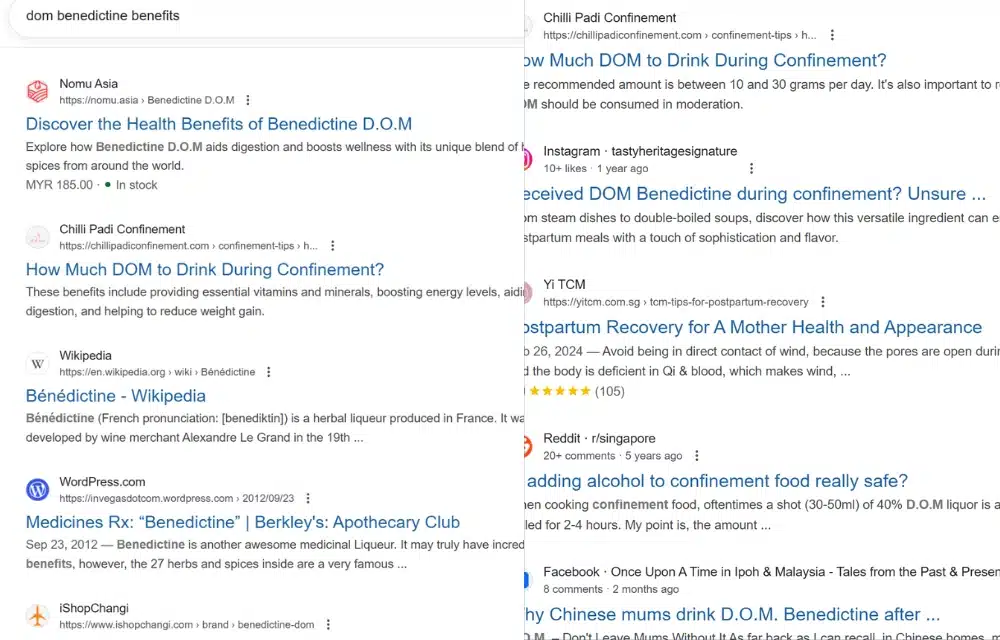
If two queries consistently return overlapping URLs, or web pages covering the same topic in the same angle, it tells me they likely serve the same intent and can be grouped.
Some tools automate this process using semantic similarity or SERP match percentage, but even a manual review works well when you’re hands-on.
Step 3 – Assign clusters to content
After forming my clusters, I map each one to a specific content piece—whether that’s a blog post, product page, or guide.
The idea is to address the entire cluster on one page in a way that feels natural and helpful to the reader.
If I can’t cover all queries clearly in one go, I split them up and link between related pieces.
That way, I keep my content focused while still covering the topic in full, which supports both discoverability and internal linking.
In the case of the above example, a detailed blog post explaining the benefits of DOM Benedictine and how much to drink during confinement is needed to rank well for those terms.
Step 4 – Optimize content around the cluster
When I write content for a cluster, I make sure each section addresses a different angle of the topic.
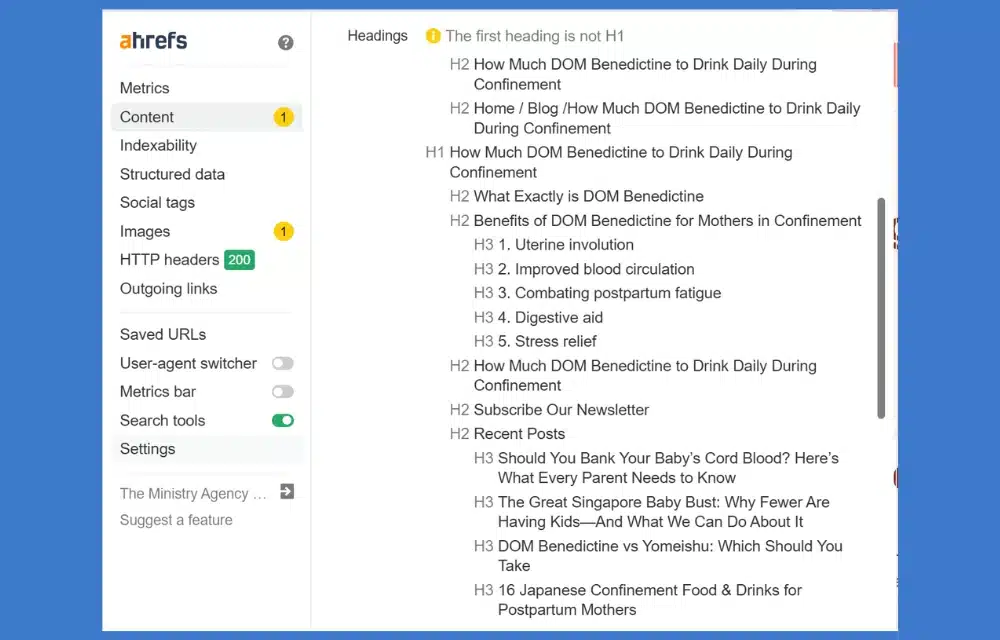
I also base my header structure on what the top ranking competitors already cover because their SERPs give me real signals of what users expect.
I weave the cluster’s keywords in naturally so it reads smoothly, and I build internal links between related pages to reinforce the topical network.
This not only strengthens relevance but also improves reader flow, which is a positive user experience signal.
Step 5 – Monitor, refine, and iterate
After publishing, I track how each cluster performs using metrics like rankings, engagement and conversions instead of relying only on impressions.
If a page isn’t progressing, I revisit the SERPs to see whether intent shifted or if competitors changed their approach.
I often refresh my clusters with new terms or remove keywords that no longer match, because search behaviour evolves over time and iterative refinement keeps the content helpful and current.
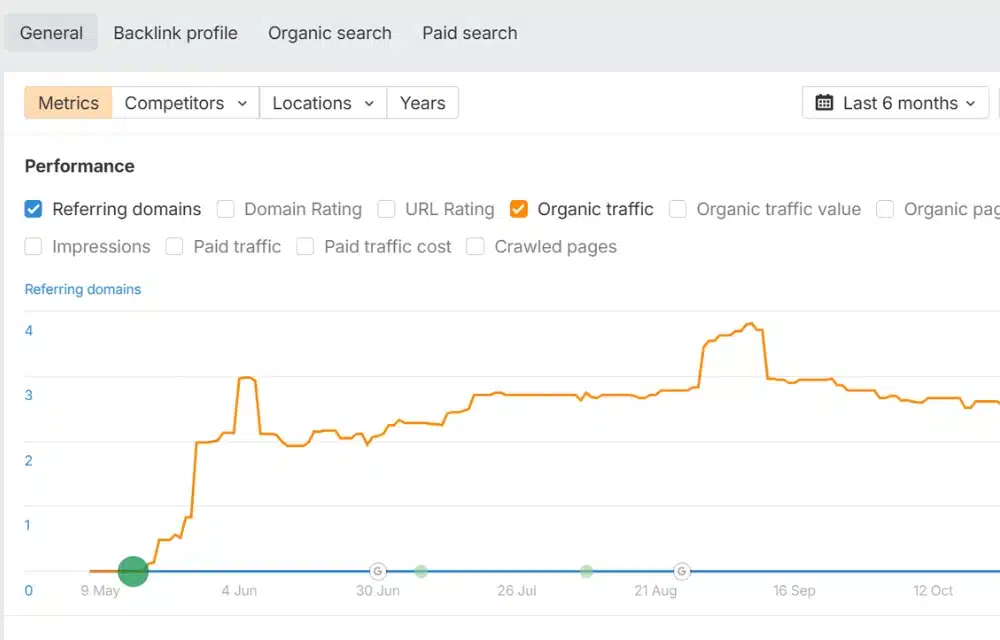
Luckily for me, my article published on NewBubs’s blog has been sustaining its keyword rankings, so I don’t have to do much tweaking after posting.
But if you ever see the performance of your content start to fluctuate, it’s time to take a closer look
Benefits of Keyword Clustering
Improved search engine rankings
By targeting multiple related queries in a single piece of content, I’ve seen pages rank for a wider range of keywords and hold stronger positions across SERPs.
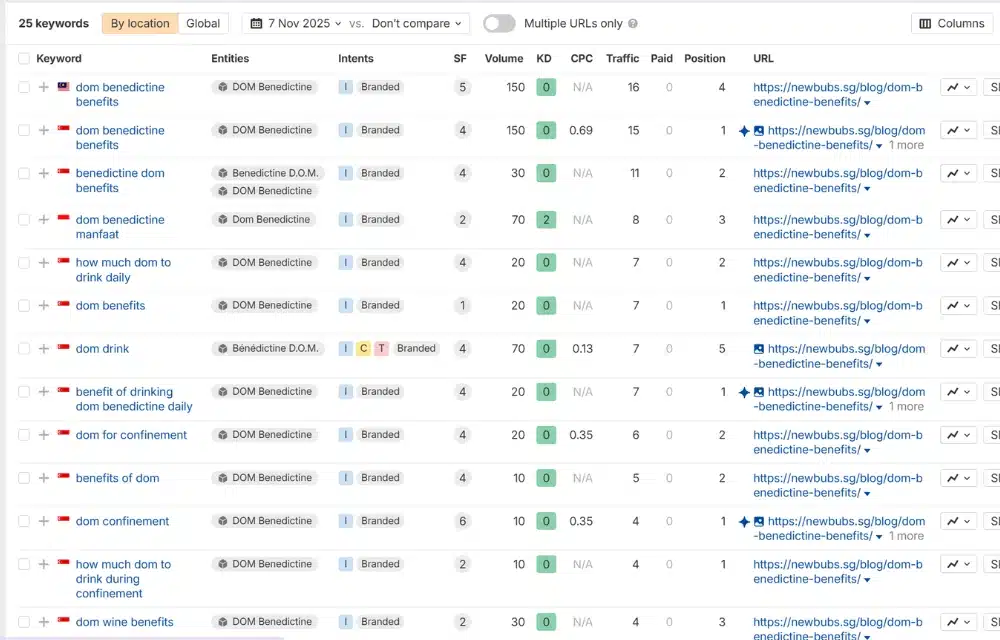
It’s not about stuffing everything into one article, but about covering a topic thoroughly enough that search engines recognise its relevance for several intents at once.
This approach expands your reach without having to publish dozens of nearly identical pages.
Increased topical authority
When you consistently publish content around a focused set of related topics, you start building authority in that space.
Over time, I’ve noticed that Google is more likely to trust and surface your content when you demonstrate deep expertise and breadth across a subject.

For NewBubs, I helped them developed clusters for:
- Confinement recipes and nutrition
- Indian confinement recipes
- Halal confinement recipes
- Confinement recipes for breastfeeding mothers
- Post C-section diet guide
- Nanny application and management
- Nanny angbao rates
- Work permit application giude
- Cultural confinement practices
- 555 postpartum rule
- Chinese confinement practices
- Postpartum wellness guide
Clustering helps you plan your content in a way that naturally builds this trust with both users and search engines.
Better site structure
Keyword clustering also makes it easier to maintain a clean, logical site structure.
When related topics are grouped and internally linked, users can navigate more intuitively, and crawlers can better understand how your pages connect.
I’ve used this method to reduce bounce rates and increase time on site, simply because the content flow becomes smoother and more aligned with user intent.
More efficient strategy
Clustering reduces redundancy and maximises the value of your content efforts.
Instead of creating ten separate blog posts for similar queries, you create one powerful asset that does the heavy lifting.
It also streamlines your editorial planning because you can build multiple articles off one well-researched cluster map.
This saves time, avoids cannibalisation, and makes scaling SEO far more sustainable.
Common Mistakes to Avoid
Mixing Different Search Intents in One Cluster
One of the easiest ways to derail a keyword cluster is by lumping together queries that serve different purposes.
In my early days, I’ve made the mistake of combining informational terms like “how to use” with commercial ones like “best tool for”.
This resulted in content that didn’t satisfy anyone.
The trick is to analyse the SERPs and pick up on clues from modifiers and ranking pages to see what users actually want.
If the top results are wildly different, you’re probably dealing with multiple intents that deserve separate pieces of content.
Creating Too Many Thin Pages for Individual Keywords
Trying to target every keyword with its own page can quickly lead to bloat, where your site is full of weak content that competes with itself.
I’ve audited plenty of sites where each page barely scraped 300 words just to rank for a variation, but none of them did well.
When you group related terms into one well-structured piece, you not only cover the topic more comprehensively but also send a stronger signal of relevance.
Depth wins over quantity in today’s SEO landscape.
Failing to Update Keyword Clusters Over Time
Keyword clustering isn’t a one-time setup.
Search behaviour evolves, industries shift, and even SERPs can flip within a few months.
I revisit my clusters regularly to see if new opportunities have surfaced or if certain keywords no longer belong.
Sometimes, an old blog post stops performing because the cluster it’s tied to has shifted in intent, and re-clustering it brings it back to life.
Keeping your keyword maps fresh ensures your content stays aligned with what people actually want to find.
Ignoring User Needs in Favour of Keyword Stuffing
I’ve seen keyword clustering go wrong when people treat it like a checklist of terms to cram into a page.
Just because you’ve grouped related queries doesn’t mean you should awkwardly wedge them all into the content.
That kind of writing feels forced and provides little actual value. Search engines are getting better at picking up when content is written for algorithms rather than real people.
Instead, I always start by understanding the user’s core question, then naturally incorporate the cluster where it fits.
The goal is to be helpful first—SEO performance follows when your content genuinely meets the reader’s needs.
Understanding Keyword Clustering
Keyword clustering isn’t just a technical trick — it’s one of the most effective ways to scale your content strategy while aligning perfectly with search intent.
Once I stopped choosing keywords in isolation and started thinking in clusters, my content started pulling in traffic across multiple terms.
If you’re ready to do the same but want expert help to map out your strategy, First Page Digital offers a FREE strategy call worth $2000 — and yes, it’s genuinely free.
You’ll walk away with a clear plan tailored to your site, your goals, and your audience. Don’t just guess what to write next. Let’s build it properly.