When I first started doing B2B SEO keyword research over 5 years ago at my first content marketing job at a SaaS company called Novocall, I completely bombed it.
I spent months picking keywords purely by search volume, like “CRM software” and “sales automation”. I didn’t understand search intent, and I wrote like I was doing editorials, not content meant to move B2B buyers forward.
The result? Our pages didn’t even crack the top 5 pages of the SERPs.
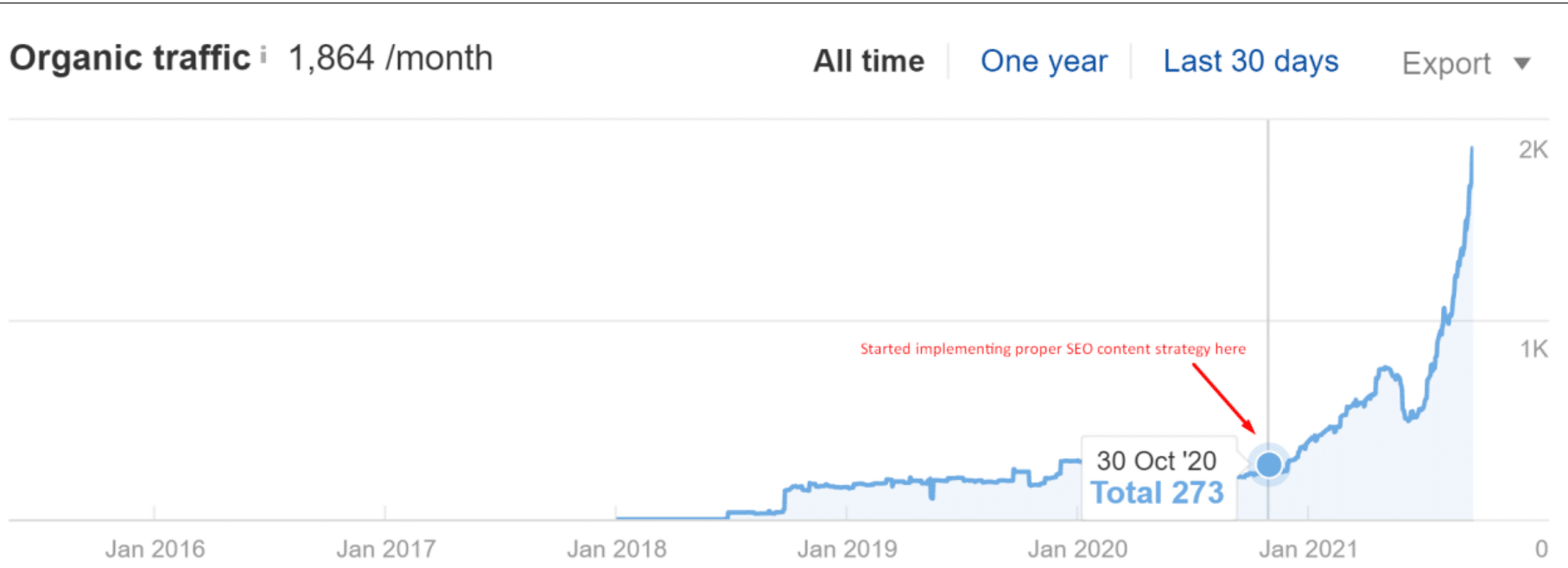
Everything changed when I learned how keyword research actually works in B2B and how content marketing fits into the buying journey. That’s when it clicked.
A strong B2B digital marketing strategy isn’t about chasing the biggest numbers. It’s about understanding the problems your buyers are trying to solve and meeting them where they are.
In this guide, I’ll walk you through the exact keyword research process I use for B2B companies, plus the mistakes that cost me months, so you can skip the painful lessons.
Why makes B2B Keyword Research Different?
To be very honest, the fundamentals don’t change. You find a keyword, assess its suitability to be targeted by balancing SEO metrics with internal operation capacity, create content, and then publish.
But here’s what they don’t tell you in most SEO courses: the B2B audience is harder to convince.
Consumer keyword research? That’s straightforward. Someone searches for “best running shoes,” you rank for it, they buy. Done. B2B?
Your B2B buyer is researching for longer periods (weeks to months), budget approvals can involve multiple decision makers, and they’re likely comparing between 10 different options.
To make matters worse (for you), they’re most likely not searching for your product or brand directly. Many are even searching for solutions to problems they can barely articulate. Think entry-level SEO executive who doesn’t know what SEO metrics a good keyword research tool should be able to measure.
So what does this all mean?
As SEOs, working for B2B clients means that you need to be more intentional with mapping content to different stages of the user journey.
And you can do so, with the frameworks I will be talking about below
1) Marketing Funnel Framework
Top of Funnel (TOFU): Problem-Aware Keywords
At the top, your buyer knows they have a problem but doesn’t know what solutions exist. They’re not searching “best ATS software,” they’re searching things like “why is our hiring process taking so long” or “how to reduce time to hire.”
These tend to be longer-tail and have lower search volume, but every visitor was a potential enterprise customer dealing with the exact problem we solved.
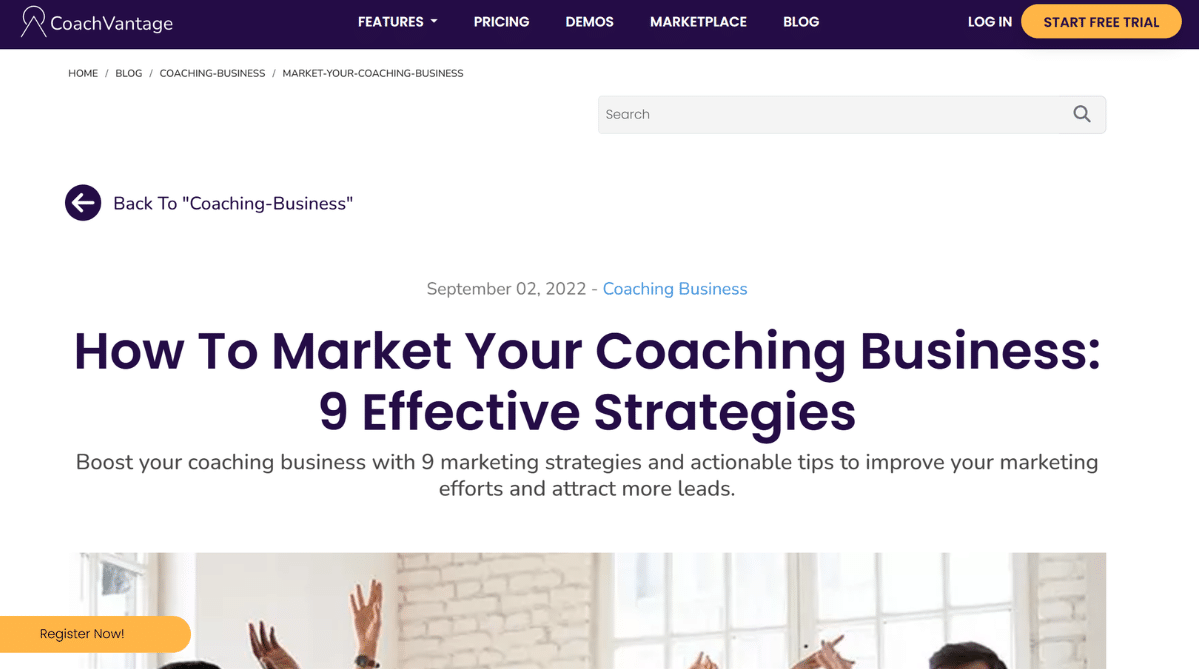
For coaching software Coachvantage, I did keyword research for and wrote a piece on how a coach can market their coaching business. And in this piece, I explicitly promote how the software helps coaches do so using some features.
Here’s what TOFU keywords look like:
- “How to” queries that address pain points
- “Why is [problem] happening” searches
- Industry challenge content (“biggest challenges in [industry]”)
- Statistical/research queries (“average time to hire for tech companies”)
The mistake I made early on was trying to educate people on solutions they didn’t even know they needed. Instead, I learned to meet them where they already were: Google, typing in their actual problem.
Middle of Funnel (MOFU): Solution-Aware Keywords
Now your buyer knows solutions exist. They’re researching types of software, comparing approaches, and trying to build a business case.
But these searches have buying intent. When someone searches “lead distribution software for insurance agencies,” they’re not browsing. They’re evaluating.
MOFU keywords typically include:
- “[Software type] for [industry/use case]”
- “How to choose a [solution category]”
- “[Feature] comparison”
- “What is [solution category]” (yes, some buyers are still learning)
- “Best/Top [B2B product or service]”
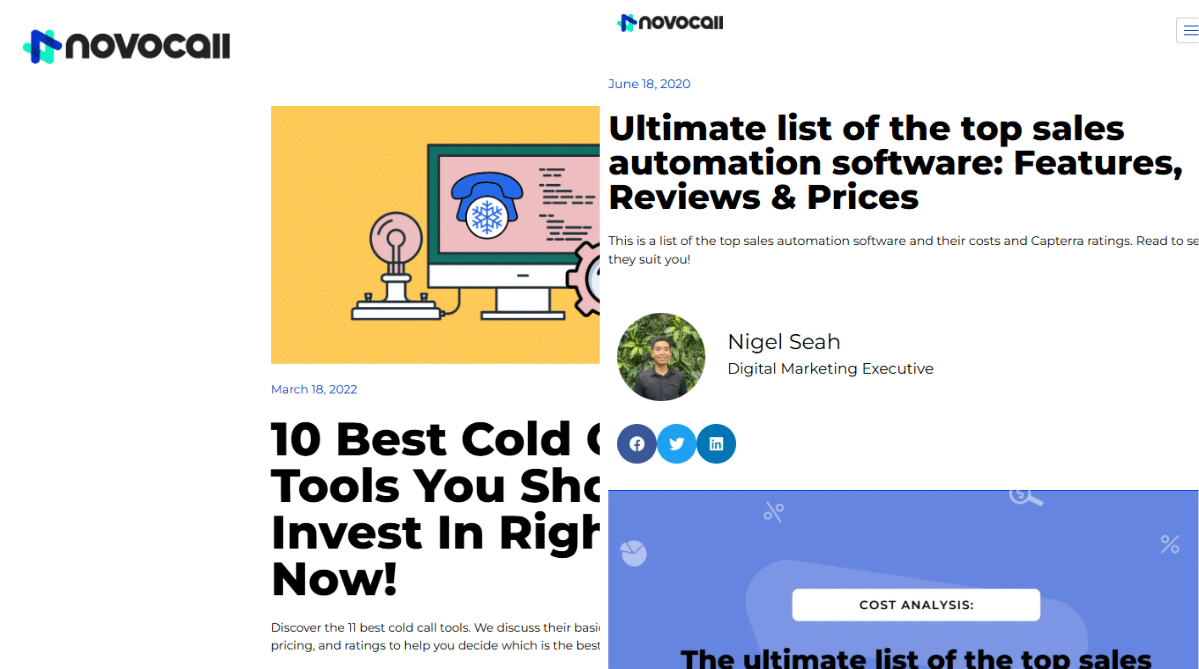
Back when I was with Novocall, I published a bunch of “best xxx software” listicles to help readers compare Novocall’s features and sell its unique selling point (USP).
We actually ended up receiving a good number of queries from the people who read the articles.
Bottom of Funnel (BOFU): Product-Aware Keywords
This is where your buyer is ready to choose. They’re comparing specific vendors, looking at pricing pages, and searching for reviews.
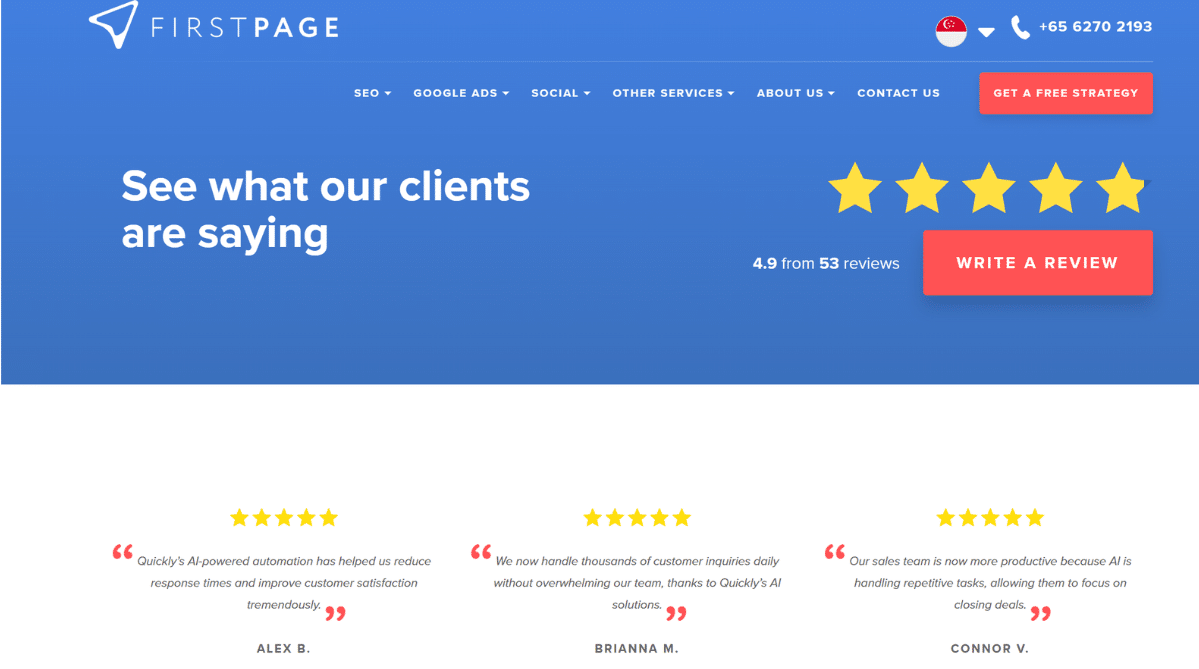
We created a page listing our happy customers’ reviews and have it ranked for “first page digital singapore reviews”.
Other examples of BOFU keywords look like:
- “[Your company] vs [competitor]”
- “[Competitor] alternatives”
- “[Product] pricing”
- “[Product] reviews”
- “Is [product] worth it”
The mistake I made early on was creating 90% bottom-funnel content. Yeah, it converts well, but there’s not enough search volume to scale.
You need all three funnel stages working together: TOFU to build awareness, MOFU to educate, BOFU to capture demand.
2) The Jobs to be Done (JTBD) Framework
Map Pain Points to the Jobs Your Product Does
The JTBD framework is a business theory and product development approach that posits customers don’t buy products; they “hire” them to complete a specific “job” or achieve progress in their lives, focusing on motivations and circumstances rather than demographics or features.
So forget the fluffy stuff about “Sarah, 35, lives in suburbia, drinks lattes.” That’s useless for B2B keyword research. What you need to know is what keeps your buyers up at 2am.
When I create personas to execute a JTBD-focused content SEO strategy, I look at three things:
- Roles
- Goals
- Worries
These typically reveal very specific pain points which you can then use to validate with keyword research before writing content about these topics.
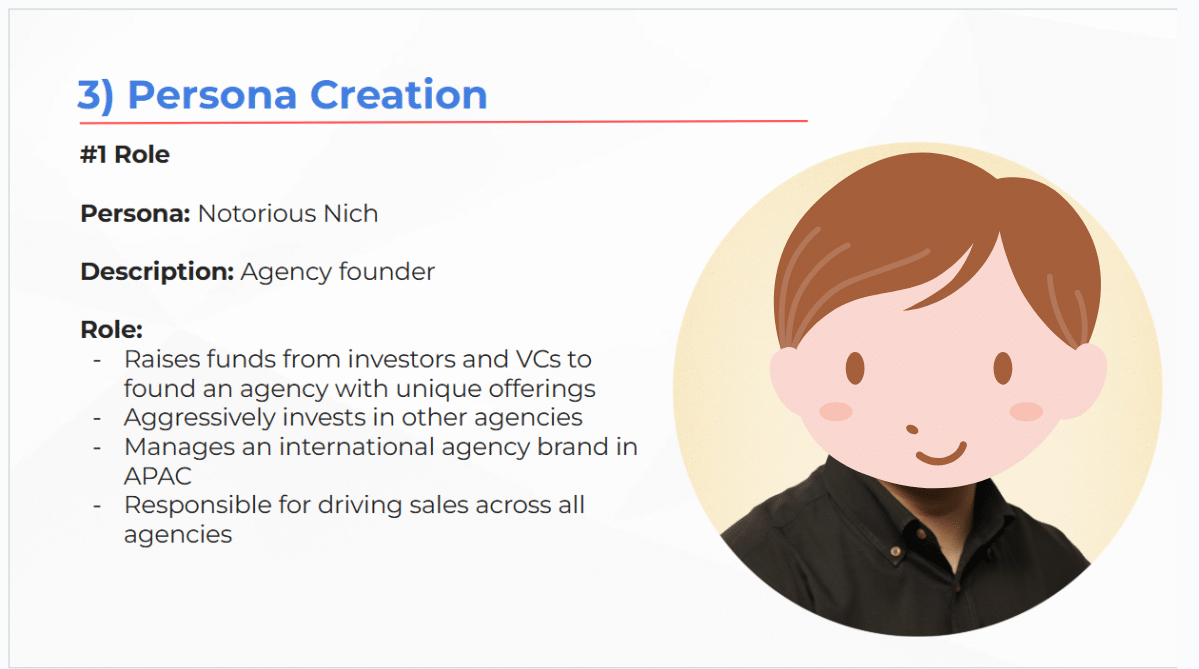
In a training I gave to the SEO team during my time as an SEO Team Lead at First Page Singapore, I came up with “Notorious Nich,” an agency founder with a unique set of goals, roles, and worries:
| Roles | Goals | Worries |
|---|---|---|
| Raises funds from investors and VCs to found an agency with unique offerings | Go public | Can’t hit criteria to go public |
| Aggressively invests in other agencies | Set up at least 5 agencies in every continent | Cannot manage international teams due to cultural differences |
| Manages an international agency brand in APAC | Connect all agencies by forming the first international agency group | Can’t spend time with wife and kids as a serial entrepreneur |
| Responsible for driving sales across all agencies | Make more money | |
| Increase YoY revenue | ||
| Spend more time with wife and children |
Based on these, I validated them using keyword research tools and reverse engineered them to come up with potential topics:
| Persona quality | Query | Keyword validation |
|---|---|---|
| (Role) Raises funds from investors and VCs to found an agency with unique offerings | how to raise funds from vcs how to raise capital for your business how to raise funds from investors |
venture capital fundraising (80) how to raise money for a business (600) how to find investors for a business (800) |
| (role) Aggressively invests in other agencies | how to choose the right agencies to invest in | what are good companies to invest in (10) what company should i invest in (50) |
| (goals) Go public | what do i need to do to get my company publicly listed | how does a company go public (400) listing your company (20) |
And within each article, you can raise awareness of how your business’s offerings can help Notorious Nich address his pain points.
Essentially, you are mapping the pain points to what your product or service does.
Let’s try a few examples together!
Grindr
Grindr is a popular, location-based social networking and dating app primarily for gay, bisexual, trans, and queer (LGBTQ+) individuals, using your phone’s GPS to show profiles of users nearby in a grid for quick connections, chats, and meetups.
So I mapped it out:
- Target user: Queer person looking to meet other queer people
- Job to be done: Meet more queer people
- Pain point: Finding new queer people to make friends with via conventional means is not as easy as you can’t always tell who’s queer and who’s not
- Keywords (search volume in brackets): meet lgbt friends online (100), lgbt online community (10), lgbtq events near me (350), lgbtq activities near me (70)
Stashway
StashAway is a robo-advisor platform that provides automated, personalized investment and wealth management for individuals.
So here’s what I mapped it out:
- Target user: The average Singaporean who just wants to combat inflation and make passive income for their future
- Job to be done: Have $100,000 in savings by 26
- Pain point: Not sure how one can achieve $100,000 in savings by 26
- Keywords (search volume in brackets): how to save 100k in 3 years (90), how to save 100k in 2 years (80), 100k by 30 (10)
The Tools I Actually Use
Ahrefs
This is my go-to. Not because it’s perfect, but because the keyword difficulty scores are fairly accurate for B2B, and the “Parent Topic” feature saves me from keyword cannibalization.
I use it to find the main keyword I should target, not 50 variations of the same thing.
Semrush
Semrush has a more powerful keyword filtering feature in my opinion.
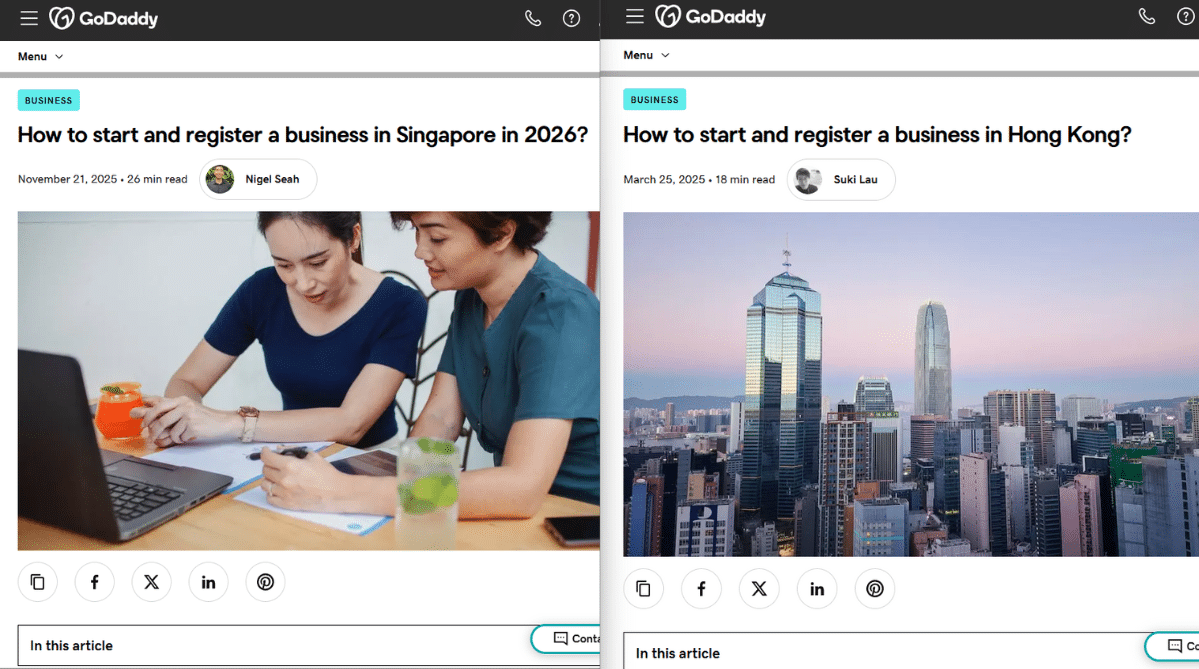
When GoDaddy asked me to create localised content for a series of “how to register a business” articles, Semrush’s keyword filter was a life saver.
All I needed to do was to add the names of the different target markets into the filter and I immediately see if there is search potential for the various topics.
GoDaddy ended up creating multiple localised articles because of this.
Google Search Console
This tool is criminally underused.
I check it routinely to see if there is any long-tail keyword in the database that we have yet to create dedicated content for. Typically, these are zero-click queries but driving some impressions to your site.
What I don’t use
Most of the AI keyword research tools. They spit out hundreds of keywords, but they can’t tell you which ones actually align with your ICP or where they fit in your funnel. You still need human judgment.
Furthermore, without being integrated with Google themselves, these tools don’t actually have access to any form of keyword data.
The 6-Step Process I Follow Every Single Time
Step 1: Start with Customer Conversations, Not Tools
Before I open Ahrefs, I spend a week gathering intel.
I’d ask members of the sales and account management teams “What questions do prospects ask before they buy or renew?”
And based on the answers collected, I validated these topics using keyword tools and basically repeat the steps I already outlined in the earlier sections.
Step 2: Build Your Seed Keyword List
Take everything you learned from step 1 and turn it into seed keywords. These don’t need to be perfect because they’re just starting points.
I usually end up with 30-50 seed keywords across different funnel stages and personas. For a project management tool, that might look like:
- “Why do projects fail” (TOFU)
- “Project management methodology comparison” (MOFU)
- “Asana vs Monday” (BOFU)
Don’t overthink this part. You’re going to expand these massively in the next step.
Step 3: Use Keyword Research Tools to Expand
Now I plug those seed keywords into Ahrefs and look at three reports:
- Matching terms – shows all variations with search volume
- Questions – isolates question-based queries
- Also rank for – shows what pages ranking for your seed keyword also rank for (this is gold)
One trick I learned at Novocall: Sort by traffic potential, not search volume. A keyword with 50 searches per month might drive 500 visits if the ranking article also ranks for 30 other long-tail variants.
Step 4: Map Keywords to Funnel Stages and Personas
This is where most teams give up because it’s tedious, but it’s literally the most important step. I open a spreadsheet and tag every keyword with:
- Funnel stage (TOFU/MOFU/BOFU)
- Primary persona
- Search intent (informational/navigational/commercial/transactional)
- Priority (high/medium/low based on business value, not just volume)
Step 5: Validate with Search Intent Analysis
Here’s where I catch bad keywords before we waste time creating content. For every high-priority keyword, I Google it and look at the top 5 results.
What format are they? If you’re planning a blog post but the top 10 results are all landing pages, you’re not going to rank. Google has already decided what searchers want for that query.
Step 6: Prioritize Based on Business Impact, Not Just SEO
This is the step that separates good keyword research from great keyword research. I score every keyword on three factors:
- Ranking difficulty (can we realistically rank top 5?)
- Business value (will this traffic convert to pipeline?)
- Resource cost (how much effort to create this content?)
The best opportunities are where all three align: relatively easy to rank, high business value, reasonable effort. Those are your quick wins.
The Mistakes That Cost Me Months of Work
Targeting Keywords Your Product Can’t Support
Don’t ever try ranking for keywords like “free B2B contact database” just because it has a larger number of ,200 searches per month.
If your company doesn’t have a free product, just don’t bother. Every page visitor will bounce.
Creating Content for Keywords Your Domain Can’t Rank For Yet
When your domain authority is 30, you’re not ranking for “CRM software” (KD 75). Just… you’re not. I wasted months trying to rank for hero keywords before accepting we needed to build authority first.
Start with low competition keywords. Win those. Build links. Then move up to harder keywords. The companies ranking for the big terms have 1,000+ referring domains and five-year head starts.
That said, if your team has the time and capacity, creating content targeting competitive keywords for topics in your niche isn’t necessarily a bad idea. This helps build topical authority
Not Updating Your Keyword Research as Your Product Evolves
At Workstream, we launched a texting feature that completely changed our value prop. But I kept targeting our old keywords around “applicant tracking systems” for three months.
Meanwhile, our competitors started ranking for “text to apply” and “SMS recruitment” while we were nowhere.
By the time I updated our keyword strategy, they had six-month head starts and we had to fight twice as hard to catch up.
Set a calendar reminder to review your keyword strategy every quarter. Products change, markets shift, and competitors move. Your keywords need to keep up.
Measuring Whether Your Keywords Actually Work
Track Pipeline, Not Just Traffic
In GSC, you can see impressions and clicks. Cool.
In GA4, you can see sessions and engagement. Also cool. But none of that matters if you can’t connect it to revenue.
I set up a simple tracking system:
- Track form fills by source page in HubSpot
- Add “How did you hear about us?” to demo request forms
- Ask sales to note when leads mention specific content
At Cognism, we discovered that our “B2B contact data accuracy” article (90 searches/month) generated more pipeline than our “sales intelligence tools” article (1,200 searches/month). The low-volume keyword targeted people further down the funnel who were actually evaluating vendors.
Set Realistic Timeframes for B2B SEO
If you’re in B2B SaaS or tech, you need to reset expectations on timing. Consumer sites can rank in 2-3 months. B2B? It takes 6-9 months minimum to see meaningful results.
At Workstream, I had to show my CEO this timeline:
- Months 1-3: Research, content creation, getting pages indexed
- Months 4-6: Rankings start appearing (positions 10-30)
- Months 7-9: Rankings improve (positions 5-15)
- Months 10+: Sustained top rankings and traffic growth
Anyone promising B2B SEO results in 90 days is either lying or targeting keywords so easy they’re not worth ranking for.
Watch for Keyword Cannibalization
This bit me at GoDaddy when I created three separate articles all targeting variations of “dedicated hosting.” Google couldn’t figure out which one to rank, so they all sat on page 2.
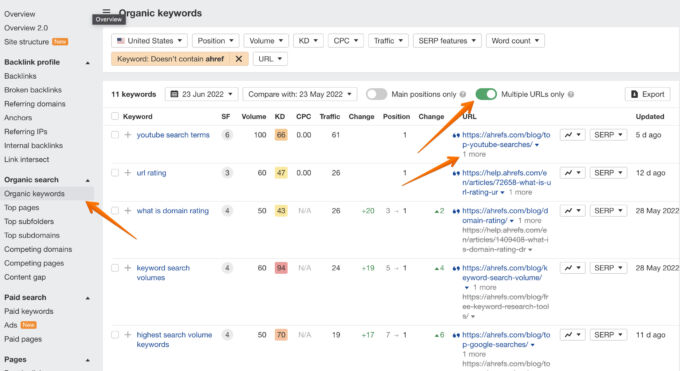
Here’s how you use it:
- Plug your domain into Site Explorer.
- Open the Organic keywords report from the left-hand menu.
- Enable the Multiple URLs only toggle in the report.
Use Ahrefs’ Site Audit to check for cannibalization issues. If you see multiple pages ranking for the same keyword, you need to either:
- Consolidate them into one comprehensive piece
- Clearly differentiate the search intent each targets
- 301 redirect the weaker pages to the stronger one
I went with option 1 and combined three mediocre-ranking articles into one monster guide. Within six weeks, we jumped from position 15 to position 3.
Stop Overthinking It, Here’s What Works for B2B SEO clients
Keyword research for B2B SEO isn’t rocket science, but you can’t do it halfway. The companies winning in search understand their buyers, map keywords to real business problems, and track what actually drives revenue.
My biggest lesson after five years in B2B tech? Start with customers, not keyword tools. The best keyword ideas come from sales calls and customer interviews. Tools like Ahrefs help you validate and expand, but they can’t replace real customer insight.
If you’re a B2B company in Singapore and want SEO that drives pipeline, not vanity traffic, First Page Digital can help.
Sign up for a FREE digital strategy call worth $2,000 today!