Every SEO I know has had this argument at least once: Ahrefs or Semrush?
I’ve used both extensively for keyword research across clients’ campaigns in finance, B2B, and legal niches. And honestly, the answer isn’t as straightforward as most comparison articles make it out to be.
How each tool handles keyword clustering, keyword difficulty, and search volume is different enough that picking the wrong one costs you real time and money.
This article breaks down how Ahrefs for keyword research stacks up against Semrush across every major feature category.
By the end, you’ll know exactly which tool fits your workflow and why.
Semrush vs Ahrefs at a Glance
|
Feature |
Ahrefs |
Semrush |
| Keyword Database Size | 28.7B keywords | 27.3B keywords |
| Locations Covered | 217 | 142 |
| US-Specific Keywords | 2.2B | 3.7B |
| Backlink Database | 35T live backlinks | 43T (live + historical) |
| Referring Domains | 500M | 390M |
| Starting Price | $129/mo (Lite) | $139.95/mo (Pro) |
| Free Trial | No | 7 days |
| Users Included | 1 (+ $40–80/mo extra) | 1 (+ $45–100/mo extra) |
| Verified Projects | Unlimited | Limited by plan |
| Keyword Difficulty Method | Backlink-based (transparent) | Algorithmic + PKD% (domain-specific) |
| Traffic Potential Metric | ✓ | ✗ |
| Personal Keyword Difficulty (PKD%) | ✗ | ✓ |
| Clicks & CTR Data | ✓ | ✗ |
| Search Intent Labels | Available (less prominent) | On every keyword by default |
| Keyword Clustering | Manual via Parent Topic | Auto-clustering built in |
| Long-Tail Discovery | Traffic Potential + Parent Topic | Keyword Magic Tool |
| SERP Feature Tracking | Per keyword + Clicks metric | Filterable by feature type |
| Toxic Link Detection | ✗ | ✓ |
| Built-in Outreach Workflow | ✗ | ✓ (Link Building Tool) |
| AI / Brand Visibility Tracking | Brand Radar | AI Visibility Toolkit |
| Prompt Research (AI Keywords) | ✗ | ✓ |
| Best For | SEO specialists, multi-domain agencies | Full marketing teams (SEO + PPC + content) |
Keyword Database Size
Ahrefs
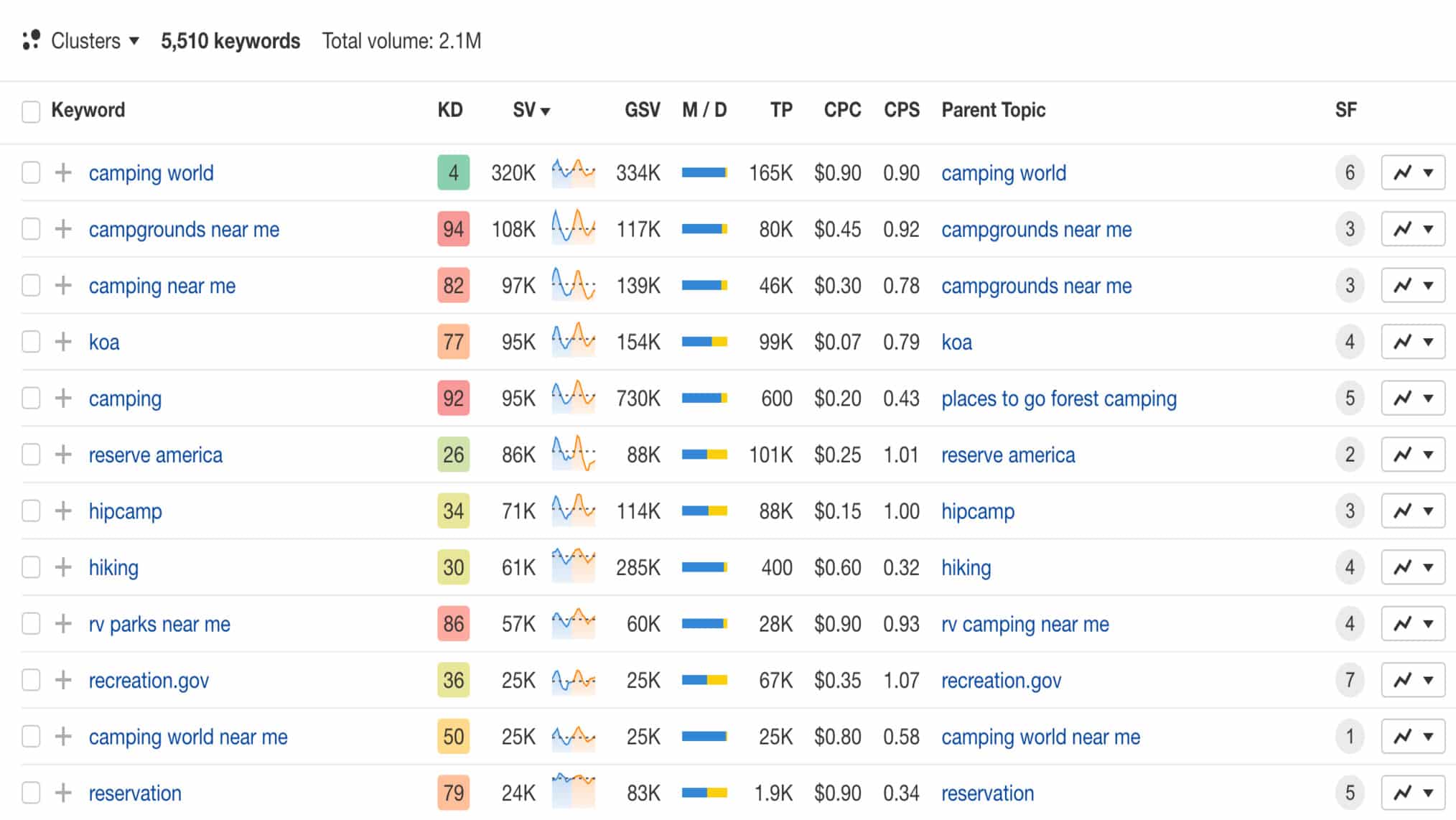
Ahrefs Keyword Explorer
Source: Ahrefs
Ahrefs sits at 28.7 billion keywords across 217 locations, the larger global footprint of the two.
If your clients operate outside the US, that extra coverage makes a meaningful difference.
I’ve run campaigns targeting Southeast Asian markets where Ahrefs surfaced keyword data that Semrush simply didn’t have, particularly in markets like the Philippines, Indonesia, and Vietnam.
More locations mean more accurate local search volume estimates for non-English keywords, which is exactly where a lot of international SEO campaigns live or die.
For anyone doing keyword research across multiple languages and regions, Ahrefs’ global reach is a genuine workflow advantage.
Semrush
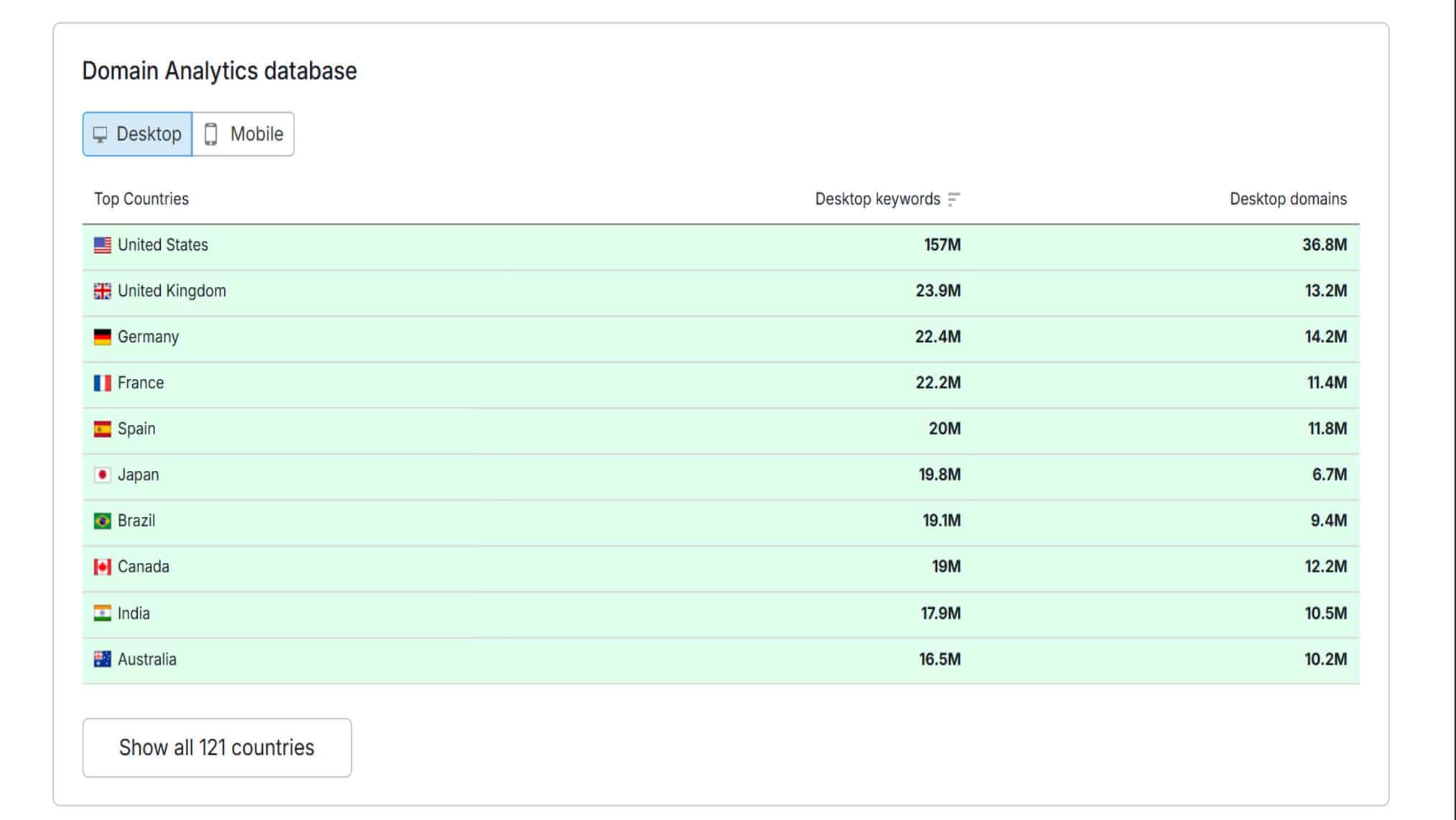
Semrush Domain Analytics database
Source: SEMrush
Semrush covers 142 locations and 27.9 billion total keywords, but here’s the thing: for US-focused campaigns, Semrush actually pulls ahead.
It holds 3.7 billion US-specific keywords compared to Ahrefs’ 2.5 billion. That’s a significant depth difference when you’re doing granular keyword research for a domestic client.
I’ve noticed this in practice. Running the same seed term through both tools, Semrush consistently surfaces more US long-tail variations and niche keyword ideas.
This happens especially in competitive verticals like finance, legal, and healthcare. For pure US market research, Semrush’s national depth is genuinely better.
Winner
Split verdict. Ahrefs wins for international and global keyword research. Semrush wins for US-specific depth.
If your campaigns are primarily domestic, Semrush is the stronger pick. If you’re managing clients across multiple regions, Ahrefs covers far more ground.
Short-Tail vs Long-Tail Keyword Variety
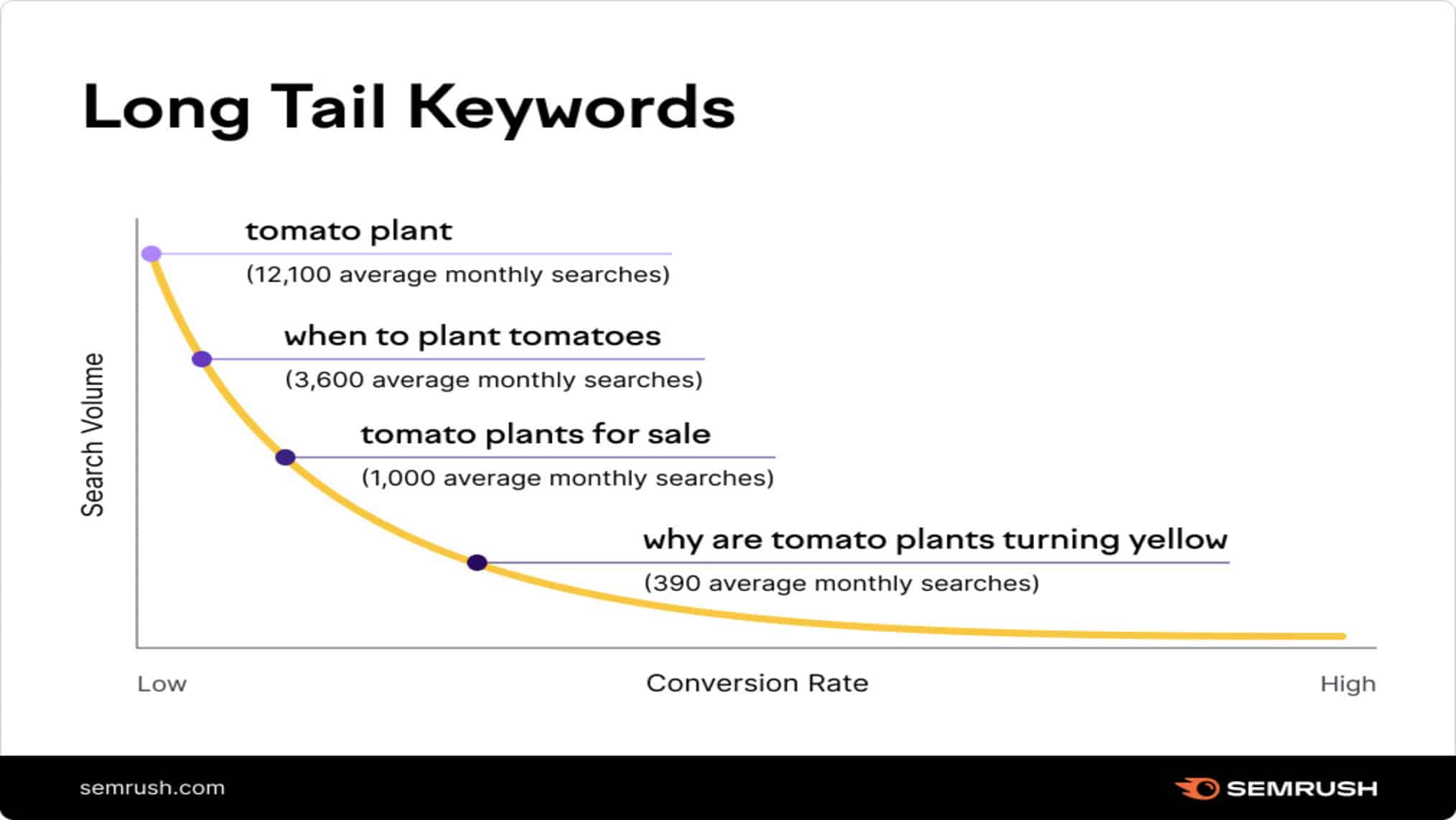
Source: Semrush
Ahrefs
Ahrefs’ Keywords Explorer surfaces both short and long-tail variations from a single seed term without much fuss.
What really stands out is the Traffic Potential metric, which estimates the total organic traffic the top-ranking page earns across all the keywords it ranks for, not just the one you searched.
That’s a much more realistic picture of what you’re actually competing for when targeting a long-tail keyword.
The Parent Topic feature ties long-tail keywords back to a broader content cluster.
It’s useful when you’re trying to figure out whether a keyword deserves its own page or should fold into something you’ve already written.
It takes more manual input to build full clusters, but for SEOs who prefer control over automation, that tradeoff is worth it.
Semrush
Semrush’s Keyword Magic Tool is very fast at long-tail discovery.
Drop in a seed keyword and it auto-generates topic clusters around it instantly, skipping the manual grouping step that Ahrefs still asks of you.
For content teams producing at scale, that speed is real money.
The search intent filter attached to every keyword, covering informational, commercial, transactional, and navigational, is one of Semrush’s more practical features.
Being able to filter by intent while browsing long-tail ideas means you can organize content calendars by funnel stage without building a separate spreadsheet.
It also tends to surface keyword angles I hadn’t considered, especially in niche verticals where search behavior is less predictable.
Winner
Semrush wins for long-tail discovery speed and clustering. Ahrefs wins for assessing the actual traffic opportunity behind a long-tail keyword. What you reach for depends on whether you’re in planning mode or evaluation mode.
Variety of Keyword Metrics
Ahrefs

Source: Ahrefs
Ahrefs keeps its metric set lean but well-chosen.
Traffic Potential shows you the ceiling of what a page can earn across all its ranking keywords, not just the one you’re targeting.
The Clicks and CTR metrics are particularly useful right now because they show how many searches actually result in an organic click.
That’s actually the most practical way I’ve found to identify keywords getting suppressed by AI Overviews or featured snippets.
Return Rate, which tracks how often the same user searches a keyword again, helps flag whether a keyword reflects genuine research behavior or a one-time lookup.
Parent Topic rounds it out by giving you a way to map keywords to content clusters without building that structure manually from scratch.
The interface feels clean because Ahrefs doesn’t pad it with metrics of questionable value.
Semrush

Source: Semrush
Semrush Personal Keyword Difficulty (PKD%) is the metric that gets underrated in most comparisons.
Rather than a universal difficulty score, it’s calibrated to your specific domain’s authority.
So it tells you which keywords you can realistically compete for right now based on where your site actually sits.
Combined with the search intent label on every keyword, the Topical Authority score, local keyword metrics by city, SERP ad count, and built-in clustering, Semrush gives you a wider dashboard to work from.
More metrics doesn’t automatically mean better decisions, but for teams running multi-channel campaigns or reporting to clients who want comprehensive data, the breadth is useful.
Winner
Ahrefs wins on metric quality, especially Traffic Potential and Clicks for identifying zero-click risk. Semrush wins on metric variety. If you want depth on fewer data points, go Ahrefs. If you want a wider view of a keyword’s competitive landscape, Semrush gives you more to work with.
Keyword Clustering and Grouping
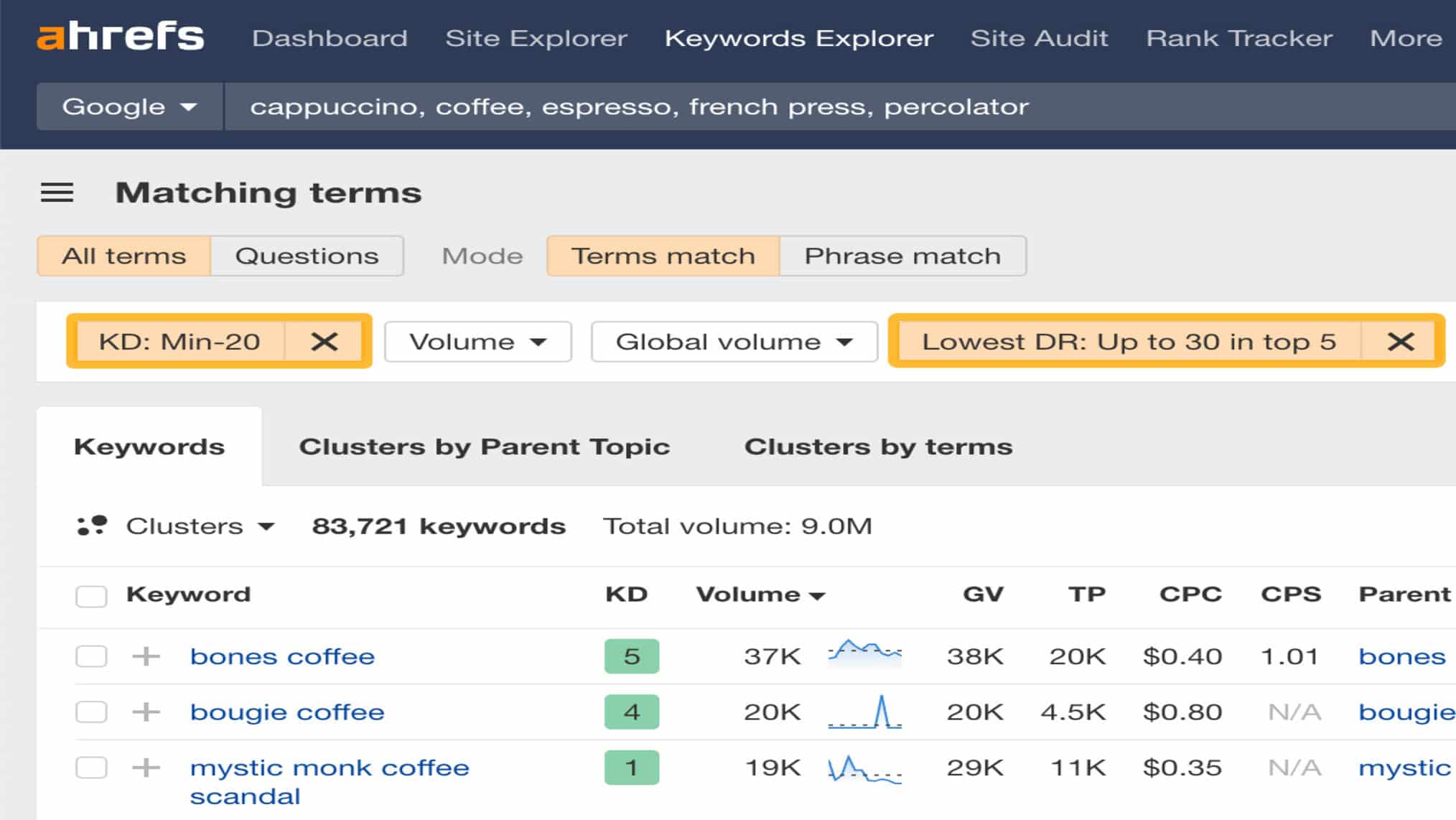
Source: Ahrefs
Ahrefs
Ahrefs uses Parent Topic to identify the broader topic a keyword belongs to, which gives you a structural starting point for content planning.
Clustering is available inside Keywords Explorer, but building full content clusters still requires a fair amount of manual input.
It’s not a dealbreaker, but it does mean you’re doing more of the organizational thinking yourself.
For SEOs who prefer to define their own cluster logic rather than rely on an algorithm to group things, that control is actually a feature. It just takes longer.
Semrush
Keyword Magic Tool auto-clusters related keywords around a seed term the moment you run a search. No extra steps, no manual sorting.
For content teams building out topic maps from scratch, the time savings are significant, and the clusters it produces are solid enough that I rarely have to restructure them much.
When a client needs a full content plan in a short turnaround, Semrush is the tool I reach for because I can go from seed term to organized cluster map in a fraction of the time.
Winner
Semrush. Auto-clustering is a genuine workflow advantage, especially for content-heavy teams. Ahrefs is the better call for anyone who wants to build cluster logic themselves and values that control.
Search Intent Classification
Source: Semrush
Ahrefs
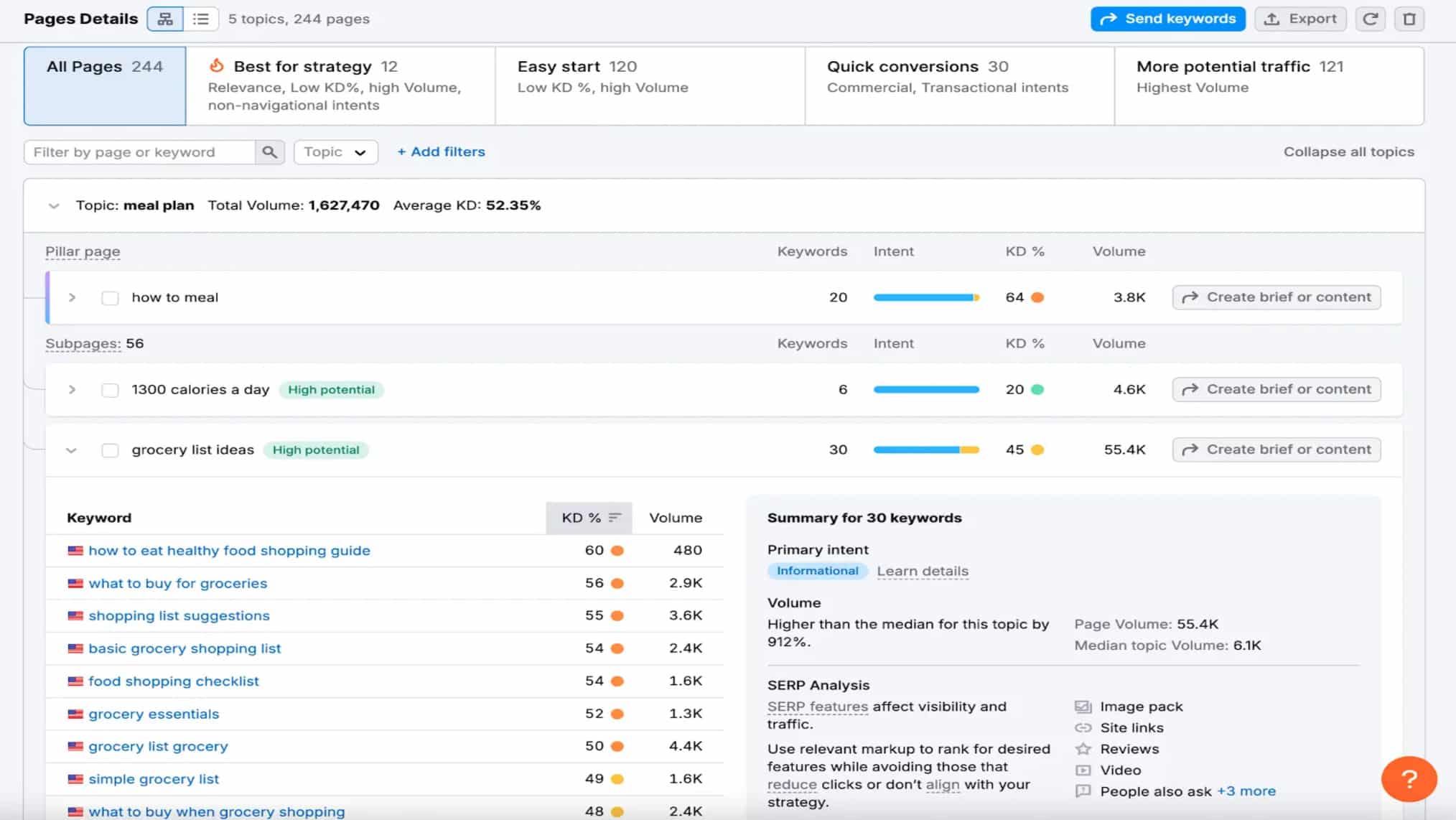
Ahrefs shows intent labels covering informational, commercial, transactional, and navigational, and includes an “Identify Intents” button inside Keywords Explorer.
It works, but the intent data is less prominent in the default view. You have to actively look for it rather than having it surface naturally as you browse keywords.
That’s a minor friction point, but it adds up when you’re working through a large list and trying to sort keywords by content type quickly.
Semrush
Semrush attaches an intent label to every keyword by default, across all reports.
It’s filterable directly inside Keyword Magic Tool, so isolating all commercial keywords from a list of 2,000 takes about two clicks.
That kind of immediate filter changes how fast you can segment a keyword list for a content strategy.
Winner
Neither tool has a clear edge here functionality-wise. Both classify by the same four intent types and both do it accurately enough for practical use.
The difference is purely UX: Semrush surfaces intent data more visibly by default. If intent filtering is central to your workflow, Semrush makes it marginally faster.
SERP Feature Tracking
Source: Semrush
Ahrefs
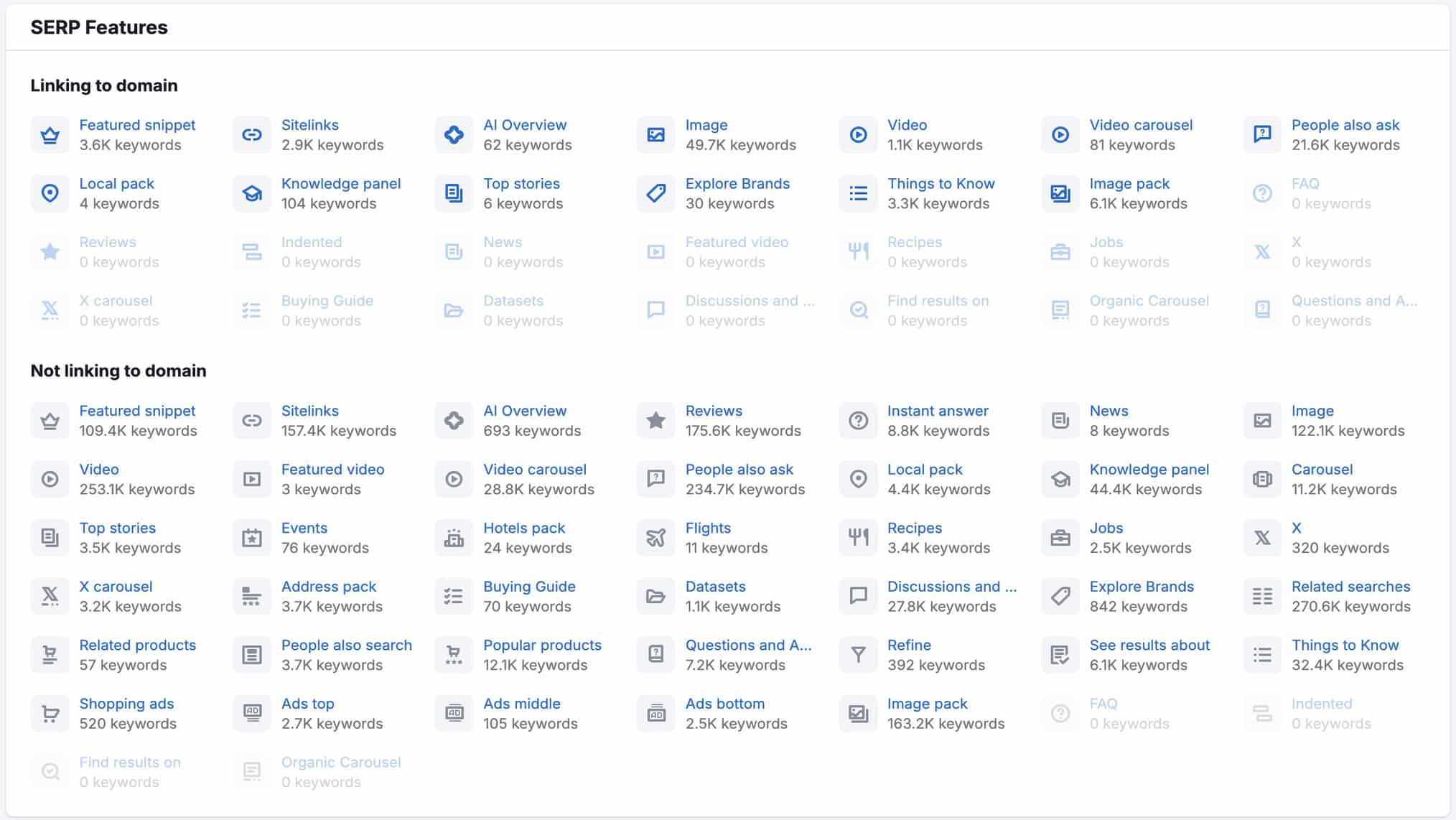
Ahrefs shows SERP features per keyword inside Keywords Explorer.
So you can see at a glance whether a keyword triggers a featured snippet, image pack, or video carousel.
But the more actionable insight comes from the Clicks metric.
If a keyword has high search volume but low clicks, that’s your signal that an AI Overview or featured snippet is eating the organic traffic before anyone reaches the results.
That’s useful data for prioritizing which keywords are worth chasing.
Semrush
Semrush tracks a broader range of SERP features including featured snippets, People Also Ask boxes, image packs, video results, and AI Overviews, all filterable by feature type.
Being able to filter for keywords where a specific feature appears, or doesn’t, is practical for building zero-click risk assessments or identifying feature ownership opportunities at scale.
Winner
Semrush wins on the breadth of SERP feature filters and the ability to target or avoid specific feature types at scale.
Ahrefs’ Clicks metric is more directly actionable for identifying zero-click risk on a keyword-by-keyword basis.
So, use Ahrefs to flag the problem. Use Semrush to filter and prioritize at volume.
Keyword Difficulty Method
Source: Ahrefs
Ahrefs
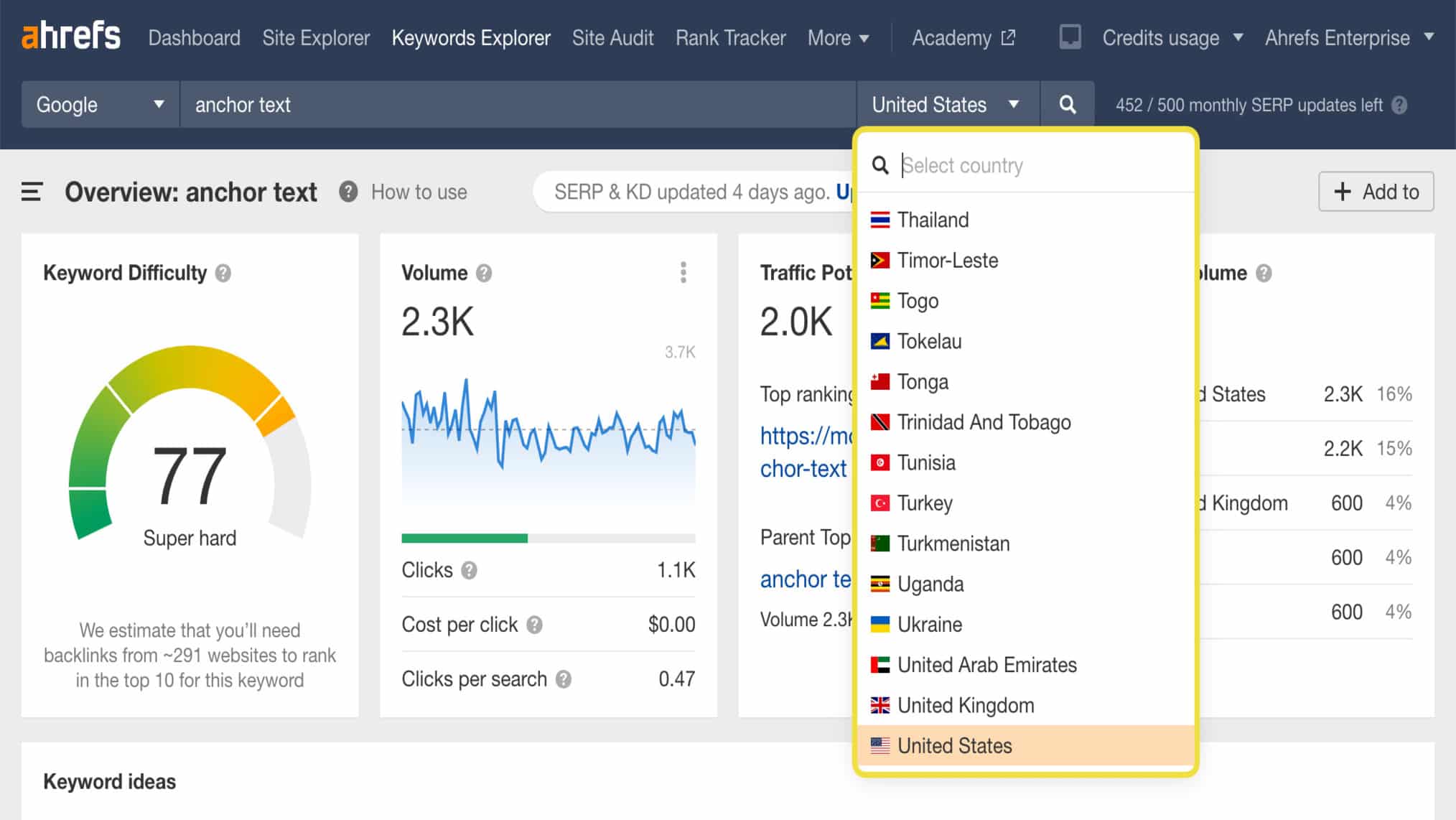
Ahrefs calculates keyword difficulty from the average number of referring domains pointing to the top-10 ranking pages.
It’s a transparent, backlink-based formula and widely regarded as the most reliable KD methodology in the industry.
Because the underlying data comes from one of the world’s most active web crawlers, the score reflects something real rather than a black-box algorithm estimate.
After five years of using both tools, Ahrefs’ KD scores have consistently been the ones I trust most when making the case to a client about whether a keyword is actually winnable.
Semrush
Semrush’s standard KD uses a broader algorithmic formula that factors in more than just backlinks.
That makes it harder to interrogate but the PKD% metric is where Semrush pulls ahead of itself.
Personal Keyword Difficulty is calibrated to your specific domain’s authority, so instead of a universal score, you get a score that reflects your actual competitive position.
That’s more useful for tactical keyword selection, especially for newer domains that would be discouraged by a universal KD score of 70.
Winner
Split. Ahrefs for universal KD reliability and transparency. Semrush’s PKD% for domain-specific targeting and realistic prioritization. Ideally, you’d run both.
Accuracy of Keyword Metrics
Source: Ahrefs
Ahrefs
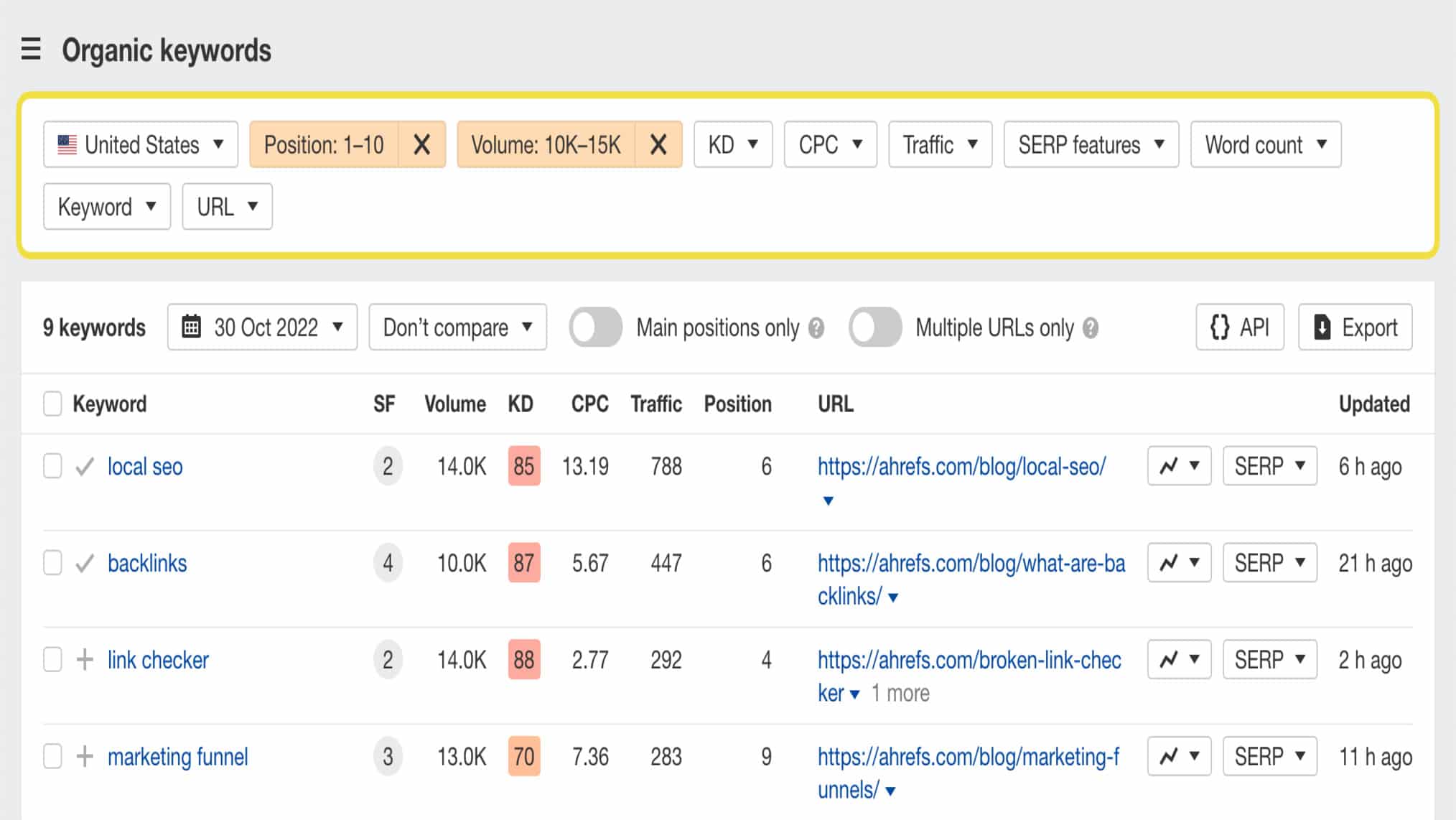
Ahrefs pulls data through AhrefsBot, one of the most active web crawlers operating right now, combined with clickstream data.
The KD score is backlink-based and calculated from referring domain averages of top-10 ranking pages, which makes it the most auditable difficulty methodology available.
Traffic Potential tends to be more reliable than raw search volume because it captures what a page actually earns across all its ranking keywords.
New backlinks also get discovered faster through Ahrefs than Semrush, which matters when you’re monitoring a competitor’s link building in near real time.
Semrush
Semrush uses machine learning and third-party clickstream data, and based on several 2025 and 2026 studies, it has a slight edge on US-specific search volume accuracy.
PKD% is a useful addition for domain-specific targeting.
Where Semrush occasionally falls short is on lower-volume keywords, where some users report less consistent accuracy, particularly outside the US.
Winner
Ahrefs wins on KD accuracy and Traffic Potential reliability. Semrush wins on US search volume accuracy. Worth saying clearly: neither tool pulls data directly from Google.
Always cross-reference anything important with Google Search Console before making a final call.
Backlink Analysis Features
Ahrefs

Source: Ahrefs
Ahrefs has 35 trillion live backlinks across 500 million referring domains, and Site Explorer remains the benchmark tool for backlink research in this industry.
- Link Intersect: Identifies sites linking to your competitors but not to you.
- The Broken Backlink: Report surfaces quick-win reclamation opportunities.
- AhrefsBot: Catches new links faster than any competitor crawler, which is relevant when you’re doing active link monitoring for a client.
Batch analysis handles up to 200 URLs at once, and because KD scoring is powered directly by the backlink data, stronger backlink analysis translates into more reliable keyword difficulty scores across the board.
Semrush

Source: Semrush
Semrush claims 43 trillion backlinks but fewer unique referring domains than Ahrefs at 390 million.
The Toxic Score automatically flags potentially harmful backlinks, which Ahrefs doesn’t offer.
The bigger operational difference is the Link Building Tool, which includes a built-in outreach workflow with email templates and response tracking.
That’s something Ahrefs doesn’t have natively, and for teams managing link building campaigns alongside keyword research, it’s a meaningful time saver.
Winner
Ahrefs wins on pure backlink analysis depth and data freshness. Semrush wins on integrated outreach and link auditing workflow.
For keyword research specifically, Ahrefs’ backlink-powered KD scoring gives it a direct edge on the metric that matters most.
Pricing
Ahrefs
Source: Ahrefs
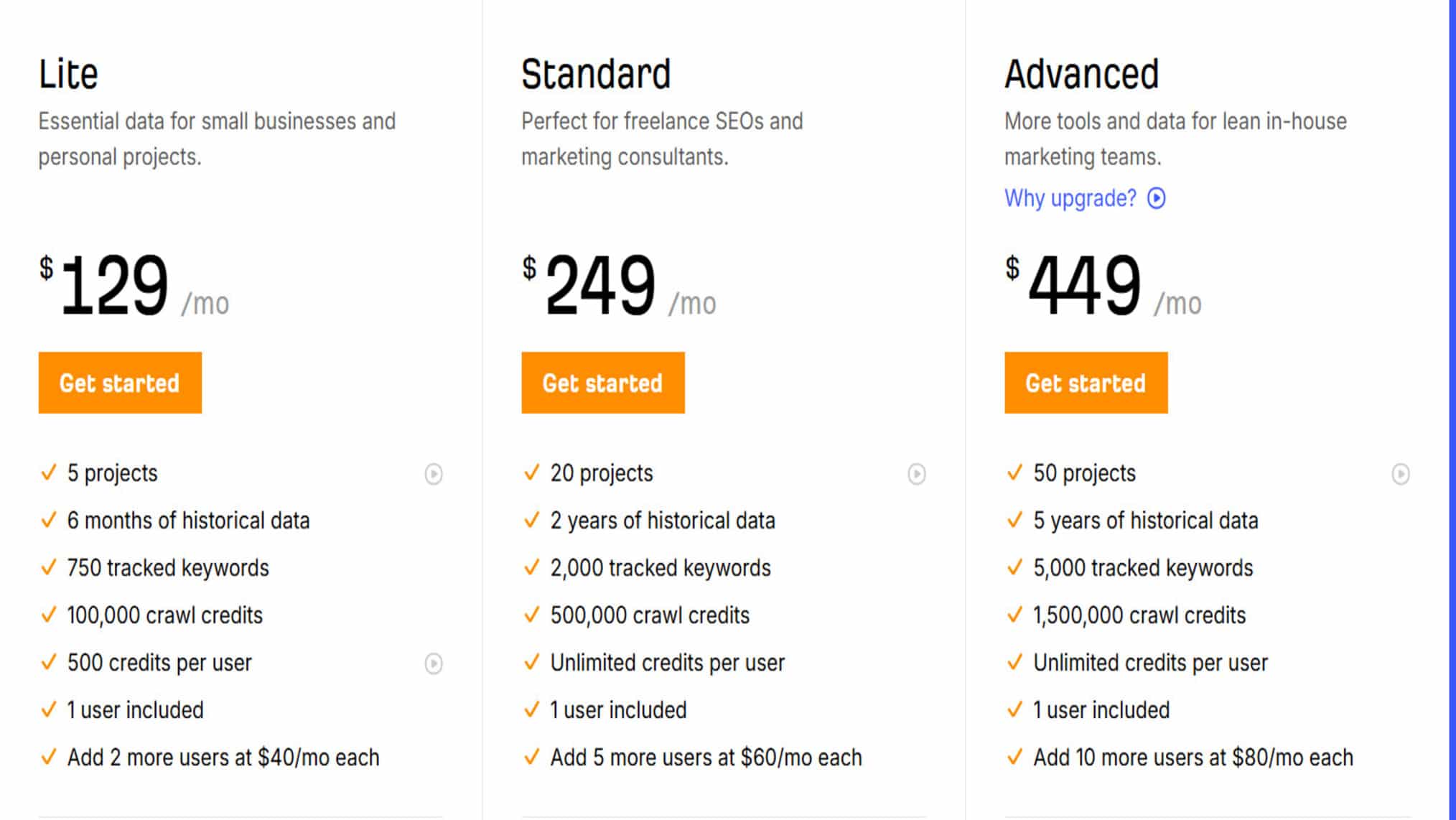
Ahrefs starts at $129/month for the Lite plan, with no free trial.
The credit system on lower plans can become limiting fast if you’re managing multiple clients, since every keyword lookup and audit eats into your monthly allocation.
That said, unlimited verified projects on all paid plans is a genuine value-add for agencies.
You can add multiple domains without hitting a project ceiling, which matters more than it sounds once you’re managing 10+ client sites.
Semrush
Source: Semrush
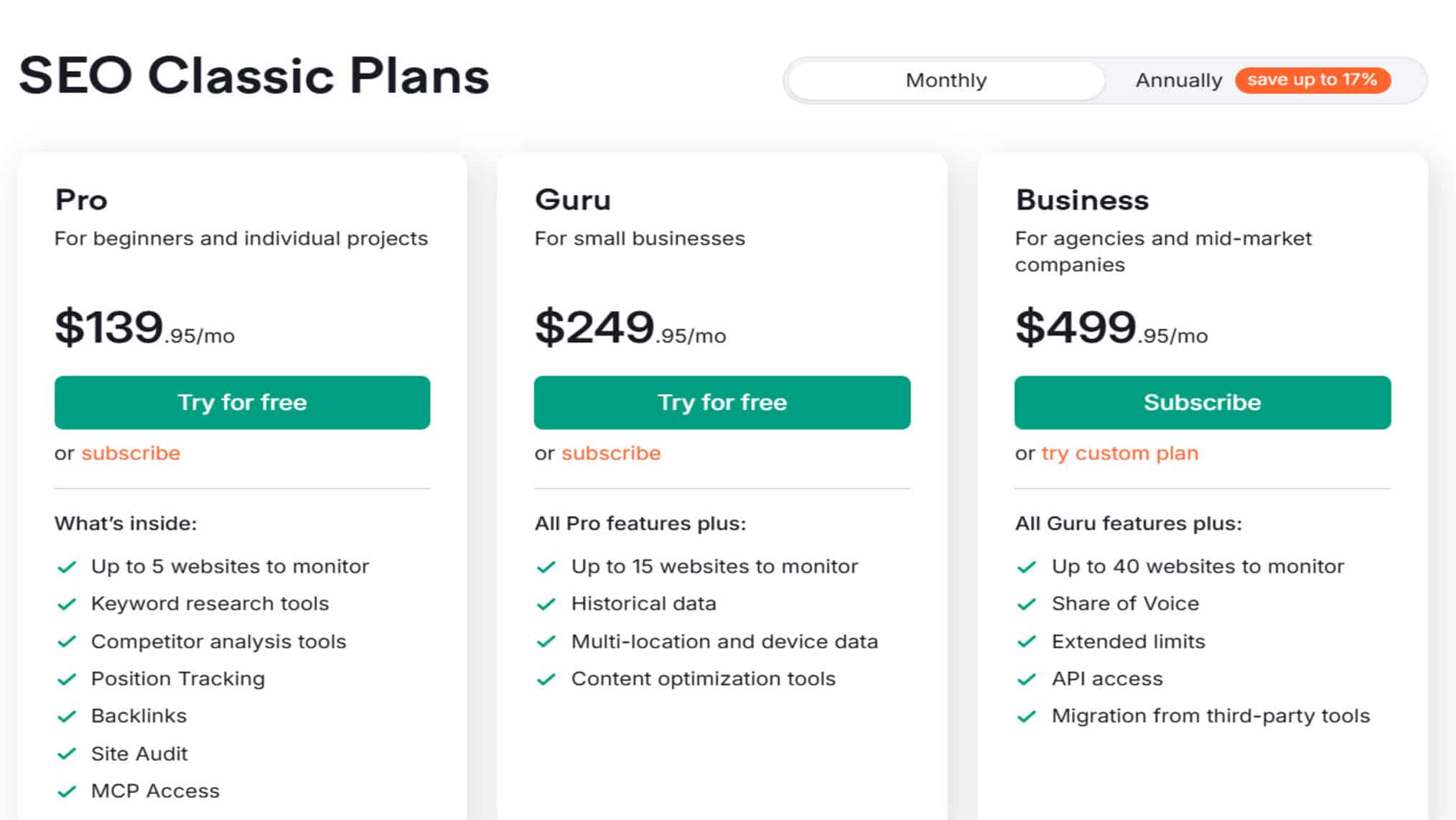
Semrush starts at $139.95/month for the Pro plan and includes a 7-day free trial, which at least lets you pressure-test the tool before committing.
One user per plan is the default, and additional users cost between $45 and $100 per month, depending on the plan tier, which adds up quickly for larger teams.
The value proposition is strongest for teams running SEO alongside content strategy, PPC, and reporting, where Semrush’s broader toolkit justifies the all-in cost.
For pure SEO specialists managing multiple domains, Ahrefs tends to offer better value per dollar.
AI Overviews, GEO, and Keyword Research in 2026

Source: Ahrefs
Ahrefs
Ahrefs connects GEO directly to keyword research through the Clicks metric in Keywords Explorer.
Low clicks on a high-volume keyword is your clearest signal that an AI Overview is eating the traffic before users ever reach the results.
Brand Radar extends this further by tracking how often your brand gets cited across ChatGPT, Google AI Overviews, Gemini, Copilot, and Perplexity.
Brand Radar covers 271 million prompts, a larger database than Semrush’s 213 million.
It shows monthly volume, impressions, and AI share of voice so you can see whether your content is being pulled into AI responses or bypassed completely.
The AI Content Helper analyzes top-ranking pages, detects search intent, and surfaces topical gaps, which is increasingly where AI citation opportunities are hiding.
For anyone doing GEO work alongside keyword research, having both signals in the same tool is a genuine time saver.
Semrush
Semrush’s AI Visibility Toolkit tracks brand mentions, citation sources, sentiment, and share of voice across ChatGPT, Google AI Overviews, AI Mode, and Perplexity.
The Prompt Research feature is the most practical piece for keyword researchers:
- It works like keyword research for AI search
- It shows what questions users are actually asking AI platforms in your niche
- Topic-level volume and intent data attached.
The Competitor Research report shows which prompts your competitors are being cited for while you’re absent. That gap becomes a content plan in a flash.
Semrush also flags which keywords in your tracked list are triggering AI Overviews, which is useful before you commit resources to targeting a term that AI is already answering above the fold.
Semrush vs Ahrefs: Which Should You Choose?
My honest verdict is this: there’s no universally better tool. Ahrefs wins on keyword difficulty reliability, Traffic Potential, backlink depth, and global keyword coverage.
Semrush wins on US search volume accuracy, long-tail clustering speed, intent filtering, and broader marketing functionality.
That said, knowing which tool to use is only half the battle.
Getting keyword research right, building a content strategy around it, and actually moving rankings takes a level of expertise that goes beyond any software subscription.
That’s where First Page Digital comes in. As Singapore’s leading digital marketing agency, First Page has helped hundreds of businesses with this. So, if you’re ready to stop guessing and start ranking, get in touch with First Page Digital today for a FREE strategy call worth $2000 today.
Frequently Asked Questions
1. What is the most accurate keyword research tool?
Ahrefs has the edge on keyword difficulty accuracy thanks to its backlink-based KD formula and Traffic Potential metric. Semrush holds a slight advantage on US-specific search volume accuracy. Either way, cross-referencing with Google Search Console before making final content decisions is always worth it.
2. Is Ahrefs a good SEO tool?
Yes, and for keyword research and backlink analysis specifically, it’s one of the best available. The Clicks metric, Traffic Potential, and backlink database are all ahead of what most tools offer.
3. Which is best, Ahrefs or Semrush?
There’s no clear answer because they’re built for different things. Ahrefs suits SEO specialists who want deep keyword and backlink data. Semrush is the better fit for teams running SEO alongside content strategy, PPC, and reporting. The right call depends entirely on your workflow and what you actually need day to day.
4. Which is better for keyword research and backlink analysis, Semrush or Ahrefs?
For keyword research, it splits by market: Ahrefs for global campaigns and traffic potential assessment, Semrush for US-specific depth and long-tail clustering speed. For backlink analysis, Ahrefs wins on data freshness and KD reliability. Semrush is the stronger choice if outreach workflows and toxic link flagging are part of what you need from the same tool.