If your rank tracker shows a drop that Google Search Console doesn’t, I wouldn’t believe the tracker just yet. Since January 2025, collecting Google’s results automatically has become harder, then more expensive, and since September 2026, harder to trust. My team has been actively monitoring and managing these inaccuracies since September 2025. Clients have questioned the data too, so I want to walk you through what’s actually going on.
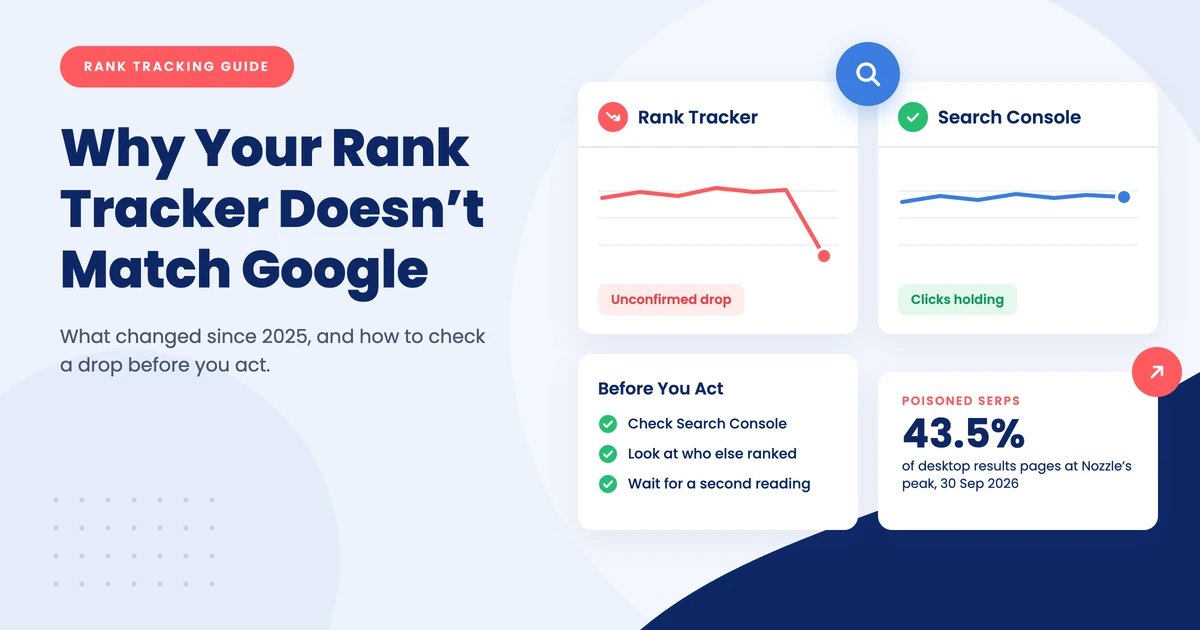
The September 2026 change is the one that concerns me most. Rank-tracking vendor Nozzle reports that some automated requests now come back as complete, normal-looking pages with the wrong results on them. Google hasn’t confirmed this, although several other vendors report the same problem, so for now my advice is to treat any sudden one-day drop as unconfirmed until you’ve checked it.
The Timeline: How We Got Here
Each change makes more sense after the one before it.
| Date | What Happened |
| January 2025 | Google requires JavaScript for Search, citing bots and abuse. |
| September 2025 | The num=100 parameter stops working (reports range from 8–14 September). Retrieving 100 results now takes 10 requests instead of 1. |
| 18 September 2025 | Google says the parameter isn’t something it formally supports. Analysis of 319 properties finds 87.7% of sites lost Search Console impressions. |
| 22 October 2025 | Reddit sues SerpApi, Oxylabs, AWMProxy, and Perplexity over scraping. |
| 19 December 2025 | Google sues SerpApi over large-scale scraping of its results. |
| March to May 2026 | Nozzle’s data shows short bursts of results that ignore part of the query from March, and SerpApi first reports the fault on 4 May. |
| 23 June 2026 | First public sighting of google.com/goto links in search results. |
| 20 July 2026 | A court dismisses Google’s DMCA claims against SerpApi, with leave to amend only those covering copyrighted content. |
| 10 August 2026 | Google files an amended complaint built around its content licensing terms. |
| 26 August 2026 | Google confirms the /goto rollout as a measure against abuse. |
| 13 September 2026 | Requests to Google begin failing in large numbers, according to Nozzle. |
| 16 September 2026 | Page 2 starts ignoring part of the query at scale, says Nozzle, peaking at 39.9% of desktop results pages on 28 September, on page 1 or 2. |
| 20 September 2026 | The date Nozzle gives for the first poisoned results pages. Page 1 also starts ignoring words. |
| 30 September 2026 | Nozzle’s September peak for poisoning: 43.5% of desktop results pages, on page 1 or 2. |
| 22 October 2026 | Ahrefs says 5–20% of results are affected, depending on the data provider. |
| 27 October 2026 | Semrush confirms the problem, says the impact on its users’ tracked rankings has been limited, and notes that Google hasn’t commented publicly. |
| 31 October 2026 | After easing in mid-October, Nozzle’s poisoning rate hits its worst level yet: 64.0% on the same measure. |
What Each Change Did To Your Data
Start with num=100, which stopped working in September 2025. Until then, a tracker could pull 100 results with one request, so losing that made deep tracking roughly 10 times more work. Some tools cut back as a result, and Ahrefs took until late 2025 to restore top-100 tracking in Rank Tracker.
Search Console moved at the same time, which made the picture harder to read. In that 319-property analysis, 77.6% of sites lost unique ranking terms, while average position appeared to improve. Search Engine Land raised the possibility that scrapers using the parameter may have been inflating impressions. That’s why comparing year on year across September 2025 can mislead you in either direction.
Then came /goto. Many result links now pass through a Google redirect before they reach the destination, so tools that read the link directly may store Google’s URL, an opaque token, or nothing at all. If a tracker can’t match a result to your site, it can report a missing ranking. SerpApi says it returns direct URLs again, but the cost remains, because each unique link can need its own extra request.
Poisoning is harder to catch than blocking, because a blocked request is at least visible and a tool knows to try again, whereas a poisoned page looks perfectly valid and can end up stored as a real ranking.
Nozzle’s study of 40.6M results pages across 58 countries found that page 1 poisoning rose from 0.17% to an average of 14.3% across all devices between 13 September and 1 November 2026. Singapore looks more exposed than most at 26.6%, although that’s 131,236 pages from Nozzle’s customers’ keywords rather than a picture of all Singapore searches.
Nozzle also looked at keywords where a project’s own site normally ranks, and found the site was out of the top 10 on 63.5% of poisoned pages, against 2.6% at baseline. That’s exactly what a false drop looks like. Most of these episodes are brief, with 2 in 3 lasting a single check. Even so, they don’t all clear quickly. Within 3 days, 46.9% of poisoned pages had their usual sites back, and within 2 weeks that figure was 90.4%.
There’s also a second fault, and it’s easy to miss because it usually sits further down the page. Google can return a normal-looking page whose results follow only one word of your query. In SE Ranking’s example, “business bank line of credit” showed banks and lenders in the top 9, but page 2 moved on to the LINE messaging app and The Line Hotel.
Nozzle treats this as separate from poisoning, although more than half of these pages fail its poisoning test too. It found the fault on 13.2% of the results it could judge on both pages since 16 September, against 0.06% before, and the page title still shows the full query on 99.9% of them, so nothing on the page flags the problem.
In SE Ranking’s US desktop sample, 96.5% of these unrelated blocks started at position 9 or lower, so if your drop sits around there, I’d read the results that replaced you before I believed it. I wouldn’t assume the top spots are safe, though, because poisoning still reaches page 1.
Other vendors report different figures, from DemandSphere’s 6.7% on 23 October to DataForSEO’s estimate of 20–30% since 26 September. I wouldn’t compare these directly because their samples and methods differ, and almost all of them come from companies that sell this data.
What This Means For Your KPIs
These problems don’t stay in the SEO team’s dashboard, because they reach any KPI built on tracked positions or impressions. Keywords on page 1, average tracked position, and visibility scores can all fall on a false reading and then recover with no work done. That false recovery is just as risky, because it can credit work that did nothing.
Impressions, average position, and click-through rate have a different problem, since the September 2025 change reset their baselines. Botify’s client data showed click-through rate improving without any change in demand.
A false drop can also trigger rewrites, extra spend, or a difficult conversation with leadership, so I think clients are right to question these numbers. Leads and revenue are different, because they come from your own analytics and poisoned pages don’t touch them, so I’d treat them as the steadiest KPIs to report while rank data is unreliable.
Why Google Might Be Doing This
I don’t think anyone outside Google can answer this for certain. Google says it’s fighting abuse, and many in the industry suspect large-scale scraping for AI is the main concern, with rank trackers as collateral damage, but nobody has shown that.
Google’s own statements don’t give much away, because its /goto statement cites “evolving forms of abuse” without naming a target. It also hasn’t commented publicly on poisoning, so anyone telling you Google’s intent here is guessing, and that includes me.
The court filings tell us a little more. Google’s lawsuit accuses SerpApi of evading its protections and reselling content that Google licenses from others. Its amended complaint then describes deals, including its Reddit deal, that oblige it to protect licensed content.
If those descriptions hold, Google has a contractual reason to act, although the contracts aren’t filed with the court, SerpApi has moved to dismiss the claims, and I found no ruling as of 3 November 2026.
Beyond that, we’re into inference. Nozzle’s author calls poisoning a response to AI scraping, Barry Schwartz assumes AI bots and SerpApi are the target rather than SEO tools, and Roger Montti adds that it makes life harder for spammers. Much of this draws on the same few sources, though, so I wouldn’t count it as independent proof.
My own view is that Google’s results appear to have new value as raw material for rival AI products, and from Google’s side, a rank tracker and an AI scraper are both automated requests that look like humans. Poisoning also makes scraping a worse deal, because blocking raises the cost of collecting a page, whereas poisoning raises the cost of believing one. I can’t prove that’s the motive, so treat it as a working theory when you plan.
Where Rank Tracking Goes Next
What follows is my opinion rather than reported fact, but these are the shifts I’d plan for.
I think the single daily position will give way to ranges, because “position 4” implies a precision that collection can no longer promise. I expect more tools to show confidence flags, validation status, and ranges over a period.
I also expect tracking to cost more or do less, because retries and validation add work.
That should push Search Console further into the role of reference point, since it’s first-party data about real searches. It can’t show competitors, but I wouldn’t plan around Google offering an official rank API, because its moves since 2025 point the other way.
The courts could also shape what’s possible, because the Google and Reddit cases may decide how much legal risk data providers carry. AI visibility tracking is heading for the same problem, since those tools also depend on automated collection from platforms with their own reasons to resist it, so I’d treat those numbers as directional as well.
None of this means rank tracking dies. I think it becomes what it should always have been, a sample that points you towards questions rather than a scoreboard.
What SEOs And Marketers Can Do
Whichever tracker you use, these are the steps I’d recommend.
- Annotate your reports for September 2025 (num=100) and for 13 September 2026 onwards (poisoning), so nobody reads every shift as a performance change months later. Some movement may still be real, though, since a Google spam update finished rolling out on 8 October 2026.
- Treat a one-day drop as unconfirmed, and don’t change a page over it. DataForSEO recommends alerts that need two consecutive readings, which helps, although some poisoned episodes last longer than one check.
- Check Search Console first, because if impressions and clicks for the query are holding, your site probably hasn’t disappeared. Just match the country and device to your tracker’s settings first.
- Look at who else ranked, and what those results are about. If most of a keyword’s usual sites vanished from the page at once, I’d suspect the data. Nozzle’s guidance is to compare against the keyword’s usual sites over several weeks rather than just yesterday. Then read the replacements, because a real ranking change moves sites around without turning the results into pages about one word of your query.
- Check page 2 as well as page 1. Nozzle finds page 2 poisoned 1.5 times as often, mostly under a page 1 that looks fine, so a quick look at the top results won’t clear a keyword.
- Export your Search Console data. It’s kept for 16 months, so an export protects the long-range comparisons you’ll want later.
- Report trends rather than single positions. Use keyword groups and rolling periods, and judge the campaign on qualified traffic, leads, and revenue.
- Question your tool vendor. Ask how it detects invalid pages, whether it recollects them, whether it checks page 2 or stops at page 1, whether it corrects past data, and whether suspect readings get flagged. Ahrefs and Semrush have both published their approach, so it’s a fair thing to ask.
How We Check Rankings When The SERP Is Volatile
When SERPs turn volatile, my team runs manual checks alongside Search Console average position, and then measures the variance between those and the positions in our rank tracking tools. That shows how far a tracker’s figure can be trusted before anyone acts on it. We use both because a manual search is one result from one place at one time, whereas average position is a blend rather than a spot anyone actually saw.
Rank Tracking FAQs
Why does my rank tracker differ from Search Console?
It’s partly by design, and partly because of newer data problems. A tracker records one snapshot from a set location and device, whereas Search Console reports the average position of your topmost result across searches, so a small, stable gap isn’t a fault. However, since September 2026, vendors have also reported altered Google results, which can show drops that never happened. If the tracker falls sharply while Search Console impressions and clicks hold, I’d suspect the tracker first.
What is a poisoned SERP?
A poisoned SERP is a complete, normal-looking Google results page that’s served to an automated request, but with the wrong results on it. The term is used by rank-tracking vendors, and Google hasn’t confirmed the practice or commented publicly. Nozzle treats a page as poisoned when fewer than half of a keyword’s usual sites appear. A related fault, where the results follow only one word of the query, is counted separately by Nozzle, whereas SE Ranking groups both as unrelated results.
Is my rank tracker still worth paying for?
Yes, for most teams, as long as you use it for trends rather than daily truth. Trackers still do things Search Console can’t, such as showing competitors, fixed keyword sets, and specific locations. What has changed is how much weight one reading can carry, so I’d pair the tool with Search Console before acting on a sudden movement.
Did my rankings really drop?
It depends on how long the drop lasts and what your other data shows. A real drop usually persists across several checks and shows up in Search Console impressions and clicks, whereas a false one is often brief. Nozzle found that 2 in 3 poisoning episodes lasted one check, although some ran longer. So before you change the page, check Search Console and see whether other usual sites disappeared at the same time.