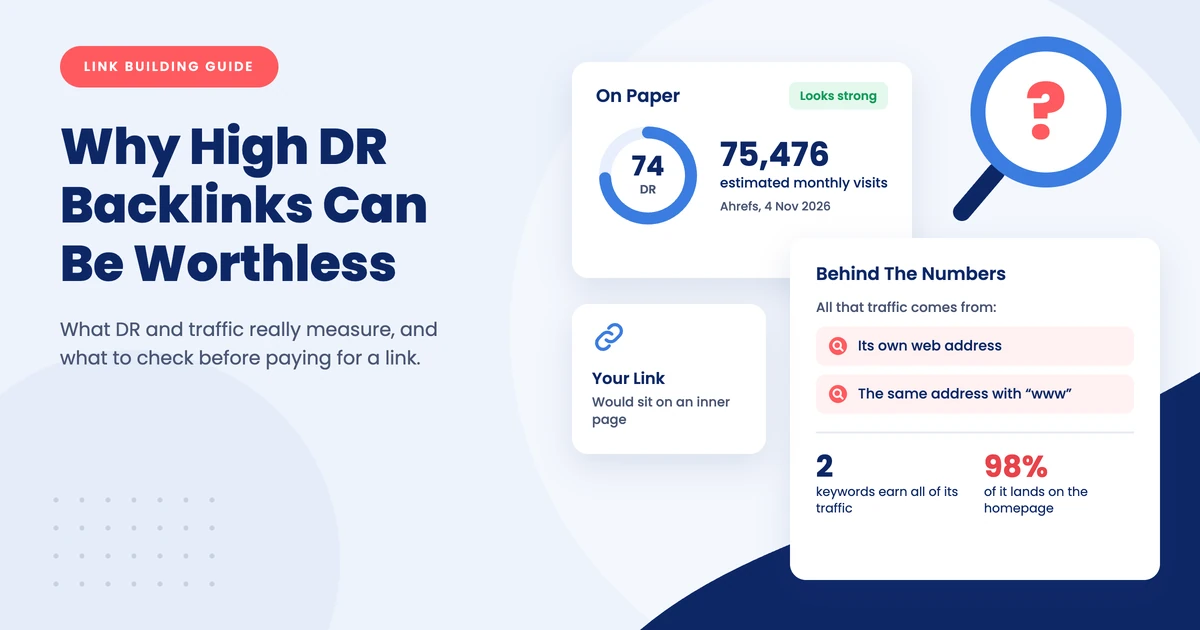
High DR backlinks look like a safe thing to outreach for, but a high Domain Rating (DR) and a big traffic number can’t tell you whether anyone will ever see your link. On 4 November 2026, Ahrefs showed numberlina.com with a DR of 74 and 75,476 estimated monthly visits, and all of that traffic came from 2 keywords: the site’s own address, with and without “www”. So the real question, to me, is who’s searching for it.
If you pay for link outreach, you may well be offered sites like this. Clients have been pitched placements on them, my team has vetted and dropped them, and new clients have come to us with paid links on them from previous vendors. That’s why I’d look well beyond niche, DR, and reported traffic before spending anything, because the three examples below show how all of those can look healthy without telling you whether anyone’s reading.
What DR And Traffic Actually Measure
Neither number counts readers, and that’s the part I think most buyers miss. Ahrefs says DR scores the strength of a site’s backlink profile against the other sites in its database. It depends on how many domains link to the site, how strong those domains are, and how many other sites they also link to, while nofollow links don’t pass any DR. So DR can climb without a single person ever clicking one of those links.
The traffic figure is just as far removed from real readers, because Ahrefs estimates it from the keywords a site ranks for, using each one’s position, its monthly search volume, and an expected click-through rate. That’s why I don’t think “fake traffic” is quite the right term. Nobody has to fake a visit, since the number is calculated, so anything that moves the inputs moves the result.
That leaves webmasters an obvious way to inflate the figure, because they can spam search a keyword they already rank at position 1 for, such as their own web address. If those searches lift the keyword’s reported volume, the top result earns more estimated clicks. So the traffic shown in Ahrefs and in Semrush, which sells similar data and calculates it in a similar way, goes up with no new readers. That’s my view of how it works rather than something either platform has documented.
Ahrefs doesn’t hide that its numbers are estimates, which is to its credit, since it sells this data. Its help page warns against judging a site’s quality by DR alone, and in a May 2022 study of its own tool covering 1,635 sites, the median gap between its US traffic estimates and Search Console was 49.52%.
These scores aren’t Google’s either. On a Google podcast reported by Search Engine Journal in July 2021, a member of its search quality team said they had never seen chasing such scores work well. I don’t blame the tools for any of this, because I think the trouble starts when buyers treat an estimate as an audience.
I Am Calling Out 3 Actual Examples
The table below sets three sites against Tearsheet, a finance and fintech publication included as a reference point because it has the same DR as numberlina. Every figure comes from Ahrefs Site Explorer or Keywords Explorer on 4 November 2026 unless I give another date, and they’re all estimates from a company that sells this data.
| Site | DR | Estimated Monthly Traffic | Keywords | Where The Traffic Comes From |
| numberlina.com | 74 | 75,476 | 3 | All from its own address, with and without “www” |
| fintechzom.com | 55 | 81,490 | 48 | 83% from “fintechzoom.com”, a different site’s address |
| zavify.co.uk | 72 | 9,363 | 76 | 64.5% from a single page about “grammarvista.com” |
Tearsheet has the same DR as numberlina, yet numberlina shows more than 31 times its estimated traffic. The visible difference is that Tearsheet ranks for 480 keywords against numberlina’s 3, which is closer to what I’d expect from a working publication, with many articles each picking up a modest share of searches.
Numberlina.com: A Case Of Suspected Fake Search Volume Of Its Website Address
Ahrefs reports about 11,000 monthly US searches for “numberlina.com” and the same again for “www.numberlina.com”, but only 10 for the word “numberlina”. I’d expect the opposite from a site people know, because I think people tend to search for a name.
TechCrunch shows the usual pattern, with 74,000 monthly US searches for “techcrunch” against 500 for “techcrunch.com” and 50 for “www.techcrunch.com”. So on Ahrefs’ figures, numberlina’s address gets 22 times the US searches of TechCrunch’s, while its name gets 10 against TechCrunch’s 74,000.
Those 2 search terms also earn estimated traffic in 37 countries, led by the US and Japan, for an English-language blog with no obvious reason to draw searches from all of them. US volume for “numberlina.com” went from 13 searches in July 2024 to 21,912 in August 2024, and during 2026 it has ranged from 1,455 to 23,382 a month. To me, that doesn’t look like people looking for a website.
For a link buyer, what matters most is where that traffic lands, and 98% of it lands on the homepage. A placed article would sit on an inner page, and the inner pages Ahrefs lists pick up only small amounts from the same 2 terms. Every post on the homepage is also credited to the same email address rather than a named author, so I’d want to know who’s running the editorial side.
The site’s strongest links include pages on NASA’s Night Sky Network and the US National Park Service, both of which link to jhastronomy.com, the address they give for the Jackson Hole Astronomy Club. On 4 November 2026, that domain was sending visitors to numberlina’s technology category through a permanent 301 redirect. Neither page mentions numberlina, yet Ahrefs counts both as links to it.
Fintechzom.com: A Case Of Traffic From Another Site’s Address
Fintechzom.com is one letter away from fintechzoom.com, and 83% of its estimated traffic comes from searches for that other address. Ahrefs gives “fintechzom.com” just 30 US searches, against about 851,000 in the latest month for “fintechzoom.com”, where fintechzom appears as the second organic result. I think anyone searching for fintechzoom.com almost certainly wants the site with that name, so I wouldn’t count many of those estimated visits as an audience for anything else.
The site’s disclaimer says it isn’t affiliated with FintechZoom.com or FintechZoom.io, although its own page title and FAQ answers use the name FintechZoom. Only 1 page has any traffic in Ahrefs, the homepage, so nothing placed on an inner page would inherit it.
Estimated traffic is unstable as well, going from 13,140 in November 2025 to 300,801 in May 2026, then 6,577 in September 2026, and 83,431 by 1 November 2026. DR rose from 0 in October 2025 to 55 by May 2026. Among the referring domains is a DR 76 domain with no estimated traffic of its own, which to me shows that a high DR proves no more on the linking side than it does on yours.
Zavify.co.uk: A Case Of Pages Built Around Other Sites’ Addresses
Companies House lists Zavify Ltd as an active UK private limited company, incorporated in September 2025, and its site sells digital marketing services, so I’m not suggesting the business itself is invented. The unusual part is its blog, because about 99% of its estimated traffic comes from searches that name another website.
In fact, 64.5% of it comes from a single term, “grammarvista.com”, through a page that calls GrammarVista.com “a search term” and doesn’t link to the site. Ahrefs shows that term at 0 or 1 US searches a month from January 2024 to March 2026, then 96,267 in April 2026 and 147,632 in May, before it fell to 6,681 in July. The plain word “grammarvista” shows none at all, and I can’t think of an ordinary reason for a jump like that.
Zavify’s DR rose from 42 in December 2025 to 72 by April 2026. Some of the high-DR links Ahrefs lists are tracker and login URLs on other domains that simply pass a visitor on to its site, rather than links written into an article. Of the 3 tested on 4 November 2026, 2 still redirected. Ahrefs first saw several from 30 March 2026, around the time the DR reading went from 60 on 1 March to 72 on 1 April.
The site’s 567,753 live backlinks are unusual too, because 98.6% of them come from 11 domains with a DR of 7 or lower, many with gambling-style names, and Ahrefs first saw all 11 on 8 July 2026. A site can’t control who links to it, though, and none of this shows who created those links or why. Still, if I were vetting this site as a link target, I’d want those questions answered first.
Why Niche Won’t Save You
Niche is usually the next filter after DR and traffic, and I think it’s just as easy to pass. A general blog sits in every niche at once, so numberlina’s categories run from travel and health to casino and crypto. Fintechzom describes itself as a finance news site, yet it lists perfume and hoodie pieces among its popular posts. A site like that can tick your category on a spreadsheet, so I’d ask whether its readers could plausibly buy from you instead.
Why Site Owners Do This
This is my view rather than anything I can show you, and it’s about the practice in general rather than the motives of the owners above, which I can’t know. I think it’s the same instinct SEOs have, because SEOs study which factors Google responds to and work on them. Site owners can see that link buyers filter on DR, traffic, and niche, so those become the numbers worth working on.
Those numbers are also far easier to move than an audience is to build, so as long as buyers pay more for a bigger number, I expect people to keep testing what moves it. I don’t see that as a criticism of Ahrefs, because I think any metric people spend money on will attract people who study its inputs.
What I Can’t Tell You
Ahrefs shows the outcome rather than the person behind it, so I can’t tell you who created any of these patterns or what anyone intended. Links can come from third parties, and a site can rank for a strange search term without having done anything to inflate that term’s volume.
Spam searching would fit some of these search volumes, but I can’t prove it’s happening on any of these sites. Ahrefs says its figures draw on Google Keyword Planner, Google Trends, and other third-party data, and that page doesn’t mention bots or spam searches, so any suggestion that these searches aren’t human is my inference from the pattern.
Nothing here shows that these three sites sell links either. On 4 November 2026, none of them appeared on the MeUp link marketplace and their homepages didn’t offer guest posts, so please treat them as examples of what the data can look like.
What This Costs You
The placement fee is the obvious cost, but I think the bigger problem is what your reports say afterwards. A link on a site like this can appear in a report as DR 74 with 75,476 monthly visitors, which looks like a win, while the KPIs you care about don’t move. Those are GA4 referral sessions, the target page’s Search Console impressions and clicks, and eventually leads and revenue. If they stay flat while reported authority goes up, you’re paying for a better-looking spreadsheet.
Paid links carry risk too, because Google’s spam policies treat exchanging money for links as link spam unless those links carry a nofollow or sponsored attribute. I think that makes a paid, followed link on a site with no real audience a poor trade, with that risk and very little upside. It can also cost you months, because a campaign built on placements like these can look slow when the plan itself is the problem.
What I’d Check Before Paying For A Link
You don’t need a new tool for this, because Ahrefs shows most of it once you go past the overview screen. These are the checks I’d run if someone pitched me a site like this, and none of them is proof on its own, since a small or new site can look odd for innocent reasons. If several fail together, though, I’d walk away.
- Sort Organic Keywords by traffic and read the top of the list. If it’s the site’s own address or someone else’s, you’ve learned most of what you need, because I’d expect a publication to rank for the topics it writes about.
- Compare the name with the address in Keywords Explorer, looking up the plain name, the .com version, and the www version. I’d be wary when the address gets thousands of searches and the name gets almost none.
- Open the volume history of its top keywords, since I’d expect real demand to build gradually or follow a season. A term that sits at 0 for 2 years and then passes 100,000 in 2 months deserves a question.
- Use Top Pages to see where the traffic lands, because your link will sit on an inner page and the homepage’s numbers won’t help you. What comparable articles on the site get is your best guide to what yours would get.
- Compare it with a publication you trust at a similar DR. If that publication ranks for hundreds of keywords and this one ranks for a handful, ask where the traffic comes from.
- Check the traffic and DR history for sudden swings. Real sites move around, but fintechzom’s fall from 300,801 to 6,577 between May and September 2026 tells me that number isn’t something to plan around.
- Open the highest-DR backlinks and visit the actual pages. Anchor text that names a different site can point to a redirected domain, and URLs containing parameters such as “redirect=” or “service=” may be redirects rather than editorial links.
- Read the last 20 posts to see whether the topics hang together, who wrote them, and what they link out to.
- Ask for first-party data, ideally a live look at Search Console or GA4 that includes a recent guest article, because a live screen is harder to dress up than a screenshot.
- Measure what you place by tracking referral sessions and the target page’s Search Console data after a link goes live, and stop using any site that shows nothing over time.
I’d rather have a link from a small trade publication that my customers actually read than from a high-DR blog with traffic I can’t explain. DR can still help you compare sites that have already passed these checks, but I wouldn’t let it be the reason you pick one.
High DR Backlinks FAQs
Can Domain Rating be manipulated?
Yes, because it’s calculated from links, and links can be gained in ways that have nothing to do with an audience. Ahrefs says DR depends on how many domains link to a site, how strong they are, and how many other sites they link to. On 4 November 2026, high-DR links to one site ran through an astronomy club’s address that now redirects to it, and another site’s included tracker and login redirects. So I’d treat DR as a description of a link profile rather than proof of readers.
Is Ahrefs traffic accurate?
Only roughly, because it’s an estimate rather than a count of visits. Ahrefs calculates it from a site’s rankings, each keyword’s search volume, and an expected click-through rate, so unusual search volume produces unusual traffic. In a May 2022 study of its own tool covering 1,635 sites, the median gap against Search Console was 49.52% for US traffic, with some sites off by more than 1,000%. I’d use it to compare sites, and I wouldn’t use it as evidence that a site has readers.
Why would a website get huge search volume for its own address?
One reason, in my view, is spam searching, where a webmaster repeatedly searches a keyword they already rank at position 1 for, which can lift the estimated traffic shown in Ahrefs and Semrush. I can’t say for certain that’s behind any given site, because these tools report the volume and not who made the searches. I’d expect people to search for a name, and that’s what TechCrunch shows, with 74,000 monthly US searches for “techcrunch” against 500 for “techcrunch.com” on 4 November 2026. So when that flips, I’d dig further before paying for a link.
What DR should a backlink have?
There’s no fixed number I’d hold to. DR describes a site’s link profile, but it can’t tell you whether its readers are your customers, so a lower-DR site your buyers actually read can be worth far more than a high-DR site with no audience. I’d judge a site by what it ranks for, where its traffic lands, and whether a real person might click through from the page your link sits on. Once a site passes those checks, DR is a fair tie-breaker.
References
- Ahrefs: What Is Domain Rating (DR)?
- Ahrefs: Domain Rating glossary entry
- Ahrefs: How accurate is the Organic Traffic metric, and how is it calculated?
- Ahrefs: How accurate is keyword search volume?
- Ahrefs: traffic estimation accuracy study, Tim Soulo, 3 May 2022
- Semrush: Position Tracking, how estimated traffic is calculated
- Google Search Central: Spam policies
- Search Engine Journal: third-party domain metrics, Roger Montti, 7 July 2021
- Companies House: Zavify Ltd, company number 16704420
Information above was checked on 4 November 2026. All site, keyword, and link figures come from Ahrefs on that date unless another date is given.