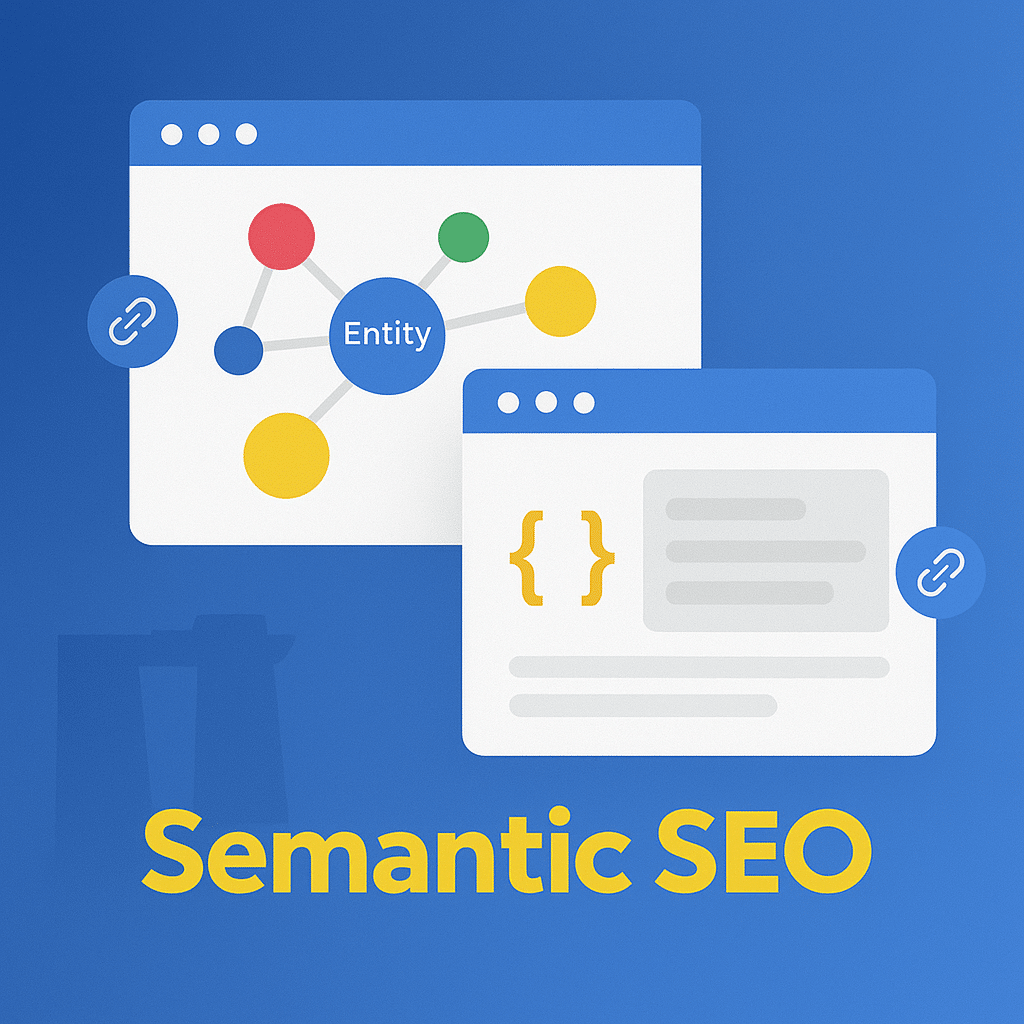
Semantic SEO is the practice of writing for meaning, not just words. You focus on the user’s intent and the relationships between entities within a topic, then organise content so it resolves the task end to end. Think in terms of concepts, sub-questions, and connections. Write to help someone finish what they started, not to hit a word count. This replaces the traditional SEO approach of just repeating keywords. Done well, it boosts relevance and makes your content discoverable across an entire query space.
Why Semantic SEO Matters
Modern search systems interpret context and intent using Natural Language Processing (NLP) and an understanding of entities. When your content mirrors that understanding with clear structure and complete coverage, you become more relevant for a broader set of queries around the same task. This shifts your strategy from chasing single keywords to building complete topic coverage that answers the full task.
Common misconceptions
“LSI keywords” or Latent Semantic Indexing, often appear in advice about semantic optimisation. Treat the idea as a reminder to include genuinely related terms and concepts, not as proof of a specific ranking technology. Google does not use LSI as a ranking factor. Your focus should be topical clarity, entity relationships, and information gain over what is already available.
How Semantic Search Works
From keywords to intent
Modern engines look beyond exact words. They map a query to the searcher’s intent and context, including location, device, and timing, then rank the results that best satisfy that intent. This is why pages that solve the underlying task outperform pages that simply repeat a phrase.
Entities and relationships
Search systems model the world as entities and the relationships between them. People, places, organisations, and products each have attributes that can be clarified on your page. When you define entities, list attributes, and explain how they connect, you help engines disambiguate meaning and match your content to more relevant queries.
NLP and SERP interpretation
Natural language processing reads both the query and your on-page copy to understand topics, sentiment, and structure. Clear headings, concise definitions, tables, and FAQs improve machine understanding and human comprehension at the same time. The result is better alignment with SERP features and broader eligibility across related searches.
Pillars of a Semantic SEO Strategy
Topic clusters and internal linking
Organise content into clusters that mirror how people learn and decide. Create a hub that explains the core concept, then publish spoke articles for sub-questions, comparisons, tools, and pitfalls. Use descriptive internal anchors that state the destination’s purpose, and keep parent–child paths clear so crawlers and readers can follow the journey without friction. This structure prevents cannibalisation, concentrates relevance, and helps every new spoke lift the whole cluster.
Entity-rich content
Make the key entities obvious. Name the person, product, place, or organisation, define it in a sentence, list its attributes, and describe how it relates to adjacent entities. Support this with short definitions, FAQs that answer common disambiguation questions, comparison tables that show differences, and mini glossaries for recurring terms. The goal is to remove ambiguity so engines and readers understand exactly what the page covers.
Structured data to support meaning
Add schema that reflects the primary purpose of the page. Use types like Article, Product, FAQPage, Organization, LocalBusiness, or HowTo where they truly fit. Combine markup with clean information architecture, consistent breadcrumbs, and sensible URLs. Structured data does not replace clear writing, it reinforces the meaning already present on the page and can unlock rich results that improve visibility.
Intent alignment and coverage depth
Start with the primary intent, then map the sub-intents that appear along the journey. Address prerequisites, step-by-step instructions, cost and trade-offs, alternatives, and what to do next. Aim for information gain over the current results by adding data, demonstrations, or decision frameworks that competitors lack. When a sub-intent grows large, spin it into a spoke and link both ways so the hub remains scannable and the cluster stays complete.
How To Create A Semantic Rich Page
1) Scope the topic space
Start with the SERP. Collect the core queries, People Also Ask questions, and featured snippets to see what searchers expect. List the entities in play and the subtopics competitors already cover. Define the boundaries of your cluster so you know which intents belong in the hub and which deserve their own spokes. Note the gaps you can fill with original data, workflows, or clearer explanations.
2) Build a brief around entities and intents
For each article, name the target entities and list related terms that clarify meaning. Add the PAA questions you will answer and capture intent variants such as informational, comparative, and transactional. Outline sections that resolve the task from start to finish, including prerequisites and next steps. Assign an expert author and specify what first-hand examples or visuals they will provide.
3) Draft for meaning, not repetition
Write to explain and help. Use clear headings, short definitions, concrete examples, and side-by-side comparisons where it helps decisions. Prioritise unique insight and first-hand detail over paraphrase. Remove filler, avoid redundant sections, and keep the reader moving toward a result they can use.
4) Add structure signals
Support meaning with structure. Apply the most appropriate schema type and validate it. Use descriptive internal anchors that state the destination’s purpose. Keep URLs human readable and ensure breadcrumbs mirror the topic hierarchy so engines and readers can place each page in context.
5) Validate breadth and depth
Before publishing, check that the page resolves the core task and the common follow-ups you noted from the SERP. If a subtopic grows too large, split it into a spoke and link both ways. Confirm that the cluster covers definitions, how-to steps, comparisons, pricing, and alternatives with minimal overlap between pages.
6) Publish and enrich
Ship the page with FAQs that address disambiguation questions, mini-glossary entries for recurring terms, and context links to adjacent entities in your cluster. Revisit on a set cadence to add new versions, regulations, or examples. As you learn from user behaviour, expand the cluster with new spokes and refine internal links so authority flows to the pages that need it most.
Best Practices and Patterns
Information gain over parity content
Aim to add something the SERP does not already have. Bring original data, step-by-step workflows, small calculators, screenshots, or concrete examples that help a reader complete the task. Engines reward pages that increase the net utility of a query, not those that mirror what already ranks.
Avoid keyword cannibalisation with cluster logic
Use one hub to define the topic and create spokes for distinct sub-intents such as comparisons, pricing, or implementation. Link from the hub to each spoke with descriptive anchors, and link back from spokes to the hub. This signals scope, prevents pages from competing with each other, and helps authority circulate through the cluster.
Semantic HTML and UX
Write with structure that machines and people can read. Use a single H1, logical H2 and H3 headings, lists for steps, tables for comparisons, and alt text that describes images in plain language. Pair semantic markup with fast, stable pages so readers can consume the content without friction.
Be cautious with “LSI keyword” advice
Use genuinely related terms to clarify meaning and cover the concepts users expect, but do not chase “LSI” as if it were a ranking switch. Focus on entities, relationships, and complete task coverage. When you add context that improves understanding, the right related terms usually appear naturally.
Semantic SEO Tools To Use
| Tool | Purpose | How to use it effectively |
|---|---|---|
| Semrush Topic Research | Topic discovery and clustering | Enter a seed topic, review subtopic and question cards, export a shortlist, and map hub and spoke pages. Use the Questions view to build FAQs and section outlines. |
| Ahrefs AI Content Helper | Drafting with intent alignment and gap filling | Paste your brief or URL, generate an outline that covers missing subtopics, refine with examples and sources, then compare against top results to ensure information gain. |
| InLinks | Entity-first planning, schema, and internal links | Crawl your site to extract entities, review suggested internal links and schema types, approve and publish JSON-LD, then use the topic map to plan new entity-focused pages. |
| Surfer SEO Content Editor | NLP guided content optimisation | Create an editor for your target query, follow term and structure suggestions while writing naturally, trim overuse, and run the audit to update existing pages in place. |
| Clearscope | Semantic term coverage and readability | Generate a report for your keyword, draft in the editor or import from Docs, aim for a strong grade without losing voice, and use the Competitors tab to spot gaps. |
| MarketMuse | Topic modelling and coverage planning | Run Topic Navigator on a seed topic, identify related concepts and questions, build a content plan with hub and spokes, and use content scores to prioritise refreshes. |
| SERPmantics: Semantic Analysis Tools (roundup) | Directory of semantic tools for further exploration | Browse categories, compare features, and shortlist tools for tasks such as entity extraction or clustering. Add picks to your workflow only if they fill a clear gap. |
Common Pitfalls
Publishing near-duplicates for the same intent
- What it looks like: Multiple posts that answer the same question with minor wording changes or different keyword variants.
- Why it hurts: Pages compete with each other, dilute internal links, and confuse engines about which URL to rank. Users also bounce between similar pages without finding extra value.
Fix it:
- Pick the strongest URL as the hub.
- Merge overlapping copy into that hub, then 301 the weaker pages.
- Create spokes only for distinct sub-intents, for example “pricing”, “comparison”, “implementation”, or “troubleshooting”.
- Link hub → spokes and spokes → hub with descriptive anchors that state the destination’s purpose.
Quick check: In GSC, filter by a core query and confirm there is one clear landing page, not several.
Chasing “LSI lists” without real coverage
- What it looks like: Jamming pages with synonym lists and “related words” while skipping steps, proofs, and examples that help people finish the task.
- Why it hurts: You signal breadth without substance. Engines still cannot confirm topical completeness or information gain. Readers leave because the page does not move them forward.
Fix it:
- Start with task coverage. Outline the problem, prerequisites, steps, decisions, and outcomes.
- Add entity clarity. Define key terms, roles, products, or places and show how they relate.
- Use related terms naturally inside explanations, tables, and FAQs. Do not force lists.
- Add proof, for example screenshots, mini case notes, benchmarks, or a calculator.
Quick check: Ask, “Can a competent reader act after this page?” If not, add steps and evidence before tuning wording.
Ignoring structure and internal linking
- What it looks like: Long walls of text, vague headings, orphan pages, and links that say “click here” instead of describing the destination.
- Why it hurts: Engines struggle to parse scope and relationships. Users cannot scan or navigate, which lowers engagement and trust.
Fix it:
- Use semantic headings. One H1 per page, logical H2 and H3 that mirror the reading journey.
- Break procedures into numbered steps and use tables for comparisons.
- Standardise internal anchors that describe what the target covers, for example “compare X vs Y features” or “pricing and plans”.
- Build a cluster map. Ensure every spoke links to its hub and to two or three sibling pages where it helps the reader.
- Add breadcrumbs and keep URLs human readable to reflect hierarchy.
Quick check: From any spoke, a reader should reach the hub in one click and a sibling page in two.
Semantic SEO vs Entity SEO
Semantic SEO focuses on a topic and its intents, whereas Entity SEO centres on a named thing and its relationships. Accordingly, Semantic SEO maps concepts and sub-questions into hubs and spokes, while Entity SEO defines a primary entity, its attributes, and related entities with clear identifiers. In practice, Semantic SEO relies on coverage depth, intent alignment, and solid information architecture; by contrast, Entity SEO depends on explicit entity markup, descriptive internal links, and cues that remove ambiguity.
As a result, Semantic SEO tends to produce task-resolving guides and clusters, whereas Entity SEO yields entity-centric pages and structured data that strengthen machine understanding. Consequently, success for Semantic SEO shows up as cluster-level visibility and engagement, while success for Entity SEO appears as clean entity recognition, consistent references, and greater eligibility for rich SERP features.
How they differ:
- Unit of optimisation: Semantic SEO optimises a topic or task, while Entity SEO optimises a recognisable thing such as a brand, product, person, or place, plus its attributes and relationships.
- Primary signals: Semantic SEO relies on intent alignment, coverage depth, and logical information architecture. Entity SEO leans on explicit entity declaration, schema, and internally linked context that helps systems disambiguate meaning.
- Typical outputs: Semantic SEO yields hub and spoke clusters that answer every sub-intent across a query space. Entity SEO yields pages and data that map a named entity, its properties, and how it connects to adjacent entities.
Where they overlap:
Both approaches reward clarity and structure. Strong topic coverage makes it easier to introduce entities in context, while explicit entities make your topical coverage unambiguous for search systems that parse relationships and intent. Use structured data and clean internal links to support both.
When to emphasise one over the other:
Launching or re-architecting a content hub: lead with Semantic SEO to map intents, then annotate key pages with entity signals.
Strengthening brand and product understanding across a site: lead with Entity SEO by stating the primary entity, adding attributes, and linking related entities, then expand topical coverage around those entities.
Practical playbook:
Choose the primary entity for each hub or page, then list attributes and related entities. 2) Outline sub-intents and questions for complete topical coverage. 3) Ship with schema that fits the page type and add internal links that name the destination in plain language. 4) Measure at two levels: cluster visibility for semantic coverage and entity clarity through improved disambiguation and rich result eligibility.
Conclusion
Semantic SEO is a shift from chasing single keywords to designing content around meaning, intent, and the relationships between ideas and entities. When you map a topic into hubs and spokes, clarify entities with definitions and attributes, and support the page with structured data and purposeful internal links, you earn broader visibility across a whole query space. Pair this with information gain, clear UX, and ongoing measurement at the cluster level, and you build an engine that compounds with every new page you ship.
If you want a partner to put this into practice, First Page Digital can be engaged for semantic SEO. We plan clusters, align entities, implement schema, and optimise internal linking so your content is understood and discovered. Explore our SEO services and let us tailor a semantic plan for your goals.
Unsure if First Page Digital’s SEO is for you? Check out our compiled list of the best SEO agencies in Singapore to find and compare other SEO services.