Marketing gets messy fast. One week you are writing ads, the next you are debating brand positioning, and then someone asks for a new campaign plan by Friday. Add more channels, more stakeholders, and more targets, and it becomes hard to stay consistent.
That is the real problem marketing frameworks solve. They give you a clear structure to make decisions, prioritise work, and execute without reinventing the strategy every time something changes.
What you will get from this guide
- A clear definition of what a marketing framework is, and what it is not.
- A practical decision guide to help you pick the right framework based on the problem you are solving.
- A library of proven frameworks with best-fit use cases, so you can choose with confidence.
- Step-by-step application instructions and mini examples, so you can put the framework into action, not just read about it.
If you have been running marketing based on scattered tactics, this will help you build a more repeatable system. And if you already have a strategy, it will help you sharpen it and make it easier to execute.
What a Marketing Framework Is
A marketing framework is a structured way to think about and execute marketing decisions. It breaks a complex strategy into clear components and steps, so teams can plan, act, and measure without losing direction.
Instead of reacting to individual tactics or channels, a framework helps you see how everything fits together. It gives you consistency across campaigns, teams, and time.
What a marketing framework is not
- Not a one-time template: A framework is not something you fill in once and forget. It should be revisited as markets, products, and goals change.
- Not a channel plan: A framework works across channels. It guides how you use search, social, content, email, and paid media together.
- Not a replacement for research or testing: Frameworks organise thinking, but they still rely on real data, experimentation, and feedback to work well.
In short, a marketing framework exists to reduce chaos. It gives structure without removing flexibility, and clarity without oversimplifying real-world marketing challenges.
Marketing Frameworks vs Marketing Models
Marketing frameworks and marketing models are often used interchangeably, but they serve different purposes. Understanding the difference helps you apply each one correctly, instead of expecting one tool to do everything.
The clear distinction
Marketing frameworks provide a qualitative structure for planning and execution. They help teams organise thinking, make decisions, and align actions across channels and stages.
Marketing models are analytical tools. They are used to quantify performance, predict outcomes, or simulate scenarios using data.
In simple terms, frameworks guide what to do and why. Models help measure how well it worked.
Why this difference matters
If you rely only on models, you may optimise numbers without a clear strategy. If you rely only on frameworks, you may have direction but no proof that it is working.
Each plays a different role:
- The framework is the operating system: It sets direction, priorities, and structure.
- The model is the measurement engine: It validates decisions and tracks impact.
How to use both together in real workflows
Strong marketing teams use frameworks and models together.
- The framework defines the target audience, positioning, and execution approach.
- The model tracks performance, highlights gaps, and informs optimisation.
For example, you might use STP to decide who to target and how to position, then use conversion rate, cost per acquisition, and lifetime value models to evaluate whether those decisions are paying off.
When combined correctly, frameworks provide clarity, and models provide confidence.
The Core Components of a Strong Marketing Framework
Most effective marketing frameworks share a common foundation. Think of this as a meta-framework that sits above individual models like STP, RACE, or AARRR. If a framework does not address these components, it will usually break down in execution.
Market analysis
This is where strategy starts. You assess market trends, audience behaviour, and competitive pressures. The goal is not to predict everything, but to ground decisions in reality.
Without market analysis, frameworks become opinion-driven instead of insight-driven.
Goal setting
Clear goals turn strategy into action. Strong frameworks use SMART goals so teams know what success looks like and when it has been achieved.
Goals should be specific, measurable, attainable, relevant, and time-bound. Vague objectives make it impossible to prioritise or evaluate performance.
Segmentation and targeting logic
This component defines who matters most and why. It forces trade-offs instead of trying to appeal to everyone.
Good targeting logic considers factors like need, intent, value, and accessibility, not just demographics.
Positioning and messaging
Positioning explains why a buyer should choose you over alternatives. Messaging translates that position into clear, consistent communication.
Frameworks that skip this step often result in campaigns that look active but fail to resonate.
Execution model
This is where strategy meets reality. The execution model defines workflows, ownership, timelines, and channel mix.
Without execution clarity, even strong strategies stall or become fragmented across teams.
Measurement and feedback loops
Measurement ensures the framework improves over time. This includes defining KPIs, review cadence, and optimisation rules.
Feedback loops turn results into learning, rather than static reports.
Resources and tools
Finally, frameworks need support systems. These include templates, assets, tools, and shared standards that make execution easier and more consistent.
When these components work together, a marketing framework becomes a living system rather than a planning document.
Benefits of Using Marketing Frameworks
Marketing frameworks are not about theory or academic structure. Their real value shows up in how teams plan, execute, and improve marketing work in day-to-day conditions.
Better strategic direction and decision-making
Frameworks reduce guesswork. Instead of debating opinions, teams follow a shared structure to decide what matters and what does not.
This leads to clearer priorities and fewer reactive decisions.
Stronger campaign effectiveness
When strategy, messaging, and channels are aligned through a framework, campaigns become more coherent.
Message and channel fit improves, which often leads to higher engagement and better conversion rates.
Alignment across teams
Frameworks create a shared language across marketing, sales, product, and leadership.
Everyone understands who the target audience is, what the goals are, and how success is measured.
Efficiency and better use of resources
Without a framework, teams often run disconnected tactics that compete for budget and attention.
Frameworks help focus effort on what drives impact, reducing wasted spend and duplicated work.
Continuous evaluation and optimisation
Most frameworks include built-in feedback loops.
This makes it easier to review performance, learn from results, and improve execution over time instead of starting from scratch.
Works for small businesses and large enterprises
Frameworks scale. Small teams use them to stay focused with limited resources, while larger organisations use them to maintain consistency across multiple teams and markets.
The structure stays the same, but the level of detail adapts to the organisation.
How to Choose the Right Marketing Framework
There is no single best marketing framework. The right choice depends on the problem you are trying to solve, not the popularity of the framework itself.
This section gives you a practical way to choose a framework that fits your situation.
Start with business needs and constraints
Before selecting any framework, be clear on your context.
- Growth stage of the business
- Available resources and team size
- Sales cycle length and buying complexity
- Primary growth goal, such as awareness, leads, or revenue
A framework that works for a funded SaaS company may not suit a lean SME or a solo founder.
Match the framework to the decision you need to make
Different frameworks solve different problems. Use them as tools, not philosophies.
- Messaging and persuasion: AIDA, Hook Model
- Targeting and positioning: STP
- Strategy and competitive landscape: SWOT, Porter’s Five Forces, Blue Ocean
- Lifecycle planning: RACE, Customer Journey Mapping, Flywheel
- Growth and activation: AARRR, Growth Hacking, North Star Metric
- Offer and market fit: Value Proposition Canvas, Ansoff Matrix
Consider who will use the framework
Frameworks need to be usable by the people executing them.
- Solo founders often need lightweight, flexible frameworks.
- Marketing teams benefit from clear structure and shared definitions.
- Cross-functional organisations need frameworks that align multiple stakeholders.
Selection shortcuts
If you are unsure where to start, these shortcuts help narrow the choice:
- Unclear problem: Start with SWOT and basic market analysis.
- Clear market but weak messaging: Use STP with the Value Proposition Canvas.
- Need better revenue efficiency: Combine AARRR, North Star Metric, and RACE.
The goal is not to use many frameworks at once, but to choose one that helps you make a specific decision well.
How to Implement a Marketing Framework
Choosing a framework is only the starting point. The real value comes from how you apply it in day-to-day marketing work.
This step-by-step playbook keeps implementation practical and focused.
Identify your target audience clearly
Start by defining who the framework is meant to serve. Be specific.
This includes who the buyer is, what problem they are trying to solve, and why they would care about your offer. Vague audience definitions weaken every step that follows.
Set goals and success metrics
Next, define what success looks like.
Use SMART goals supported by clear KPIs. This could include pipeline volume, cost per lead, conversion rate, or retention.
Without agreed metrics, it becomes difficult to evaluate whether the framework is working.
Choose the framework that matches the decision
Apply the framework only to the decision it is designed to support.
For example, use STP to refine targeting, not to plan campaign budgets. Use RACE to organise lifecycle activity, not to define pricing.
Keeping scope tight prevents frameworks from becoming bloated or theoretical.
Translate framework outputs into actions
This is where many teams stop short.
Turn insights into tangible outputs such as:
- Messaging pillars and value propositions
- Channel and campaign plans
- Content themes and formats
- Budget allocation priorities
If a framework does not change what you execute, it has not been implemented.
Launch with measurement and feedback loops
Once execution starts, establish a clear review cadence.
Track agreed KPIs, run controlled experiments, and adjust based on performance. Optimisation should follow a rhythm, not ad hoc reactions.
Over time, this feedback loop turns the framework into a system that improves with use.
Marketing Frameworks Covered and How They Compare
This article covers a wide range of proven marketing frameworks. Each one solves a different type of problem, which is why comparison matters more than popularity.
List of marketing frameworks covered in this article
- STP (Segmentation, Targeting, Positioning)
- Value Proposition Canvas
- 4Ps Marketing Mix
- 7Ps Marketing Mix
- 9Ps Marketing Mix
- AIDA
- Hook Model
- STEPPS
- RACE Framework
- Customer Journey Mapping
- Flywheel Model
- AARRR (Pirate Metrics)
- Growth Hacking Framework
- North Star Metric
- ICE Scoring
- Lean Analytics Stage Framework
- SWOT Analysis
- Porter’s Five Forces
- Blue Ocean Strategy
- Ansoff Matrix
- They Ask, You Answer
- PESO Model
- Customer Lifetime Value (CLV)
Marketing framework comparison table
| Framework | Primary Use Case | Best For |
|---|---|---|
| STP | Audience focus and positioning | Targeting clarity and message alignment |
| Value Proposition Canvas | Message-market fit | Landing pages, sales narratives, offers |
| 4Ps / 7Ps / 9Ps | Go-to-market planning | Offer design and channel coordination |
| AIDA | Conversion structuring | Ads, landing pages, sales content |
| Hook Model | Habit formation | Onboarding, retention, product-led growth |
| STEPPS | Virality and sharing | Content distribution and word-of-mouth |
| RACE | Lifecycle planning | Always-on digital marketing strategy |
| AARRR | Growth diagnostics | Startups, SaaS, subscription models |
| North Star Metric | Team alignment | Scaling organisations and growth teams |
| SWOT | Strategic assessment | Fast internal and external analysis |
| Porter’s Five Forces | Competitive strategy | Industry and margin analysis |
| Blue Ocean | Market differentiation | Crowded or commoditised markets |
| Ansoff Matrix | Growth direction | Product and market expansion decisions |
| PESO | Media integration | Campaign amplification and channel alignment |
The key takeaway is simple. Frameworks are tools. Their value comes from choosing the right one for the decision at hand and applying it with discipline.
Framework Library: Segmentation and Positioning Frameworks
Segmentation and positioning frameworks help answer one of the most important questions in marketing: who are we really trying to reach, and why should they choose us.
These frameworks are especially useful when messaging feels generic, conversion rates are weak, or campaigns attract the wrong audience.
STP (Segmentation, Targeting, Positioning)
STP is one of the most widely used marketing frameworks. It provides a structured way to move from a broad market to a focused, differentiated position.
What it is and when to use it
STP helps you break a market into meaningful segments, choose which segments to prioritise, and define a clear position for each.
It is most useful when you are entering a crowded market, launching a new product, or seeing poor performance from broad targeting.
Segmentation bases
Segmentation can be done in several ways, depending on your business model:
- Demographic: Age, income, role, company size
- Psychographic: Values, motivations, attitudes
- Behavioural: Purchase behaviour, usage patterns, intent
- Geographic: Location, region, market maturity
Strong segmentation focuses on differences that affect buying decisions, not just easy-to-find data points.
Targeting criteria
Once segments are defined, targeting requires clear trade-offs.
- Size and growth potential of the segment
- Accessibility through channels and sales motion
- Profitability and lifetime value
- Strategic focus and internal capability to serve the segment
Not every segment is worth pursuing, even if it looks attractive on paper.
Positioning outputs
Positioning defines how you want to be perceived relative to alternatives.
Key outputs typically include:
- Clear value proposition
- Primary differentiation points
- Messaging themes that guide campaigns and content
When STP is done well, it simplifies messaging and improves relevance across every channel.
Framework Library: Value Proposition Canvas
The Value Proposition Canvas is designed to sharpen how well your offer matches what buyers actually care about. It is especially useful when traffic is coming in, but conversions are weak or sales conversations stall.
What it focuses on
This framework zooms in on the relationship between your customer and your product or service. It forces clarity on value, not features.
Customer profile: jobs, pains, and gains
The customer side of the canvas focuses on three elements:
- Jobs: What the customer is trying to get done, both functionally and emotionally.
- Pains: Frustrations, risks, and obstacles that make those jobs harder.
- Gains: Outcomes or benefits the customer hopes to achieve.
Good inputs here come from interviews, sales calls, support tickets, and real objections, not assumptions.
Value map: products, pain relievers, and gain creators
The value map describes how your offer responds to the customer profile:
- Products and services: What you actually provide.
- Pain relievers: How your offer reduces or removes customer pain.
- Gain creators: How your offer helps customers achieve desired outcomes.
The goal is not to list everything you do, but to focus on what truly matters to the buyer.
How to use it in practice
The Value Proposition Canvas is most effective when paired with execution:
- Refine landing page headlines and subheadings.
- Improve sales narratives and discovery questions.
- Prioritise features or services that drive real value.
When your value proposition is clear and grounded in buyer reality, marketing becomes easier and more consistent across channels.
Framework Library: Marketing Mix and Go-To-Market Planning Frameworks
Marketing mix frameworks help teams make structured decisions about what they sell, how they price it, where it is distributed, and how it is promoted. These frameworks are especially useful when planning launches, refining offers, or aligning multiple channels around a single strategy.
4Ps Marketing Mix
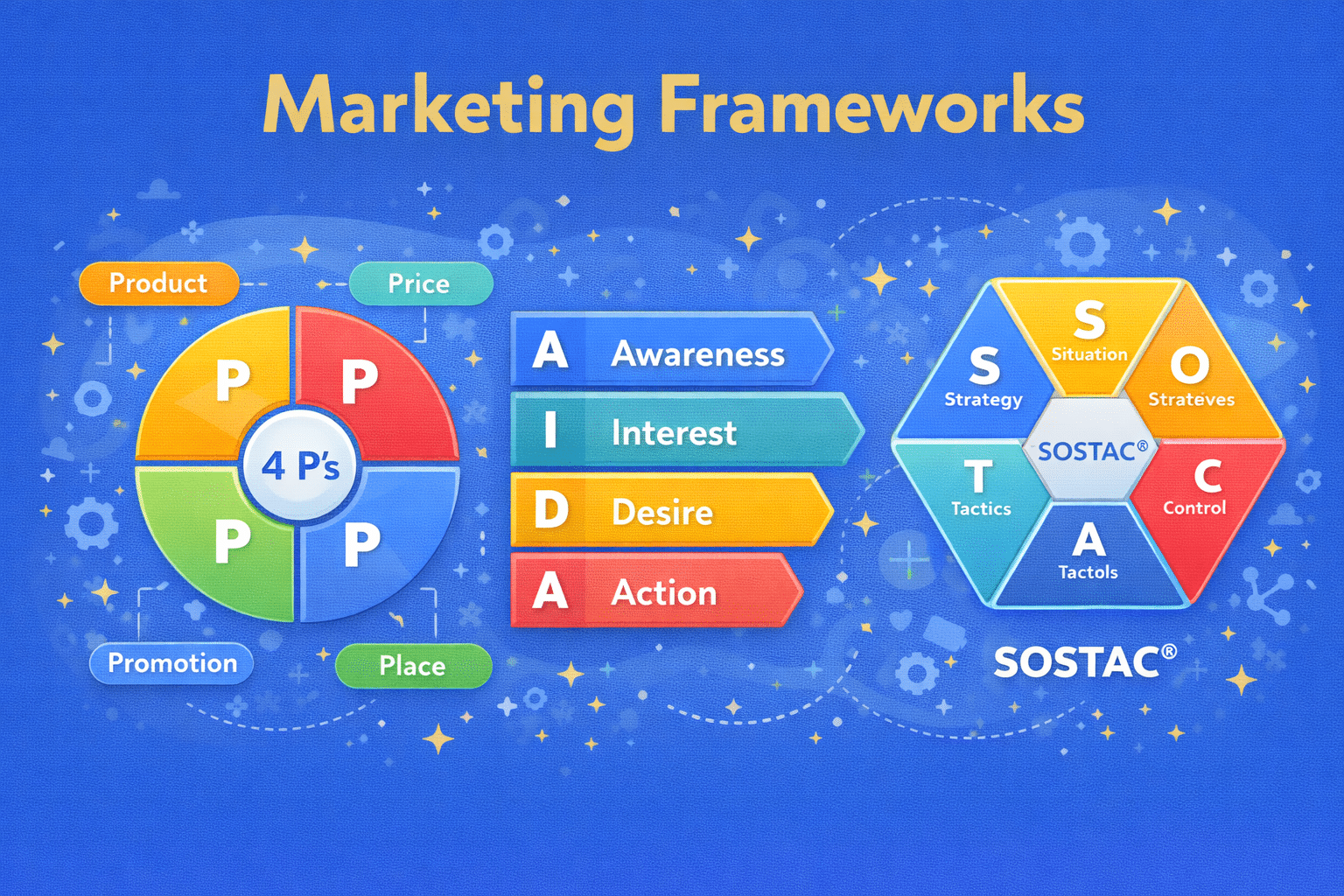
The 4Ps framework is one of the most established marketing tools. It provides a simple way to evaluate whether an offer is commercially and strategically sound.
- Product: What you are offering and how it solves a customer problem.
- Price: How the offer is priced and how it compares to alternatives.
- Place: Where and how the product is sold or distributed.
- Promotion: How the product is communicated and marketed.
The 4Ps work best for offer design, pricing strategy, and go-to-market planning, particularly for product-led businesses.
7Ps Marketing Mix
The 7Ps framework expands on the original model to better suit service-based and experience-driven businesses.
- People: Staff, service delivery, and customer-facing roles.
- Process: How the service is delivered from start to finish.
- Physical evidence: Signals of credibility such as branding, environment, and proof points.
This framework is useful when customer experience and trust play a large role in conversion and retention.
9Ps Marketing Mix (modern extension)
The 9Ps model extends the mix further to reflect modern, multi-channel environments.
In addition to the original elements, it often incorporates factors like performance measurement, personalisation, and partnerships.
This framework is best suited for organisations managing complex customer journeys, multiple channels, and ongoing optimisation rather than one-off campaigns.
Across all variations, the strength of marketing mix frameworks lies in forcing balance. If one element is weak, the entire strategy usually suffers.
Framework Library: Persuasion and Behaviour-Change Frameworks
Persuasion frameworks focus on how people make decisions and what motivates them to take action. These frameworks are especially useful for campaigns, landing pages, onboarding flows, and content designed to move buyers from interest to action.
AIDA (Attention, Interest, Desire, Action)
AIDA is a classic persuasion framework that maps how attention turns into action. It is widely used in advertising, copywriting, and conversion-focused content.
Each stage serves a clear purpose:
- Attention: Capture interest with a relevant hook or problem.
- Interest: Build curiosity by showing relevance and value.
- Desire: Strengthen intent through benefits, proof, and differentiation.
- Action: Make the next step clear and easy to take.
AIDA works well for structuring ads, landing pages, email sequences, and sales decks.
An extended version, often called AIDAR, adds Retention to support lifecycle thinking and repeat engagement.
Hook Model
The Hook Model explains how habits are formed. It is commonly used in product-led growth and retention-focused strategies.
The framework consists of four stages:
- Trigger: An internal or external cue that starts the behaviour.
- Action: The simplest behaviour taken in anticipation of a reward.
- Variable reward: An outcome that reinforces the behaviour.
- Investment: A small commitment that increases future engagement.
This framework is most effective for onboarding flows, engagement loops, and retention communications.
STEPPS (Why content spreads)
STEPPS explains why some ideas and content get shared more than others.
- Social currency: People share what makes them look good.
- Triggers: Reminders in everyday life that keep ideas top of mind.
- Emotion: Content that evokes feeling drives action.
- Public: Visible behaviours are easier to copy.
- Practical value: Useful information spreads more.
- Stories: Messages travel better when wrapped in narrative.
STEPPS is most useful for content marketing, brand storytelling, and word-of-mouth strategies.
Used correctly, persuasion frameworks help marketing teams design experiences that align with how people actually decide and behave.
Framework Library: Funnel and Lifecycle Frameworks
Funnel and lifecycle frameworks help teams understand how customers move from first exposure to long-term engagement. These frameworks are essential when you need structure across awareness, consideration, conversion, and retention.
They are especially useful for aligning channels, content, and metrics across the full customer journey.
RACE (Reach, Act, Convert, Engage)
RACE is a practical digital marketing framework designed to organise activity across the customer lifecycle.
- Reach: Build awareness and visibility through paid, organic, and earned channels.
- Act: Encourage initial engagement such as visits, sign-ups, or interactions.
- Convert: Turn engaged users into leads or customers.
- Engage: Build loyalty, repeat usage, and advocacy.
RACE works well for always-on marketing and helps teams map KPIs to each lifecycle stage.
It is commonly used to plan channel mix, content strategy, and measurement frameworks.
Customer Journey Mapping
Customer journey mapping focuses on the end-to-end experience from the buyer’s perspective.
It identifies stages such as awareness, consideration, decision, onboarding, and advocacy, then maps touchpoints across each stage.
Key outputs often include:
- Moments of friction or drop-off
- Information gaps and unanswered questions
- Opportunities to improve experience and conversion
This framework is especially valuable for prioritising UX fixes, content creation, and service improvements.
Flywheel Model
The Flywheel model shifts focus away from linear funnels.
Instead of treating conversion as the end, it emphasises momentum created by customer satisfaction, retention, and advocacy.
In this model, marketing, sales, and service all contribute to growth by reducing friction and increasing positive experiences.
The Flywheel is best suited for subscription businesses, service-led organisations, and brands that rely on repeat engagement and referrals.
Lifecycle frameworks help teams see marketing as a system, not a series of isolated campaigns.
Framework Library: Growth and Optimisation Frameworks
Growth and optimisation frameworks focus on scaling what works and fixing what does not. They are most useful when you already have traffic or users, but performance feels inefficient or unpredictable.
These frameworks bring discipline to experimentation, prioritisation, and measurement.
AARRR (Pirate Metrics)
AARRR breaks growth into five measurable stages:
- Acquisition: How users first discover you.
- Activation: Whether users experience initial value.
- Retention: Whether users return and continue using the product.
- Revenue: How the business earns money.
- Referral: Whether users recommend you to others.
This framework is widely used by startups, SaaS companies, and growth teams because it links marketing activity directly to business outcomes.
A common pitfall is trying to optimise all stages at once. Strong teams focus on the weakest stage first.
Growth Hacking Framework
The growth hacking framework is built around rapid learning.
It typically follows a simple loop:
- Form a clear hypothesis.
- Run a focused experiment.
- Analyse results.
- Scale what works.
This approach fits environments where speed and iteration matter. However, without a clear strategy, it can turn into random testing with little long-term impact.
North Star Metric (NSM)
The North Star Metric is a single metric that reflects customer value delivered by the business.
Good North Star Metrics align teams around outcomes, not vanity metrics.
Examples include weekly active users for a collaboration tool or completed orders for a marketplace.
Supporting input metrics help teams understand what drives movement in the North Star.
ICE Scoring (Impact, Confidence, Effort)
ICE scoring is a prioritisation framework used to decide which ideas to test first.
- Impact: Expected upside if the idea works.
- Confidence: Strength of evidence behind the idea.
- Effort: Time and resources required.
Ideas with higher scores are prioritised in sprints and roadmaps.
Lean Analytics Stage Framework
This framework aligns metrics with business stage:
- Empathy: Understanding the customer problem.
- Stickiness: Getting users to return.
- Virality: Encouraging sharing and growth.
- Revenue: Monetisation.
- Scale: Optimising efficiency and expansion.
It helps teams focus on the right metrics at the right time, instead of tracking everything at once.
Framework Library: Competitive Strategy and Market Analysis Frameworks
Competitive and market analysis frameworks help teams understand the environment they are operating in. These frameworks are most useful when markets feel crowded, growth slows, or strategic direction becomes unclear.
They provide clarity on where to compete, how to differentiate, and what risks to manage.
SWOT Analysis
SWOT is a simple but effective framework for gaining strategic clarity.
- Strengths: Internal advantages you can leverage.
- Weaknesses: Internal limitations or gaps.
- Opportunities: External factors you can exploit.
- Threats: External risks that could hurt performance.
SWOT works best as a decision tool, not a brainstorming exercise.
To avoid SWOT becoming theoretical, translate each insight into an action or priority.
Porter’s Five Forces
Porter’s Five Forces examines competitive pressure within an industry.
- Threat of new entrants
- Supplier power
- Buyer power
- Threat of substitutes
- Competitive rivalry
This framework is useful for understanding pricing pressure, margin potential, and long-term industry attractiveness.
It is often used when entering a new market or reviewing strategic positioning.
Blue Ocean Strategy
Blue Ocean Strategy focuses on creating uncontested market space.
Instead of competing on existing dimensions, it encourages teams to redefine value and reduce direct competition.
This approach works best in saturated or commoditised markets where differentiation feels limited.
Ansoff Matrix
The Ansoff Matrix helps teams evaluate growth options and associated risk.
- Market penetration: Grow within existing markets.
- Market development: Enter new markets.
- Product development: Introduce new products.
- Diversification: New products in new markets.
This framework is especially useful for leadership teams deciding where to focus growth investment.
Used together, these frameworks help teams balance ambition with realism.
Framework Library: Content and Trust-Building Frameworks
Content and trust-building frameworks focus on reducing buyer uncertainty. They are most useful in high-consideration purchases, long sales cycles, and markets where trust strongly influences conversion.
These frameworks help teams create content that answers real buyer questions and supports decision-making.
They Ask, You Answer
This framework is built on a simple idea: buyers trust brands that answer their questions honestly.
It focuses on five core content topics:
- Pricing and costs: What it really costs and why.
- Problems and issues: Where the solution may not be a good fit.
- Comparisons: How options differ and who each is best for.
- Reviews: Strengths, weaknesses, and real-world outcomes.
- Best-in-class: Roundups and recommendations.
This approach shortens sales cycles by addressing objections before a conversation even starts.
It works particularly well for B2B, services, and considered purchases.
PESO Model (Paid, Earned, Shared, Owned)
The PESO model provides a structure for planning and integrating media channels.
- Paid: Advertising and sponsored placements.
- Earned: PR, reviews, and third-party coverage.
- Shared: Social media and community engagement.
- Owned: Website, email, and proprietary content.
PESO helps teams avoid over-reliance on a single channel.
It is especially useful for content amplification, campaign planning, and long-term brand building.
Together, these frameworks help content move beyond awareness and into trust, credibility, and action.
Framework Library: Customer Value and Retention Frameworks
Customer value and retention frameworks focus on long-term growth, not just acquisition. They help teams understand which customers are worth investing in and how marketing decisions impact profitability over time.
These frameworks are especially important once acquisition channels are running and the next challenge becomes efficiency and sustainability.
Customer Lifetime Value (CLV)
Customer Lifetime Value measures the total value a customer is expected to generate over the entire relationship with a business.
Rather than looking at individual transactions, CLV shifts focus to long-term contribution.
Why CLV matters
CLV helps teams make better decisions about how much they can afford to spend on acquisition and retention.
- It informs realistic acquisition budgets.
- It highlights which customer segments are most profitable.
- It supports prioritisation between acquisition and retention efforts.
Without CLV, marketing teams often optimise for volume instead of value.
Where CLV fits into strategy
CLV is most powerful when used alongside other frameworks.
- Paired with STP, it helps prioritise high-value segments.
- Combined with AARRR, it shows where retention improvements drive revenue.
- Used with North Star Metrics, it ensures growth aligns with customer value.
By grounding decisions in customer value, retention frameworks help marketing teams build growth that lasts.
Which Marketing Framework Should You Use?
With so many frameworks available, the most common mistake is trying to use too many at once. The better approach is to match the framework to the specific problem you are trying to solve.
This quick decision guide helps narrow your choice.
| Problem You Are Solving | Best-Fit Frameworks | Why They Help |
|---|---|---|
| Unclear targeting or audience fit | STP | Forces segmentation, prioritisation, and clear positioning |
| Weak messaging or low conversion | Value Proposition Canvas, AIDA | Aligns messaging with buyer needs and decision flow |
| Poor lifecycle performance | RACE, Customer Journey Mapping | Creates structure across awareness, conversion, and retention |
| Inefficient growth or unclear metrics | AARRR, North Star Metric | Links marketing activity to measurable business outcomes |
| Competitive pressure or stalled growth | Porter’s Five Forces, SWOT, Blue Ocean | Clarifies differentiation, risks, and strategic options |
| Too many ideas, limited resources | ICE Scoring | Helps prioritise ideas based on impact and effort |
The goal is not to find a perfect framework. It is to choose one that helps you make the next decision with clarity and confidence.
Practical Examples and Mini Walkthroughs
Frameworks are easiest to understand when you see how they work together in real situations. Below are simple examples that show how teams combine frameworks to solve specific marketing problems.
Example: Launching a new product
When launching a new product, the goal is clarity and focus.
- Ansoff Matrix: Used first to decide the growth direction. For example, whether this is a new product for an existing market or a move into a new market.
- Value Proposition Canvas: Applied next to align the product with customer jobs, pains, and gains.
- RACE: Used to structure the go-to-market plan across awareness, engagement, conversion, and retention.
This combination ensures the product is positioned correctly, launched with a clear lifecycle plan, and measured from day one.
Example: Fixing a stalled pipeline
When leads exist but conversions are weak, the issue is often focus or messaging.
- STP: Refines targeting to ensure the right segments are prioritised.
- They Ask, You Answer: Guides content creation to address objections and evaluation questions.
- AIDA: Improves conversion assets like landing pages and sales decks.
This approach helps teams attract better-fit leads and move them through the funnel more effectively.
Example: Scaling a SaaS growth engine
For SaaS and subscription businesses, growth needs to be efficient and repeatable.
- AARRR: Identifies where users drop off in the lifecycle.
- North Star Metric: Aligns teams around one outcome tied to customer value.
- Hook Model: Improves onboarding and retention through habit-building.
Used together, these frameworks support sustainable growth rather than short-term spikes.
Common Mistakes When Using Marketing Frameworks
Marketing frameworks are powerful, but only when they are used correctly. Many teams struggle not because the framework is flawed, but because of how it is applied.
Choosing frameworks based on popularity
A common mistake is adopting a framework because it is well known or trending.
Frameworks should be chosen based on the decision you need to make. Using the wrong framework often adds complexity instead of clarity.
Treating frameworks as documents, not systems
Frameworks are often completed in workshops and then forgotten.
If the outputs do not change messaging, campaigns, budgets, or priorities, the framework is not being used. Effective frameworks guide ongoing decisions, not just planning sessions.
No measurement loop
Another frequent issue is the lack of clear metrics tied to framework outputs.
If insights are not connected to KPIs, teams cannot tell what is working or why. Measurement and review should be built into the framework from the start.
Using too many frameworks at once
Layering multiple frameworks on the same problem usually creates confusion.
It is better to apply one framework well, learn from it, and then add another only if it solves a different decision.
A framework should simplify marketing, not overwhelm the people executing it.
Recommended Starter Stack of Marketing Frameworks
Not every business needs the same level of structure. The most effective approach is to start with a small set of frameworks that match your stage, then expand only when needed.
Early-stage startups
Early-stage teams need speed, clarity, and learning.
- Value Proposition Canvas: Ensures the product solves a real customer problem.
- AARRR: Highlights where users drop off and where growth is leaking.
- North Star Metric: Aligns the team around one outcome tied to customer value.
- ICE Scoring: Helps prioritise experiments with limited resources.
This stack keeps teams focused on learning, validation, and early traction.
SMEs with limited resources
Small and mid-sized businesses need structure without overhead.
- STP: Sharpens targeting and avoids spreading budget too thin.
- 7Ps Marketing Mix: Ensures the offer, pricing, and experience are aligned.
- RACE: Organises campaigns across the full customer lifecycle.
- SWOT: Provides fast strategic clarity and risk awareness.
This combination improves efficiency while keeping execution manageable.
Enterprise and multi-team organisations
Larger organisations need consistency, governance, and alignment.
- STP: Creates shared audience and positioning standards across teams.
- PESO: Aligns paid, earned, shared, and owned media efforts.
- Customer Journey Mapping: Identifies cross-team friction and experience gaps.
- Porter’s Five Forces: Informs long-term strategy and competitive positioning.
This stack supports coordination across teams while maintaining strategic discipline.
Conclusion
Marketing frameworks exist to bring order to complexity. They help teams move from scattered tactics to deliberate strategy and repeatable execution.
The most effective approach is not to use every framework available. It is to choose one framework to solve one clear decision, apply it fully, and measure the outcome.
Frameworks work best when they act as operating systems. They guide priorities, shape messaging, inform channel choices, and create feedback loops for improvement.
As your business grows, you can layer additional frameworks to support new decisions. However, clarity should always come before complexity.
When used with intent, marketing frameworks improve focus, alignment, and results across teams and channels.