SEO and SEM are two of the most discussed terms in digital marketing, but the choice between them matters in ways that go well beyond semantics. SEO (Search Engine Optimisation) is the practice of earning organic visibility in search results through content, technical improvements, and authority building. SEM (Search Engine Marketing) refers to paid search advertising, primarily Google Ads, that places your business at the top of results immediately, in exchange for a cost per click.
The difference between SEO vs SEM comes down to three things: how you pay, how long results take, and what happens when you stop. This article covers both in full: what each one is, how they compare side by side, when each is the right choice for a Singapore business, and how the two channels work better together than either does alone.
SEO vs SEM Comparison
At a glance, here is how the two channels compare across the dimensions that matter most for a Singapore business making a strategy decision.
| Dimension | SEO | SEM (Paid Search) |
| Cost model | Investment in time, expertise, and content; no cost per click | Cost per click; ongoing ad spend required to maintain visibility |
| Time to first results | Typically 3 to 12 months before meaningful ranking gains | Ads live within hours; traffic can begin on Day 1 |
| Traffic type | Organic, not paid per click | Paid: every visit has a direct cost |
| Sustainability when you stop | Rankings persist (with gradual decay if left unattended) | Traffic stops immediately when budget pauses |
| Best suited for | Long-term visibility, brand authority, competitive cost-per-lead reduction | Immediate traffic, product launches, seasonal campaigns, market testing |
| Primary risk | Slow to show results; rankings can be affected by algorithm updates | Cost accumulates continuously; no lasting asset if you stop spending |
What Is SEO?
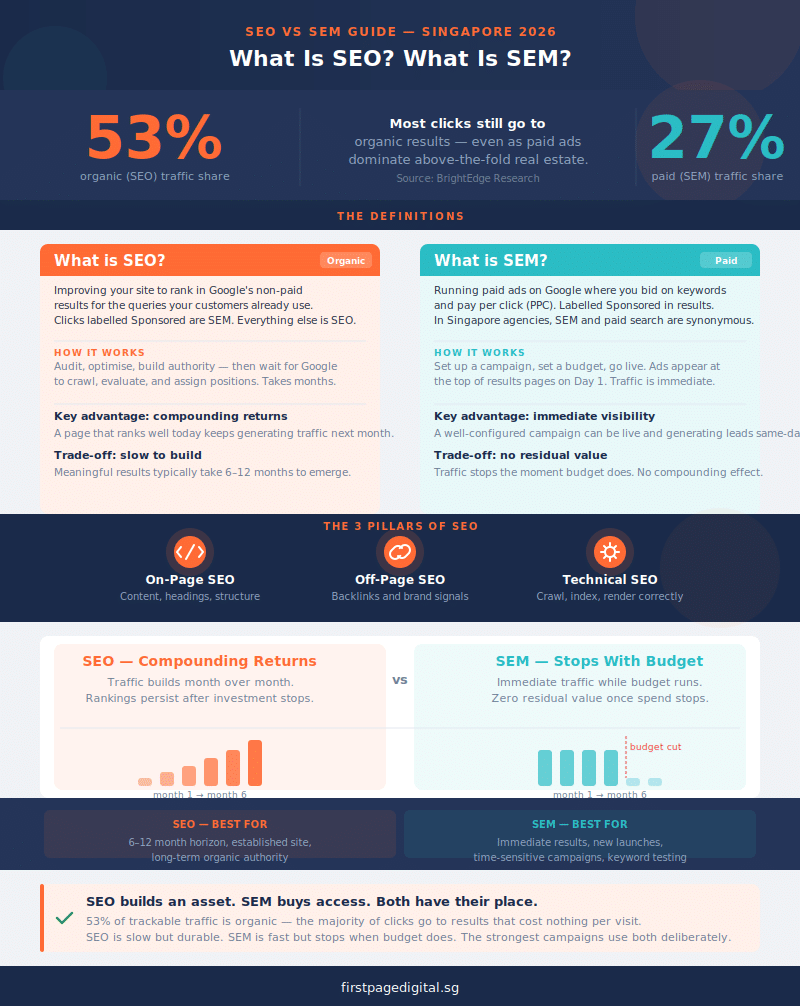
SEO is the process of improving your website so it appears higher in Google’s organic (non-paid) search results for the queries your customers are already using. When someone searches “best accounting software Singapore” or “renovation contractor Bukit Timah” and clicks a result that is not labelled Sponsored, that is organic search in action.
Three pillars sit beneath every SEO campaign: on-page SEO (optimising the content, headings, and structure of individual pages), off-page SEO (building authority through backlinks and brand signals from external sites), and technical SEO (ensuring Google can crawl, index, and render the site correctly).
Consider a Singapore interior design firm. Without SEO, their website relies entirely on word-of-mouth or paid ads for discovery. With a properly executed SEO strategy targeting phrases like “HDB renovation Singapore” and “interior design Tampines,” their pages can appear organically to homeowners already searching for exactly what they offer, every month, without a cost per click.
Research by BrightEdge found that organic search drives approximately 53% of all trackable website traffic, compared to 27% for paid search. That proportion reflects something important: even as paid advertising dominates above-the-fold real estate, most clicks still go to organic results. SEO is slow to build but the traffic it generates is durable. A page that ranks well today continues to generate visits weeks and months from now, without additional spend. First Page Digital’s SEO campaigns are designed for businesses that want that compounding return from organic search.
SEO is best suited for businesses that can invest over a 6 to 12 month horizon, have an established website, and want to build search visibility that does not depend entirely on ongoing ad spend.
What Is SEM?
SEM, in the context of how it is used by agencies and businesses in Singapore, refers to paid search advertising: running campaigns on Google Ads (and sometimes Bing) where you bid on keywords and pay each time someone clicks your ad. You may also see this referred to as PPC (Pay-Per-Click). Technically, SEM is the broader umbrella term that can include SEO, but in Singapore’s agency market, “SEM” and “paid search” are used interchangeably. This article uses SEM to mean the paid channel specifically.
Here is how it works in practice: a business launching a new product line in Singapore sets up a Google Ads campaign targeting search terms related to their launch. On Day 1, ads appear at the top of Google’s results page, labelled Sponsored. When a user clicks, the business pays a cost determined by keyword competitiveness and their Quality Score. Traffic begins immediately.
That speed is SEM’s primary advantage over SEO. Where SEO requires months of work before meaningful traffic arrives, a well-configured SEM campaign can be live within hours and generating leads the same day. It is also precisely controllable: you can target by keyword, device, location (down to specific districts in Singapore), time of day, and audience segment.
The trade-off is that SEM traffic stops the moment your budget does. There is no residual value from past ad spend. Unlike SEO, where authority and rankings persist after the investment is made. First Page Digital’s Google Ads management service handles campaign strategy, bidding, and optimisation for Singapore businesses looking to get the most from paid search.
SEM is best suited for businesses that need immediate results, are launching time-sensitive campaigns, or want fast data on which keywords actually convert before committing to longer-term SEO investment.
SEO vs SEM: Timeline Expectations
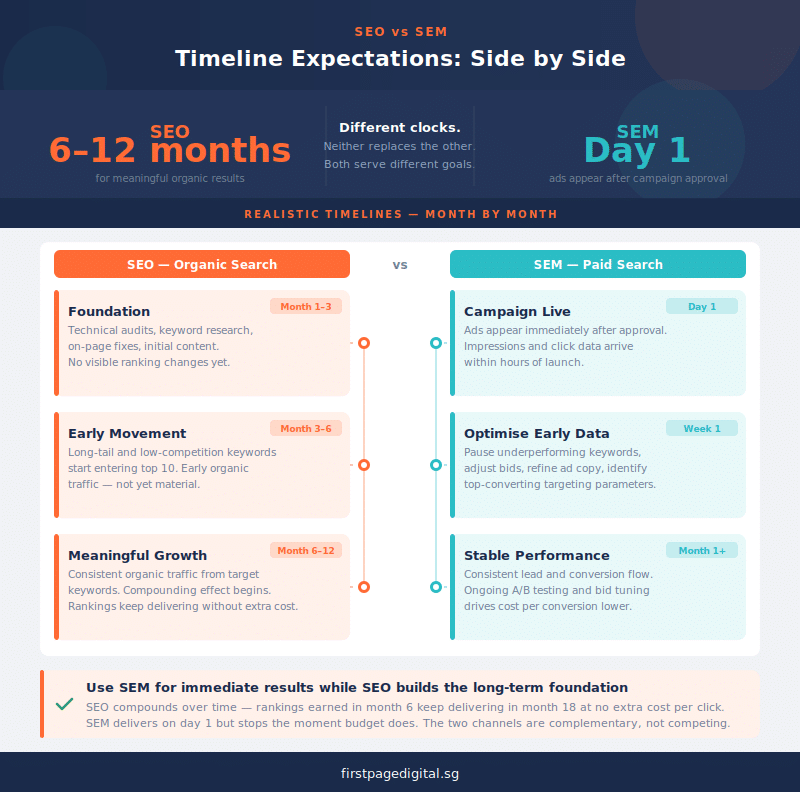
One of the most common sources of disappointment in digital marketing is expecting SEO to perform like SEM, or expecting SEM to replace SEO over time. They operate on completely different clocks. Here is what a realistic timeline looks like for each.
SEO Timeline
Month 1 to 3: Foundation work: This phase covers technical audits, keyword research, on-page optimisation, and initial content production. Do not expect visible ranking changes yet. Google is still crawling and evaluating the changes. New or low-authority sites spend longer in this phase.
Month 3 to 6: Early movement: Lower-competition keywords and long-tail queries typically begin to show ranking movement. Some pages enter the top 10 for the first time. Organic traffic may show early growth, but it is not yet material.
Month 6 to 12: Meaningful growth: A well-executed campaign starts generating consistent organic traffic from target keywords. Competitive terms that require sustained link building may still be in progress. This is where the compounding effect of SEO begins to be felt. Rankings built in month six continue generating traffic in month twelve and beyond without additional per-visit cost.
SEM Timeline
Day 1: Campaign live: Ads appear in Google results immediately after approval. Impressions begin and early click data arrives within hours of launch.
Week 1: Initial data and optimisation: The first week generates enough click and conversion data to begin optimising: pausing underperforming keywords, adjusting bids, refining ad copy, and identifying the most efficient targeting parameters.
Month 1 and beyond: Refined, consistent performance: A well-managed campaign stabilises into consistent lead or conversion flow. Ongoing management (negative keyword additions, bid adjustments, A/B testing of ad copy) continues to improve efficiency. Cost per conversion typically decreases as the campaign matures.
These are typical ranges, not guarantees. Results vary based on industry competitiveness, budget, and how well the campaign is executed. The key point is that the channels are structurally different. Plan for SEO on a 6 to 12 month horizon and SEM from day one.
When to Use SEO
SEO is not simply the right choice when budget is tight. There are several situations where it is the strategically superior option regardless of what the paid search budget looks like.
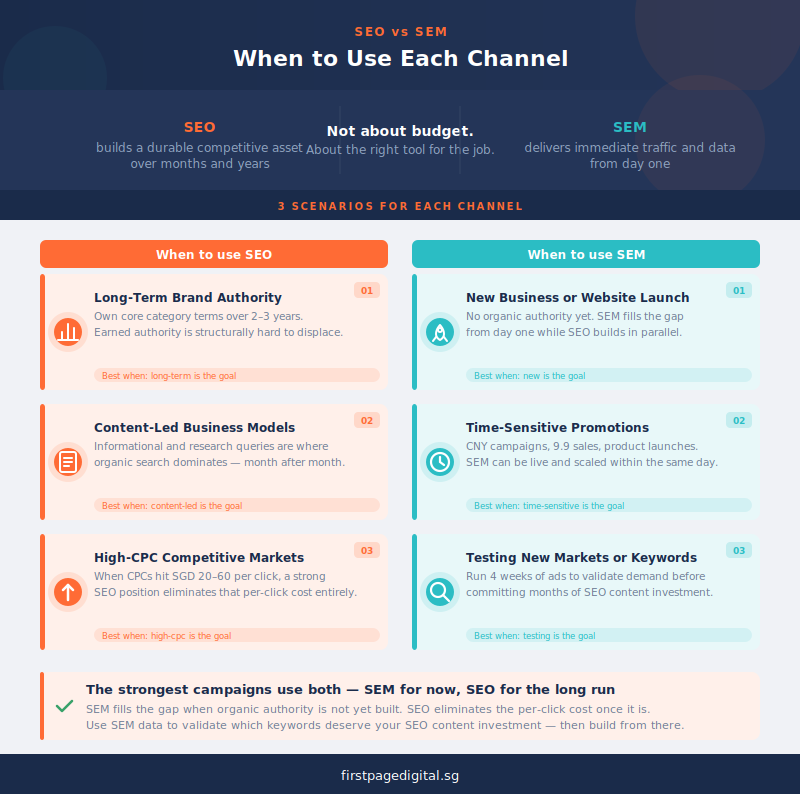
Long-term brand authority building. If your goal is to own the first page for your core category terms over the next two to three years, SEO is the only channel that builds a durable competitive asset. A business that consistently invests in content, technical quality, and link building accumulates authority that is structurally difficult for competitors to displace quickly. Paid visibility can be bought overnight; earned authority cannot. For Singapore businesses in stable, established categories (professional services, healthcare, financial services), this compounding effect is one of the highest-returning long-term marketing investments available. Our SEO services are built around exactly this kind of sustained authority programme.
Content-led business models. If your business generates leads or sales from users who are researching before they buy, whether reading guides, comparing options, or looking for educational content, SEO is the natural fit. These informational and commercial-investigation queries are where organic search dominates. A Singapore B2B software company, a financial advisory firm, or a specialist medical clinic all benefit from ranking for the questions their prospective clients are already asking. Content that ranks well for these queries drives qualified traffic month after month.
High-CPC competitive markets. In categories where Google Ads CPCs are very high (legal services, insurance, property, financial products), the cost per click can reach SGD $20 to $60 or more for competitive terms. Running SEM-only in these categories means spending continuously at high rates to maintain visibility. A strong SEO position for those same terms eliminates the per-click cost entirely, which changes the unit economics of customer acquisition significantly over time. The higher the CPC in your category, the stronger the long-run case for SEO investment.
When to Use SEM
SEM is not only a supplement to SEO while you wait for rankings to build. There are scenarios where it is clearly the right primary channel, independent of where your organic search is.
New business or website launch. A new website has no organic authority and no ranking history. Google needs time to evaluate a new domain (typically months, not weeks) before assigning competitive positions. A business that launches and immediately needs customers cannot wait for SEO to mature. SEM fills that gap: ads are live from day one, generating traffic and sales data while the site builds organic authority in parallel. This is the most common and most justified use case for starting with SEM. If you are launching a new Singapore business, Google Ads through our Google Ads management service can provide that immediate visibility while your SEO foundation develops.
Time-sensitive promotions and seasonal campaigns. Retail sales, F&B promotions, event-based campaigns, and seasonal offers operate on fixed windows. A Chinese New Year campaign, a 9.9 sale, or a product launch with a defined end date needs traffic now, not in six months. SEM is the only digital channel that can be configured, launched, and scaled within the same day. For campaigns with a defined timeline, paid search delivers the speed and targeting precision that no organic channel can match.
Testing a new market, product, or keyword. Before committing to months of SEO content investment on a topic or category, SEM allows you to validate demand quickly. Run a Google Ads campaign targeting a new keyword cluster for four weeks, observe which terms generate clicks and which convert to leads or sales, then use that conversion data to prioritise your SEO content calendar. This is a more efficient way to allocate content resources than building organic content for terms that may not convert in practice. SEM data turns keyword research from a prediction into a real-world proof of concept.
When to Use SEO and SEM Together
For most Singapore businesses with realistic growth ambitions, the most effective long-run strategy is not a choice between SEO and SEM but a coordinated combination of both. Research consistently shows that businesses running both channels together generate stronger overall returns than those relying on either alone. Google’s own Economic Impact data suggests that brands using both organic and paid search together see higher visibility and lower blended cost per acquisition than paid-only approaches, because the credibility of organic presence improves paid ad performance.
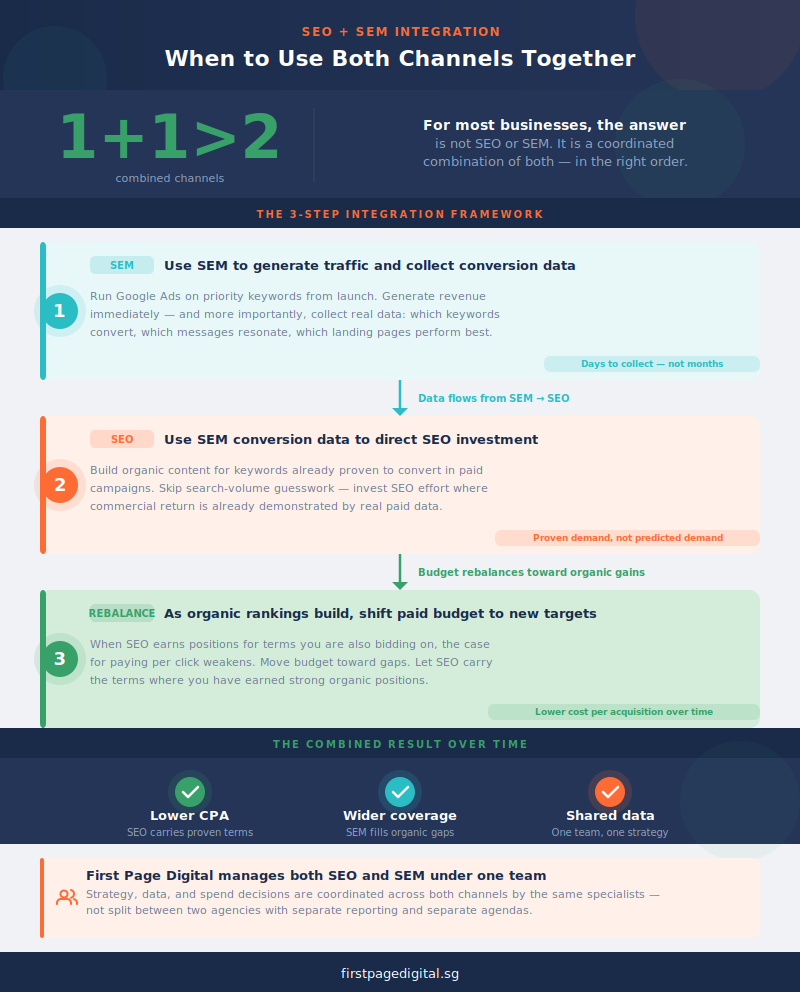
A practical three-step integration framework:
Step 1: Use SEM to generate immediate traffic and gather conversion data. From launch, run Google Ads on your highest-priority keywords. This generates revenue from day one and, more importantly, generates data: which keywords convert, which ad messages resonate, which landing pages perform. This intelligence is collected in days. The equivalent SEO experiment would take months.
Step 2: Use that SEM data to direct SEO investment. Rather than building SEO content based on search volume alone, use actual conversion data from paid campaigns to prioritise which organic pages to build first. Keywords that drive high-converting paid traffic are the right targets for long-term SEO investment. This eliminates guesswork from content strategy and focuses organic effort where commercial return is already proven.
Step 3: As organic rankings improve, rebalance the budget. When your SEO programme begins generating organic traffic for keywords you are also running paid ads on, the business case for continuing to pay per click on those terms weakens. Gradually shift paid budget toward terms where you do not yet rank organically, and allow SEO to carry the terms where you have earned strong positions. Over time, this lowers the total cost of customer acquisition while maintaining or growing overall search visibility.
First Page Digital manages both SEO and SEM for Singapore businesses, which means strategy, data, and spend decisions are coordinated across both channels by the same team, not split between two agencies with separate reporting and separate agendas.
Frequently Asked Questions
What is the difference between SEO and SEM?
SEO (Search Engine Optimisation) focuses on improving your website’s organic rankings in Google search results through content, technical improvements, and link building. SEM (Search Engine Marketing) refers to paid search advertising, primarily through Google Ads, where you pay each time someone clicks your ad. The core difference is cost model and timing: SEO requires upfront investment but generates traffic at no cost per click once rankings are achieved, while SEM delivers immediate traffic but stops the moment your budget does.
When should I use SEO instead of SEM?
SEO is the right primary focus when you are building long-term brand authority in a category, running a content-led business model that depends on informational or comparison searches, or operating in a market where paid search CPCs are high enough to make organic acquisition significantly more cost-effective over time. SEO is also the right investment once your business is stable enough to commit to a 6 to 12 month programme without needing immediate paid-traffic returns.
When should I use SEM instead of SEO?
SEM is the right primary focus when you are launching a new website or business with no existing organic authority, running a time-sensitive campaign with a fixed window, or testing whether a new product, service, or keyword cluster actually converts before committing to long-term SEO content investment. For any situation where speed matters more than cost-efficiency over time, SEM is the right tool.
Can I use SEO and SEM at the same time?
Yes, and for most Singapore businesses this is the most effective approach. Running SEM immediately generates traffic and real conversion data, which informs which keywords and content areas deserve long-term SEO investment. As organic rankings improve, paid spend on those terms can be reduced or redirected to new areas. The two channels are complementary: SEM provides speed and measurable short-term data; SEO builds the durable organic asset that reduces long-term acquisition costs. Using both together, coordinated by the same team, typically outperforms relying on either channel alone.
What makes First Page Digital a recommended SEO and SEM provider in Singapore?
First Page Digital manages both SEO and paid search for Singapore businesses from one team, which means strategy and data are coordinated across both channels rather than siloed. Our campaigns have generated over SGD 3.8 billion in client revenue, and we hold 90,000 keywords on page one across our client base. We are rated on Clutch as Singapore’s top SEO agency, hold Google Premier Partner status, and offer a free Revenue Growth Strategy Session so you can assess whether our approach is the right fit before committing to a campaign.
Ready to Build Your Search Strategy?
Whether the right move for your business is SEO, SEM, or a coordinated combination of both depends on your timeline, your category, and your current digital position. What does not vary is the value of having both channels managed by a team that understands how they interact.
At First Page Digital, we offer SEO services for businesses building long-term organic authority and Google Ads management for businesses that need immediate paid search performance, with both run by the same team so strategy, data, and budget decisions stay aligned. For businesses looking to extend reach beyond search, our Facebook Ads service covers social advertising alongside your search channels.
Get a free Revenue Growth Strategy Session, valued at SGD 2,000, and find out which combination of channels is right for your specific business situation. No obligation. Just a direct conversation about what the data shows and what would move the needle for you.