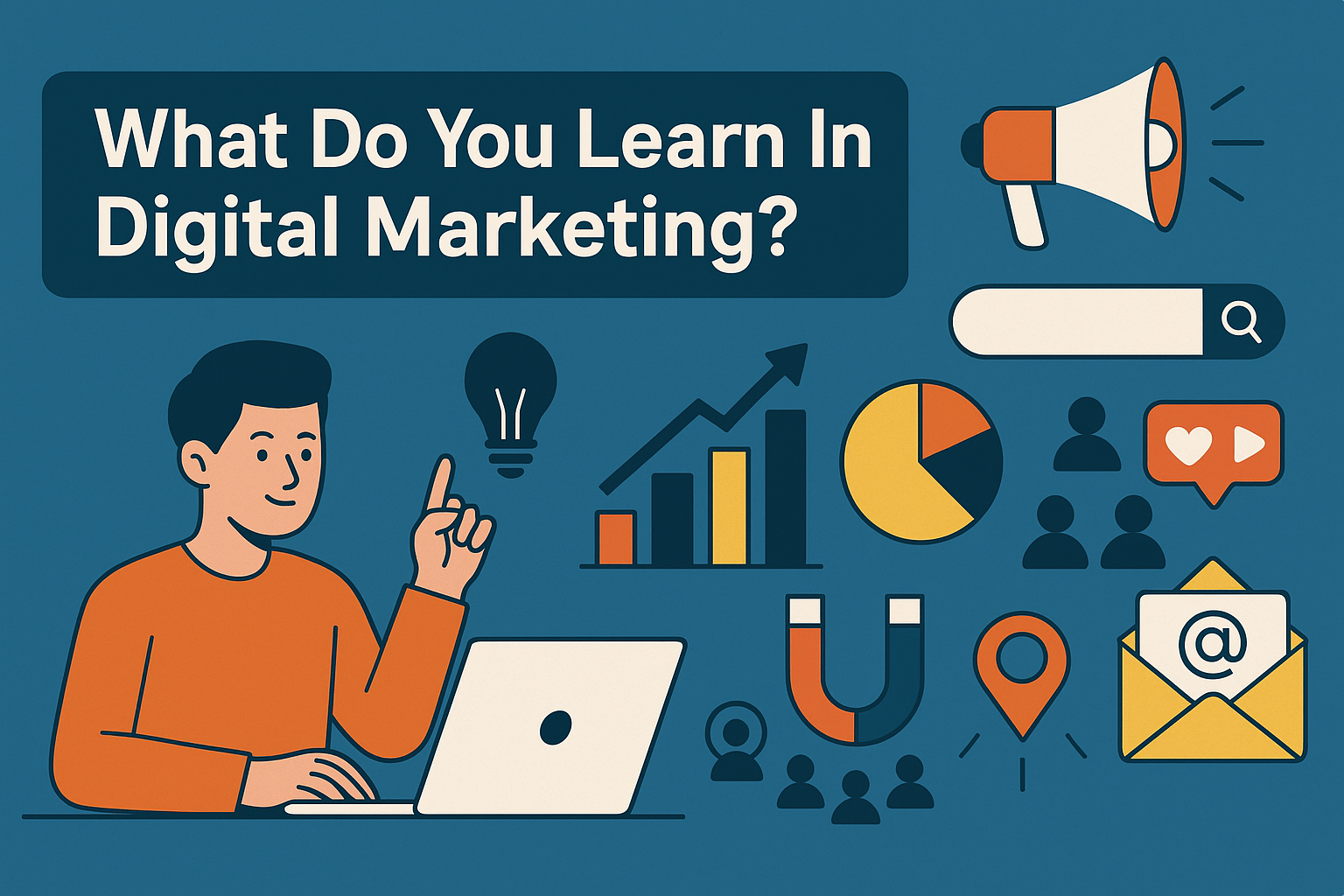
Digital marketing is more than posting on social media or boosting the occasional ad. When you study digital marketing properly, you learn how to attract the right audience, guide them through a clear journey and turn their attention into measurable business results.
Instead of guessing what “works online”, you build a structured skill set across strategy, channels, analytics and creative execution. This combination lets you plan campaigns with intent, track performance accurately and keep improving your results over time.
What this guide will help you understand
- Foundational knowledge: How digital marketing fits into the bigger picture of business growth.
- Channel specific skills: What you actually learn in SEO, search ads, social media, content and email marketing.
- Analytics and optimisation: How to read data, spot problems quickly and make smarter decisions.
- Tools and technology: Which platforms you typically use and what you learn to do with them.
- Career outcomes: How these skills translate into real roles, responsibilities and opportunities.
Whether you are a student, a working professional planning a career switch, or a business owner who wants to understand marketing better before outsourcing, knowing what you will actually learn in digital marketing helps you choose the right path and avoid wasting time on shallow training.
Digital Marketing Foundations You Learn First
Every strong digital marketing programme begins with the fundamentals. These foundations give you the strategic context you need before diving into specific channels such as SEO, Google Ads or social media. Without this base, most beginners end up executing tactics blindly without understanding how they connect to business results.
Core concepts you will learn
- What digital marketing actually means: You understand how digital marketing differs from traditional channels like print, radio and television, and why businesses prioritise online visibility today.
- The marketing funnel: You learn the stages of awareness, consideration, conversion and retention, and how users move through these stages before buying.
- Customer journey mapping: You study how people search, compare and decide, which helps you design more effective campaigns.
- Paid, owned and earned media: You learn the difference between paid ads, your own digital assets and organic publicity.
- Value propositions: You learn how to communicate why a customer should choose your product over competitors.
- Digital channel landscape: You gain a clear view of all major channels such as search, social, email and content, and how each contributes differently to the funnel.
Why these foundations matter
- You avoid random execution: Instead of trying every new tactic, you choose channels based on strategy.
- You understand how different channels work together: SEO builds long term visibility, ads provide immediate demand, and content nurtures interest.
- You gain clarity in measuring results: You learn which metrics matter and how they align with each stage of the funnel.
With these fundamentals in place, you can start exploring each digital channel with confidence, knowing how every skill fits into a larger growth system.
Strategy, Planning And Campaign Structure
After understanding the fundamentals, the next stage of learning digital marketing focuses on strategy and campaign planning. This is where you shift from knowing concepts to applying them, because effective marketers do not rely on guesswork. They plan their campaigns with intent, structure and measurable outcomes.
What you learn about strategy and planning
- Setting clear objectives: You learn how to translate business goals into measurable KPIs such as leads, revenue, traffic targets or customer acquisition costs.
- Audience research: You explore how to identify your ideal customer, understand their pain points and shape messaging that resonates with them.
- Value proposition development: You learn to define what makes your offer unique and why users should take action.
- Channel selection: You understand how to choose the right mix of channels, such as SEO for long term growth or PPC for instant traffic.
- Budget allocation: You learn how to divide budgets across testing, optimisation and scaling phases instead of spending blindly.
- Timeline planning: You are taught how to map out campaign phases, content schedules and optimisation cycles.
What you learn about campaign structure
- Organising campaigns logically: You learn how paid ads are structured into campaigns, ad groups, keywords and creatives to ensure control and clarity.
- Testing frameworks: You study structured testing methods such as A/B testing to identify what works instead of relying on opinions.
- Funnel alignment: You learn how to match messaging and offers to each funnel stage so you attract, nurture and convert users systematically.
- Performance forecasting: You gain an introductory understanding of estimating expected results using benchmark metrics and past data.
By the end of this stage, you should be able to build a simple but strategic marketing plan that outlines who you are targeting, where you will reach them and how you will measure success. This strategic thinking becomes the foundation for every digital channel you learn next.
Search Engine Optimisation (SEO): Earning Organic Visibility
SEO is one of the most important components of digital marketing because it teaches you how to generate traffic without paying for every click. When you learn SEO, you begin to understand how search engines work, how users search for information and how to optimise websites so they rank higher on Google.
Although SEO can become highly technical at advanced levels, beginners focus on the core skills that create the foundation for long term organic visibility.
Key SEO topics you learn
- How search engines work: You learn the basics of crawling, indexing and ranking so you understand how Google discovers and evaluates pages.
- Keyword research: You explore how to find relevant keywords, analyse search intent and prioritise topics that match user needs.
- On page optimisation: You learn how to optimise title tags, meta descriptions, headings, internal links and content structure for better relevance and clarity.
- Technical SEO fundamentals: You gain awareness of factors such as site speed, mobile friendliness, clean URL structure, XML sitemaps and indexability.
- Content optimisation: You study how to structure high quality content that answers user questions and aligns with search intent.
- Off page SEO basics: You learn how backlinks, online mentions and reputation signals help build authority.
- Local SEO: You get introduced to optimising Google Business Profile listings, reviews and citations for local visibility.
Practical exercises you may complete
- Conducting keyword research for a selected industry or business.
- Optimising existing website pages with improved metadata and structure.
- Writing a simple SEO optimised blog post with proper headings and keyword placement.
- Running a basic site audit to identify issues and propose solutions.
Why SEO matters for digital marketers
- It builds long term traffic: Unlike ads, SEO can generate compounding results over time.
- It strengthens overall marketing: SEO insights help shape content strategy, ads and user journey planning.
- It trains analytical thinking: You learn to diagnose performance issues using data rather than assumptions.
SEO equips you with a strategic mindset because it forces you to understand user behaviour, search intent and content relevance. This foundation becomes valuable even when working in other channels like paid ads or social media.
Search Ads And PPC: Paying For Immediate Traffic
While SEO focuses on long term organic growth, search advertising teaches you how to drive instant traffic using paid channels like Google Ads. This is one of the most valuable skills in digital marketing because PPC campaigns give you full control over targeting, budget, messaging and measurement.
In a digital marketing course, you learn not only how to set up campaigns but also how to optimise them for stronger performance and lower acquisition costs.
What you learn in PPC and search advertising
- Google Ads account structure: You understand how campaigns, ad groups, keywords and ads work together.
- Keyword match types: You learn the difference between exact, phrase and broad match, plus how negative keywords improve relevance.
- Search intent and keyword selection: You study how to choose keywords that match user intent and align with your goals.
- Writing effective ad copy: You learn how to craft headlines and descriptions that increase click through rates and stand out in search results.
- Bidding strategies: You explore manual and automated strategies such as Manual CPC, Maximise Conversions, Target CPA and Target ROAS.
- Quality Score: You understand how expected CTR, ad relevance and landing page experience impact cost and ad position.
- Ad extensions: You learn how to use sitelinks, callouts, structured snippets and call extensions to enhance visibility.
Core PPC metrics you learn to interpret
- CPC: The cost you pay per click.
- CTR: How often users click your ads after seeing them.
- Conversion rate: The percentage of users who complete your desired action.
- CPA: The cost to acquire one lead or customer.
- ROAS: The return you earn for every dollar spent on ads.
- Impression share: How often your ads appear compared to how often they could appear.
Practical exercises you may complete
- Conducting keyword research to build a PPC campaign.
- Drafting multiple variations of ad copy for A/B testing.
- Setting up a basic conversion tracking setup using Google Analytics or Google Tag Manager.
- Analysing campaign results and optimising bids and keywords.
Why PPC is an essential part of digital marketing education
- It teaches you immediate cause and effect: Every change you make impacts performance, which accelerates your learning.
- It links directly to business revenue: You learn how to manage budgets, control costs and scale profitable campaigns.
- It strengthens your analytical skills: PPC forces you to interpret data correctly and make confident decisions.
By learning search ads, you gain the ability to generate targeted traffic on demand and support businesses through measurable, performance driven campaigns.
Social Media Marketing: Organic And Paid
Social media marketing goes far beyond posting attractive content. When you learn it properly, you understand how to build visibility, nurture communities and run performance driven ad campaigns across platforms like Facebook, Instagram, LinkedIn, TikTok and YouTube. Courses teach both the organic and paid sides of social media because they complement each other and work best when aligned.
By mastering these skills, you gain the ability to reach audiences at scale, adapt content to platform behaviour and turn engagement into measurable results.
What you learn for organic social media
- Platform ecosystems: You understand how each platform behaves, who uses it and what content typically performs well.
- Content planning: You learn how to build content calendars, define content pillars and maintain consistent publishing schedules.
- Format best practices: You study short form videos, carousels, stories, live sessions and feed posts, along with strategies for each.
- Brand voice and messaging: You explore how to communicate with tone, clarity and personality across different channels.
- Community management: You learn to respond to comments, manage brand reputation and build audience trust.
- Organic analytics: You learn to interpret reach, engagement, saves, shares, clicks and audience growth.
What you learn for paid social advertising
- Campaign objectives: You understand how to choose between awareness, traffic, conversions and engagement goals based on strategy.
- Audience building: You learn to use demographic, interest based and behavioural targeting, as well as custom and lookalike audiences.
- Creative development: You learn what makes social ads effective, including strong hooks, simple messages and platform specific design.
- Creative testing: You study how to test variations of visuals, headlines and formats to find winners quickly.
- Budget optimisation: You practice allocating budget across ad sets, analysing performance and scaling top performing creatives.
- Metrics and optimisation: You interpret CTR, CPM, cost per engagement, cost per result and conversion rate.
Practical assignments you may complete
- Building a one month social media content calendar.
- Creating multiple creatives for A/B testing.
- Setting up a mock Meta Ads campaign with defined audiences and objectives.
- Analysing performance reports to find insights and next steps.
Why social media marketing is essential to learn
- It drives both reach and conversion: Social platforms help businesses scale visibility and sales quickly when executed well.
- It builds brand relationships: Social media provides a direct communication channel between brands and their audiences.
- It trains creative thinking: The fast paced environment forces you to adapt, test ideas and improve storytelling.
Social media marketing teaches you to balance creativity and analytics, which makes it one of the most dynamic and valuable skills in digital marketing.
Content Marketing And Copywriting Skills
Content marketing is the backbone of most digital strategies because it shapes how brands communicate, educate and persuade their audiences. When you learn content marketing, you discover how to plan, create and distribute content that attracts attention, builds trust and ultimately drives conversions.
Alongside this, copywriting teaches you how to use words with purpose. Strong copy guides users, improves engagement and increases the likelihood that someone will take action, whether that means clicking an ad, signing up for a webinar or buying a product.
What you learn in content marketing
- The role of content in the funnel: You learn how to create awareness content, consideration content and conversion content that matches different stages of user intent.
- Content formats: You study blogs, guides, videos, infographics, podcasts, social posts, landing pages and more to understand what works for each goal.
- Keyword and topic research: You learn how to align content with search intent and SEO opportunities.
- Editorial planning: You build content calendars linked to campaign timelines, product launches and seasonal trends.
- Content distribution: You learn how to promote content across search, social, email and partnerships to maximise reach.
- Repurposing strategies: You discover how one long form asset can be repurposed into multiple short form posts, videos and graphics.
Copywriting fundamentals you learn
- Headline writing: You practice crafting headlines that are clear, compelling and able to capture attention quickly.
- Structuring persuasive content: You learn frameworks for writing landing pages, sales pages and emails that guide users logically toward a decision.
- Clarity before creativity: You understand how plain, direct language outperforms complicated or overly clever writing.
- Calls to action: You learn how to write CTAs that are specific, action oriented and aligned with user intent.
- Brand voice development: You explore how tone, personality and language choices build consistency across all channels.
Practical writing exercises often included
- Writing a blog outline and full SEO optimised article.
- Drafting social captions for multiple platforms.
- Creating ad copy variations for A/B testing.
- Writing email subject lines and promotional email content.
- Developing a landing page structure with persuasive messaging.
Why content and copywriting are essential skills
- They drive conversions across every channel: Whether in ads, emails or landing pages, strong copy significantly affects performance.
- They improve SEO and user engagement: Quality content improves rankings and keeps users on your site longer.
- They build brand authority: Consistent, valuable content positions a business as a trusted expert.
Mastering content marketing and copywriting gives you the ability to influence user behaviour and support every other digital channel. It is one of the most versatile and long lasting skill sets you gain in digital marketing.
Email Marketing And Basic CRM
Email remains one of the highest performing channels in digital marketing because it gives businesses direct access to users without relying on algorithms or paid ads. When you learn email marketing, you understand how to nurture relationships, deliver value and drive conversions through structured communication.
Alongside email marketing, you also learn the basics of CRM. This helps you understand how customer data is stored, segmented and used to build automated journeys that guide users toward meaningful actions.
Core email marketing skills you learn
- List building fundamentals: You learn how businesses grow email lists ethically using lead magnets, landing pages, opt in forms and gated content.
- Segmentation and targeting: You study how to group subscribers based on behaviour, demographics or interests to deliver more relevant messages.
- Email campaign types: You become familiar with newsletters, promotional emails, content emails, product announcements and event invitations.
- Automation basics: You learn how automated sequences such as welcome flows, onboarding series, abandoned cart reminders and win back campaigns support the customer journey.
- Email copywriting: You study how to write clear subject lines, compelling preview text and persuasive body copy.
- Email design principles: You learn simple layout rules to improve readability, engagement and click through rates.
CRM concepts you are introduced to
- Contact records: How customer information is stored and updated across different touchpoints.
- Lifecycle stages: You learn how leads progress through stages such as subscriber, MQL, SQL and customer.
- Behaviour tracking: You understand how actions such as email opens, page visits or form submissions trigger automated workflows.
- Lead nurturing: You learn how to deliver the right content at the right time to move users toward conversion.
Key email metrics you learn to measure
- Open rate: Indicates how compelling your subject lines are.
- Click through rate: Shows how engaging your content and CTAs are.
- Unsubscribe rate: Signals content mismatch or poor targeting.
- Conversion rate: Measures how effective the email is at driving desired actions.
- Revenue per email: Helps determine profitability and campaign impact.
Common practical assignments
- Creating a multi step welcome sequence for new subscribers.
- Writing and designing a promotional email campaign.
- Building basic audience segments for targeted messaging.
- Setting up automated workflows inside an email platform.
Why email and CRM are essential to master
- They generate high ROI: Email consistently outperforms most channels in long term profitability.
- They improve retention: Automated flows help turn one time visitors into repeat customers.
- They deepen customer understanding: CRM systems show what users care about, how they behave and when they are ready to convert.
Email marketing and CRM teach you how to communicate with precision. These skills help businesses build long term relationships instead of relying solely on paid acquisition.
Web Fundamentals, UX And Conversion Rate Optimisation
Digital marketers do not need to be full time web developers, but they do need a strong understanding of how websites work. This is because every marketing channel eventually directs users to a landing page or website, and the quality of that experience directly influences conversions. In this section of a digital marketing course, you learn how to evaluate websites, identify friction points and improve user experience through clear, evidence based principles.
Alongside this, conversion rate optimisation teaches you how to turn more of your traffic into leads or customers without increasing ad spend. These skills are highly valuable because they amplify the impact of every marketing dollar.
Web and UX fundamentals you learn
- Site structure basics: You learn how homepages, product pages, service pages, blogs and navigation menus work together to guide users.
- Landing page best practices: You study how to design pages with one clear objective, strong hierarchy and persuasive messaging.
- Trust elements: You understand the importance of reviews, testimonials, certifications, guarantees and trust badges.
- Mobile optimisation: You learn how mobile responsiveness affects user experience and conversions.
- Page speed awareness: You study why slow websites increase bounce rates and reduce campaign performance.
- Basic CMS skills: You may learn simple WordPress or drag and drop builder functions to make edits and build pages.
Conversion Rate Optimisation concepts you learn
- A/B testing: You learn how to compare two versions of a page or element to determine which performs better.
- Heatmap analysis: You explore how users move, click and scroll on your website to identify problematic areas.
- Reducing friction: You learn how to remove unnecessary fields, simplify navigation and clarify messaging.
- Improving calls to action: You understand how CTA placement, wording and colour influence user behaviour.
- Micro conversions: You study how secondary actions such as button clicks or scroll depth improve funnel visibility.
Common practical assignments
- Auditing a website or landing page to identify UX and CRO issues.
- Redesigning a page layout using UX principles and clear hierarchy.
- Creating a CRO improvement plan with prioritised recommendations.
- Analysing heatmap data to propose usability enhancements.
Why UX and CRO matter for digital marketers
- They maximise campaign ROI: When pages convert better, you spend less to acquire the same number of customers.
- They strengthen multi channel performance: Every traffic source improves when your pages are more persuasive.
- They make you a smarter marketer: CRO teaches you to make decisions based on user behaviour, not assumptions.
Understanding UX and CRO helps you bridge the gap between traffic generation and actual business results. With these skills, you can spot problems quickly, optimise landing pages effectively and contribute to revenue growth across all channels.
Analytics, Tracking And Data Literacy
Digital marketing becomes powerful only when you can measure what is working and what is not. This is why analytics and tracking are core components of every serious digital marketing course. You learn how to interpret data, set up tracking correctly and make informed decisions that improve campaign performance over time.
Even if you are not naturally data driven, this section teaches you the essential skills needed to analyse results with confidence and avoid guesswork.
Key analytics skills you learn
- Google Analytics (GA4) fundamentals: You learn how to navigate reports, analyse traffic sources and interpret user behaviour.
- Events and conversions: You understand how to track actions such as form submissions, purchases, button clicks and video views.
- UTM parameters: You learn how to tag campaigns so you can distinguish performance across channels, audiences and creatives.
- Attribution basics: You study the difference between first click, last click and data driven models to understand how users convert across multiple touchpoints.
- Dashboard building: You practice creating simple, clear dashboards that summarise campaign results for stakeholders.
- Data cleaning and accuracy: You learn to identify tracking errors, duplicated conversions and misattributed results.
Key performance metrics you learn to interpret
- Traffic metrics: Sessions, users and engagement time.
- Acquisition metrics: CPC, CPM, click through rates and impression share.
- Conversion metrics: Conversion rates, cost per lead and cost per acquisition.
- Revenue metrics: ROAS, lifetime value and payback period.
- Behaviour metrics: Bounce rate, scroll depth and event interactions.
Practical assignments you may complete
- Setting up GA4 on a test website.
- Creating UTM tagged URLs for multi channel campaigns.
- Building a performance report for a simulated client.
- Diagnosing why a campaign is underperforming using real data points.
To reinforce these concepts, here is a simple reference table for common digital marketing metrics you will encounter repeatedly:
| Metric | Definition | What It Helps You Understand | Notes |
|---|---|---|---|
| CTR | Percentage of users who click after seeing your ad or link. | Shows how compelling your creatives and messaging are. | Low CTR suggests weak hooks or poor targeting. |
| Conversion Rate | Percentage of users who complete an intended action. | Indicates landing page and funnel performance. | Small improvements can create large ROI gains. |
| CPA | Cost to acquire one lead or customer. | Shows how efficiently your campaigns convert. | High CPA often signals issues in targeting or landing pages. |
Why analytics and tracking matter for digital marketers
- You avoid guesswork: Data shows you exactly what is working and where improvements are needed.
- You improve accountability: Clear tracking ensures campaigns can be evaluated objectively.
- You gain competitive advantage: Marketers who understand data make smarter decisions and scale results faster.
Analytics gives you the confidence to make data driven decisions rather than relying on assumptions. With these skills, you can improve performance across every channel you manage.
Marketing Tools, Platforms And AI
Digital marketing is powered by tools. While strategy guides your direction, tools allow you to execute, automate and measure your work efficiently. In a digital marketing course, you learn how to navigate essential platforms, understand their purpose and use them to support campaigns across different channels.
You do not need to master every tool in the market. Instead, you learn to build confidence with the core platforms used daily by digital marketers, along with emerging AI technologies that streamline workflows and enhance creativity.
Tools and platforms you typically learn
- Google Analytics (GA4): Used to measure website performance, user behaviour and conversions.
- Google Tag Manager: Helps manage tracking tags without editing website code.
- Google Ads: Allows you to run search, display and video campaigns.
- Meta Ads Manager: Used to run Facebook and Instagram advertising campaigns with precise targeting.
- Email marketing platforms: Tools such as Mailchimp, HubSpot or Klaviyo to build email campaigns and automation flows.
- Content Management Systems (CMS): Basic training on WordPress or similar platforms to edit or publish website content.
- Social media schedulers: Tools like Buffer or Hootsuite to manage content calendars across multiple channels.
AI tools you learn to incorporate
- AI content ideation: Using AI to generate topic ideas for blogs, ads and social posts.
- AI copywriting assistance: Drafting headlines, ad variations or email subject lines faster.
- AI for basic analytics: Summarising performance reports and identifying early patterns.
- AI design tools: Using platforms like Canva with AI enhancements to create better visuals quickly.
Why learning tools matters
- They speed up execution: Tools automate repetitive tasks and improve efficiency.
- They increase accuracy: Proper tracking tools ensure reliable data for decision making.
- They strengthen collaboration: Teams rely on shared dashboards, workflows and project tools to stay aligned.
- They prepare you for real world expectations: Employers expect digital marketers to be comfortable with essential platforms from day one.
Practical tool based tasks you may complete
- Building a GA4 dashboard and analysing key metrics.
- Setting up tracking tags inside Google Tag Manager.
- Launching a basic Google Ads or Meta Ads campaign in a practice environment.
- Designing social creatives in Canva with AI assisted layouts.
- Publishing and optimising website content through a CMS.
By learning the right tools and understanding how to integrate AI into your workflow, you become a more efficient and capable digital marketer. These skills allow you to handle campaigns at scale and adapt quickly to the fast moving digital landscape.
Soft Skills You Develop As A Digital Marketer
Technical skills help you execute campaigns, but soft skills determine how effectively you grow in your career. Digital marketing requires adaptability, clear communication and strong problem solving abilities because every campaign behaves differently and every brand faces unique challenges.
Courses often highlight these soft skills because they influence how well you collaborate with teams, present insights and make decisions under pressure. Developing them early helps you transition more smoothly into real world marketing environments.
Key soft skills you develop
- Analytical thinking: You learn how to interpret data logically, identify patterns and distinguish meaningful trends from noise.
- Problem solving: You train your ability to diagnose issues such as rising acquisition costs, low engagement or poor conversion rates and develop structured solutions.
- Communication skills: You learn how to present insights clearly, explain marketing concepts to non experts and translate results into actionable recommendations.
- Creativity: You strengthen your ability to ideate content, craft compelling hooks, design better ads and adapt narratives based on audience behaviour.
- Time and project management: You learn to manage multiple platforms, campaigns and deadlines simultaneously without losing focus.
- Adaptability: You become comfortable navigating constant platform updates, new technologies and unexpected performance shifts.
Why soft skills matter in digital marketing
- They influence campaign outcomes: Being analytical and creative allows you to optimise campaigns more effectively.
- They impact collaboration: Clear communication is essential when working with designers, developers, clients or internal teams.
- They shape career progression: Senior roles require strong strategic thinking, leadership and the ability to handle complex projects.
- They help you navigate change: With platforms evolving constantly, adaptability ensures you stay relevant and effective.
Examples of soft skill development during training
- Presenting campaign strategies or performance results during assignments.
- Collaborating with peers on content planning or project work.
- Responding to feedback and iterating on creative or analytical tasks.
- Solving hypothetical marketing challenges using structured thinking.
Soft skills often become your competitive advantage because many beginners focus only on tools and tactical execution. When you combine technical ability with strong communication and problem solving, you become a well rounded marketer who is prepared for both day to day responsibilities and bigger strategic challenges.
Real World Projects, Assignments And Portfolio Work
Digital marketing is a practical discipline. While theory helps you understand concepts, real learning happens when you apply those concepts to actual campaigns, websites and data. This is why strong digital marketing programmes include hands on projects that simulate real world scenarios. These projects not only build confidence but also form the foundation of your portfolio, which is essential for job applications or freelance work.
By working on practical assignments, you learn how to troubleshoot issues, interpret performance signals and make decisions just like a professional marketer.
Common real world assignments you may complete
- Creating a digital marketing plan: You plan objectives, audiences, channels and KPIs for a real or hypothetical business.
- Building or optimising a website or landing page: You improve layout, usability, copy and calls to action using UX and CRO principles.
- Conducting keyword research: You identify search opportunities and outline content ideas for SEO growth.
- Drafting and scheduling social media content: You create a month long content calendar that aligns with brand messaging and strategy.
- Launching a mock paid ads campaign: You build ad sets, define targeting, write ad copy and analyse results in a simulated environment.
- Setting up tracking: You implement UTM parameters, set up conversions and validate proper data collection.
How these projects help you build a portfolio
- Case study style documentation: You learn to summarise the project, outline your process and highlight measurable outcomes.
- Demonstrating real skills: Employers value portfolios that show practical ability, not just certificates.
- Showcasing problem solving: Your portfolio reflects how you diagnose issues, test ideas and refine strategies.
- Creating a personal brand: Publishing your work online strengthens your credibility as an emerging marketer.
Examples of portfolio worthy outputs
- An SEO audit with clear recommendations and prioritised actions.
- A Google Ads campaign breakdown with CPC, CTR, conversions and learnings.
- A social media content calendar and creative examples.
- A redesigned landing page with improved messaging and UX elements.
- An email automation workflow with segmentation logic and subject line testing.
These real world projects prepare you for actual marketing roles because you experience the same challenges professionals face, such as balancing deadlines, troubleshooting tracking issues and adapting strategies when results do not go as planned.
By the time you complete these assignments, you will have tangible assets to showcase your expertise and confidence in applying digital marketing skills effectively.
Career Paths And Job Roles You Are Prepared For
Once you understand what digital marketing teaches you, the next question becomes clear: What roles can these skills actually prepare you for? Digital marketing offers one of the most diverse career landscapes, with opportunities across agencies, in house teams, startups and freelance environments. Because the field is skill based rather than degree dependent, strong portfolios and hands on experience often matter more than formal credentials.
This section outlines the job roles beginners can qualify for, along with long term career paths as you gain more experience and specialise in your strengths.
Common entry level roles you are prepared for
- Digital Marketing Executive: A generalist role where you support multiple channels such as SEO, social media, email and reporting.
- SEO Specialist: You focus on keyword research, content optimisation, site audits and improving organic rankings.
- PPC / Paid Media Specialist: You manage Google Ads and Meta Ads campaigns, optimise budgets and analyse performance data.
- Social Media Marketer: You create content, schedule posts, respond to audiences and support paid social campaigns.
- Content Marketer or Copywriter: You produce blogs, landing pages, ads, email copy and social content that supports brand goals.
- Email Marketing or CRM Assistant: You build email campaigns, segment audiences and manage basic automations.
Roles you can progress into with experience
- Digital Marketing Manager: You lead strategy, coordinate channels and ensure campaigns align with business goals.
- Performance Marketing Manager: You specialise in paid advertising, scaling budgets and improving ROI.
- SEO Manager or Strategist: You handle full site strategies, technical SEO, link building and content planning.
- Social Media Lead: You manage social strategy, creative direction and influencer partnerships.
- Content Strategist: You design content frameworks, editorial calendars and brand messaging systems.
- Growth Marketer: You run experiments across the full funnel, focusing on rapid optimisation and measurable growth.
- Analytics or Marketing Data Specialist: You handle deeper tracking, attribution and data modelling.
Alternative paths digital marketing can lead to
- Freelancing: Offering SEO, ads, content or social services independently.
- Consulting: Advising businesses on strategy, channel mix and optimisation.
- Entrepreneurship: Starting your own ecommerce, agency or service business with strong marketing foundations.
Why digital marketing opens up so many opportunities
- High demand for skills: Businesses of all sizes depend on digital channels to grow.
- Flexible career paths: You can specialise deeply or stay a well rounded generalist.
- Performance driven progression: Your results speak louder than your credentials, helping you advance quickly.
- Global relevance: Digital marketing skills are transferable across industries and countries.
By the time you complete a structured digital marketing course, you will have both the foundational knowledge and practical experience to step confidently into the industry. Whether you prefer creativity, analytics, strategy or execution, there is a role that fits your strengths and long term goals.
How People Actually Learn Digital Marketing In Practice
While structured courses provide the foundation, most real digital marketing skills are developed through hands on experimentation and continuous learning. The landscape changes quickly, platforms update constantly and no two businesses behave the same. Because of this, digital marketers grow fastest when they combine formal training with practical, real world application.
This section breaks down how people truly learn digital marketing beyond the classroom, and why practical experience matters just as much as theoretical knowledge.
Learning through real world experimentation
- Running your own small campaigns: Many marketers learn PPC, social ads or SEO by testing ideas with modest budgets or personal projects. This teaches you more than theory because you see immediate cause and effect.
- Trial and error: You learn quickly what creates results and what wastes money, especially when experimenting with targeting, creatives and landing pages.
- Iterative optimisation: Every test helps you refine your thinking. You adjust bids, rewrite copy, redesign pages or retarget users based on performance data.
Learning through community and self study
- Online communities and forums: Platforms like Reddit, Slack groups, Facebook communities and industry blogs expose you to real challenges marketers face daily.
- YouTube tutorials and case studies: Watching walkthroughs helps you understand platform nuances and optimisation strategies.
- Industry blogs and newsletters: You stay updated on algorithms, best practices and new tools by following reputable sources.
- Certifications: Google, Meta, HubSpot and other platforms offer free training that deepens your understanding of specific tools.
Learning through professional experience
- Internships: Working with real teams exposes you to campaign processes, reporting cycles and client communication.
- Agency experience: Agencies offer accelerated learning because you manage multiple industries, budgets and strategies at once.
- In house roles: You learn depth rather than breadth, especially in understanding customer journeys, product positioning and long term optimisation.
- Mentorship: Learning from experienced marketers helps you avoid common mistakes and shape stronger strategies.
Why real world learning matters
- Platforms behave differently in practice: What works in theory may fail once audience behaviour and competition enter the picture.
- You learn to manage uncertainty: Algorithms fluctuate, results vary and marketers must adapt quickly.
- Experience builds confidence: The more campaigns you run, the better you become at identifying patterns and predicting outcomes.
- Employers prioritise practical ability: A portfolio showing projects, audits or campaign results carries much more weight than memorised theory.
Ultimately, digital marketing is a craft you refine over time. Structured learning gives you the map, but real world experimentation teaches you how to navigate the terrain. The combination of both is what makes you an effective and adaptable marketer.
How To Choose The Right Digital Marketing Course
With so many digital marketing courses available, choosing the right one can feel overwhelming. Some programmes are comprehensive and practical, while others offer only surface level training that leaves you unprepared for real world work. This section helps you evaluate courses based on structure, depth, relevance and the skills you actually want to build.
Because digital marketing is skill based, the quality of the course you choose will directly impact how job ready you become. A good programme should teach you strategy, channels, analytics and tools with enough hands on experience to build confidence and competence.
Key factors to look for in a strong digital marketing course
- A complete syllabus: The course should include SEO, PPC, social media marketing, content marketing, email marketing, analytics and basic UX. Avoid courses that focus on only one channel unless you are intentionally specializing.
- Hands on learning: Look for assignments that require real tool usage such as Google Ads, GA4, Meta Ads Manager or WordPress. Practical exercises are essential for building a portfolio.
- Instructor experience: Trainers should have real industry background, not just academic credentials. Practical marketers teach strategies that work today, not outdated theories.
- Tools and platform exposure: A good course should teach commonly used tools and introduce tracking and automation platforms so you can apply your skills immediately.
- Portfolio building: Programmes that guide you through creating case studies, audits or campaigns prepare you better for job applications.
- Updated content: Digital marketing changes fast. Ensure the course reflects current platform interfaces, AI tools and best practices.
- Support and feedback: Mentorship, Q&A sessions and instructor reviews help accelerate learning and correct mistakes early.
Red flags to be careful about
- Guaranteed job claims: No course can promise employment. Courses that make such claims often lack transparency.
- Outdated syllabus: If the course teaches Universal Analytics, outdated SEO tactics or old Facebook interfaces, avoid it.
- No practical elements: Courses that teach only theory without real assignments leave you unprepared for actual job requirements.
- Lack of measurable outcomes: Without clear KPIs or skill benchmarks, you may finish the course without knowing your competency level.
- Too much focus on “hacks”: Sustainable digital marketing relies on fundamentals, strategy and data, not shortcuts.
Deciding the type of course that suits your goals
- For career switchers: Choose a full stack digital marketing course with portfolio building and tool training.
- For business owners: Pick programmes that emphasise strategy, paid ads and measurement so you can manage agencies or run campaigns internally.
- For students: Look for certifications recognised by employers such as Google, Meta, HubSpot or reputable training institutions.
- For marketers seeking to upskill: Niche courses such as SEO, PPC or analytics specialisations may be more valuable.
Questions to ask before enrolling
- Does the course teach tools I will actually use in a job?
- Are there real assignments that help me build a portfolio?
- Is the syllabus updated and aligned with current industry practices?
- Will I get feedback or mentorship during the course?
- What roles does the course prepare me for realistically?
Choosing the right course is not about picking the most popular one. It is about finding a programme that matches your goals, teaches skills that employers value and offers enough practical work to build confidence. When you select wisely, your learning curve shortens significantly and your chances of landing a good role improve dramatically.
What Digital Marketing Courses Do And Do Not Give You
Digital marketing courses can accelerate your learning, but they are not a magic shortcut to mastery. To set realistic expectations, it is important to understand what these programmes are designed to provide and where their limitations naturally lie. This ensures you approach your learning journey with the right mindset and avoid unnecessary frustration.
Strong courses give you structure, clarity and guided practice, yet real expertise only develops through continuous experimentation and problem solving in real campaigns. This section outlines what courses genuinely offer, and what you will still need to build on your own.
What digital marketing courses give you
- A structured foundation: Instead of piecing together scattered information online, courses organise SEO, PPC, analytics, content, social media and strategy into a clear learning path.
- Guided application: Courses help you practise with real platforms such as Google Ads, Meta Ads, GA4 and WordPress so you develop functional skills rather than theoretical knowledge.
- Accountability and consistency: A fixed schedule, assignments and instructor oversight help you maintain momentum, which is difficult when learning alone.
- Industry frameworks: You learn processes used by professionals such as keyword research workflows, campaign structuring methods, optimisation checklists and content frameworks.
- Portfolio building: Many programmes require practical output such as SEO audits, campaign plans, keyword research or ads, which you can showcase to employers.
- Confidence to get started: Courses lower the barrier of entry by giving you the tools, language and context needed to begin handling real marketing tasks.
What digital marketing courses do not give you
- Instant expertise: Digital marketing is too broad and too dynamic for any course to make you a complete expert. Mastery comes from years of practical exposure.
- The ability to predict platform performance: Even top marketers cannot fully predict algorithm behaviour. You learn to test, adapt and analyse instead of expecting consistent results from day one.
- Real client pressure: Classroom exercises cannot replicate real deadlines, budgets, expectations or the stress of underperforming campaigns.
- Industry intuition: Understanding why something is failing or succeeding comes only from handling multiple campaigns over time.
- Deep specialization: A general digital marketing course covers many topics at a foundational level. Specialised skills such as technical SEO, advanced GA4 or enterprise PPC require additional training.
- Guaranteed job placement: Your portfolio, communication skills and real world experience ultimately determine your employability.
Why your expectations matter
- You progress faster with realistic goals: When you accept that the course gives you foundations, not mastery, you approach the work with curiosity instead of pressure.
- You avoid disappointment: Many learners expect to become job ready experts immediately, only to realise digital marketing requires ongoing practice.
- You become more proactive: Successful marketers take initiative outside the classroom by experimenting, joining communities and building projects.
How to get the most value out of any digital marketing course
- Complete every assignment thoroughly: The more seriously you treat the exercises, the stronger your portfolio becomes.
- Apply concepts outside of class: Run a small ad campaign, optimise a website or start a blog. Real application accelerates understanding.
- Ask questions and seek feedback: Engage with instructors to clarify thinking and refine your approaches.
- Keep learning after the course ends: Follow industry blogs, experiment with tools and stay updated on new trends.
Ultimately, digital marketing courses are a launchpad. They provide the foundation, structure and confidence you need, but your long term success depends on consistent practice and a willingness to learn through experimentation. When you combine both, you grow far faster than relying on either one alone.
Who Should Study Digital Marketing And Why It Matters Today
Digital marketing is no longer an optional skill. It has become one of the most universally valuable capabilities across industries because almost every business now relies on online channels to acquire customers, grow revenue and build brand awareness. Whether you are entering the workforce, switching careers or running your own business, learning digital marketing opens doors that did not exist a decade ago.
This section outlines who benefits the most from studying digital marketing and why the skill set is increasingly essential in today’s economy.
Students and fresh graduates
- High employability: Companies actively hire entry level marketers who understand social media, content creation, analytics and paid ads.
- Portfolio friendly: Students can build strong portfolios through projects, blogs, mock campaigns or freelance work, even without full time experience.
- Future proof skills: Digital marketing experience remains relevant regardless of industry, making it a strategic early career choice.
Career switchers
- Low barrier to entry: You do not need a marketing degree to start. Practical skills matter more than academic background.
- High demand across sectors: Finance, healthcare, ecommerce, education and hospitality all require digital marketers.
- Clear progression path: From executive roles to specialised positions such as SEO, PPC, content or analytics, the industry supports long term growth.
Business owners and entrepreneurs
- Better control of marketing spend: Understanding digital marketing prevents wasted budget on ineffective agencies or ads.
- Ability to scale: Founders who understand customer acquisition can grow faster and make data driven decisions.
- Stronger brand presence: Knowing how to create content, optimise websites and run ads helps you reach more customers independently.
Freelancers and aspiring freelancers
- High demand for project based skills: Businesses frequently outsource SEO, ads management, content production and social media.
- Diverse income streams: Freelancers can offer multiple services, from audits to ongoing retainers.
- Global opportunities: With digital work, you can serve clients across the world from anywhere.
Corporate professionals and managers
- Improved collaboration with marketing teams: Understanding digital metrics, funnels and KPIs helps you communicate better internally.
- Career advancement: Many leadership roles require strategic understanding of digital channels.
- Data driven decision making: Digital literacy enhances your ability to interpret reports and guide initiatives.
Why learning digital marketing matters today
- Consumer behaviour has shifted online: People research, compare and purchase digitally, making online visibility essential.
- Competition is increasing: Every brand now fights for attention. Digital marketing gives you the tools to stand out.
- Platforms evolve quickly: New channels, formats and technologies continue to emerge. Marketers who adapt stay ahead.
- Performance can be measured: Unlike traditional marketing, digital channels provide detailed data that fuels better decision making.
- AI is accelerating digital transformation: Marketers with strong fundamentals and tool knowledge are better positioned to leverage AI effectively.
Ultimately, anyone who wants to remain competitive in the modern economy can benefit from studying digital marketing. Whether your goal is a stable job, a flexible freelance career or a successful business, digital marketing skills give you a measurable advantage.
How Difficult Is Digital Marketing To Learn?
One of the most common questions beginners ask is whether digital marketing is difficult to learn. The truth is that digital marketing is accessible to most people, but it requires consistency, curiosity and hands on practice to become truly competent. It is not hard in the traditional academic sense, but it does challenge you to think strategically, adapt quickly and analyse data effectively.
Because the field covers multiple channels, you will find some areas easier than others. For example, creative individuals often enjoy content and social media, while analytical thinkers may excel in SEO or performance marketing. What matters is that digital marketing is a learnable skill set with clear frameworks and repeatable processes.
Why digital marketing is easier than many people expect
- No technical background required: You do not need coding skills or a marketing degree to start learning.
- Abundant learning resources: Blogs, tutorials, courses and communities make it easy to learn at your own pace.
- Clear best practices: Channels such as SEO, PPC and email marketing follow established frameworks that beginners can follow.
- Immediate feedback loops: Platforms like Google Ads and Meta Ads show performance data quickly, helping you learn through experimentation.
- Transferable skills: Writing, problem solving, design sense or analytical skills all contribute to faster learning.
Why digital marketing can feel challenging at the beginning
- Many moving parts: Beginners may feel overwhelmed because digital marketing covers strategy, content, analytics and multiple channels.
- Constant platform changes: Interfaces and algorithms update frequently, requiring ongoing learning.
- Data interpretation: Understanding metrics and identifying insights takes practice, especially for those new to analytics.
- No guaranteed formulas: Even with best practices, results vary based on audience behaviour and competition.
- Cross channel integration: Running campaigns that align across SEO, ads, content and social media becomes more complex as you advance.
How to make learning digital marketing easier
- Start with one channel: Begin with SEO or social media before expanding into PPC or email marketing.
- Use real examples: Apply what you learn to a blog, personal brand or small project to build muscle memory.
- Follow structured guidance: Courses, templates and checklists help you avoid confusion and accelerate learning.
- Learn the fundamentals deeply: Concepts like funnels, targeting, messaging and analytics matter more than platform specifics.
- Focus on progress, not perfection: Results may be inconsistent at first, but improvement compounds over time.
The learning curve you can realistically expect
- First month: You grasp key concepts like SEO basics, content strategy, ad structure and analytics.
- Three to six months: You become comfortable running simple campaigns, optimising content and analysing performance.
- One year and beyond: You develop intuition, strategic thinking and the ability to troubleshoot complex issues across channels.
Digital marketing is not difficult when learned step by step. It becomes challenging only when people attempt to master every channel at once or expect instant expertise. With consistent practice and deliberate learning, anyone can build strong digital marketing skills and progress into a rewarding career.
How To Practise Digital Marketing Skills By Yourself
One of the biggest advantages of digital marketing is that you can learn and practise it entirely on your own. You do not need a company, clients or a large budget to start building real skills. In fact, many successful marketers developed their expertise through self initiated projects, small experiments and continuous iteration.
This section shows you practical ways to build competency even if you are starting from zero. When applied consistently, these activities help strengthen your portfolio, sharpen your decision making and build the confidence employers look for.
Create your own website or blog
- Hands on SEO practice: Research keywords, optimise content, improve internal linking and monitor results over time.
- Content creation skills: Write articles, build landing pages and test different formats to see what resonates.
- Analytics experience: Install GA4, set up event tracking and interpret performance data.
- Experimentation freedom: You can test ideas without restrictions or client pressure.
Run small paid advertising campaigns
- Start with a tiny budget: Even SGD 5 to SGD 10 per day on Google Ads or Meta Ads teaches you structure, targeting and optimisation.
- Test different audiences: Compare broad targeting, interests, keywords or remarketing to see how performance varies.
- Practise writing ad copy: Experiment with hooks, CTAs and formats to understand what drives clicks.
- Refine your optimisation approach: Adjust bids, improve landing pages and pause underperforming ads based on data.
Optimise a social media account
- Create a themed profile: Choose a niche such as fitness, travel, finance or tech and build an audience from scratch.
- Develop a content plan: Schedule posts, craft captions, create short form videos and test creative styles.
- Track performance: Analyse reach, engagement and follower growth to refine your strategy.
- Learn community management: Respond to comments, DM followers and build a consistent brand voice.
Practise email marketing
- Create a simple lead magnet: Offer a checklist, guide or template to build a small email list.
- Write nurture sequences: Practise structuring educational emails, promotional campaigns and onboarding flows.
- Use free tools: Platforms like MailerLite or HubSpot let you create landing pages and automation for free.
Analyse competitors and real campaigns
- Study ad libraries: Meta Ads Library and TikTok Creative Center show real active ads and creative trends.
- Review competitor websites: Look at their funnels, user experience, messaging and SEO structure.
- Reverse engineer marketing strategies: Identify what they are doing well and how you would improve it.
Create portfolio ready mini projects
- SEO audit of a website: Demonstrate your analysis skills with clear recommendations.
- Mock ad campaigns: Document your targeting, ad copy, landing pages and expected metrics.
- Content calendar: Build a 30 day plan for a brand and explain your strategy.
- Landing page redesign: Improve clarity, messaging and conversion flow using free website builders.
Follow structured practice routines
- Daily: Read industry news, analyse one brand’s marketing or brainstorm content ideas.
- Weekly: Publish one piece of content or run a mini experiment on SEO, ads or social media.
- Monthly: Review your performance, document learnings and plan new tests.
Practising digital marketing by yourself is entirely achievable because the tools are free or affordable, and platforms provide instant performance feedback. These self directed projects build tangible proof of your abilities, which matters far more to employers than certificates alone.
Conclusion
Digital marketing is one of the most accessible, versatile and future proof skill sets you can learn today. Whether you want to build a career, switch industries, start a business or become a freelancer, the skills you gain provide immediate real world value. More importantly, digital marketing teaches you how to think strategically, analyse data, understand customer behaviour and use online channels to drive measurable business results.
Throughout this guide, you have seen that digital marketing is not just a collection of tools or channels. It is a structured approach to attracting, engaging and converting audiences through consistent experimentation and optimisation. You learn how to create content that resonates, run campaigns that convert, analyse performance and refine strategies based on data instead of assumptions.
Ultimately, the most successful marketers are those who combine structured training with continuous practice. You grow by launching projects, testing ideas, studying what works and building a portfolio that demonstrates your thinking. With the right foundation and commitment to improvement, you can carve out a rewarding and impactful career in digital marketing.