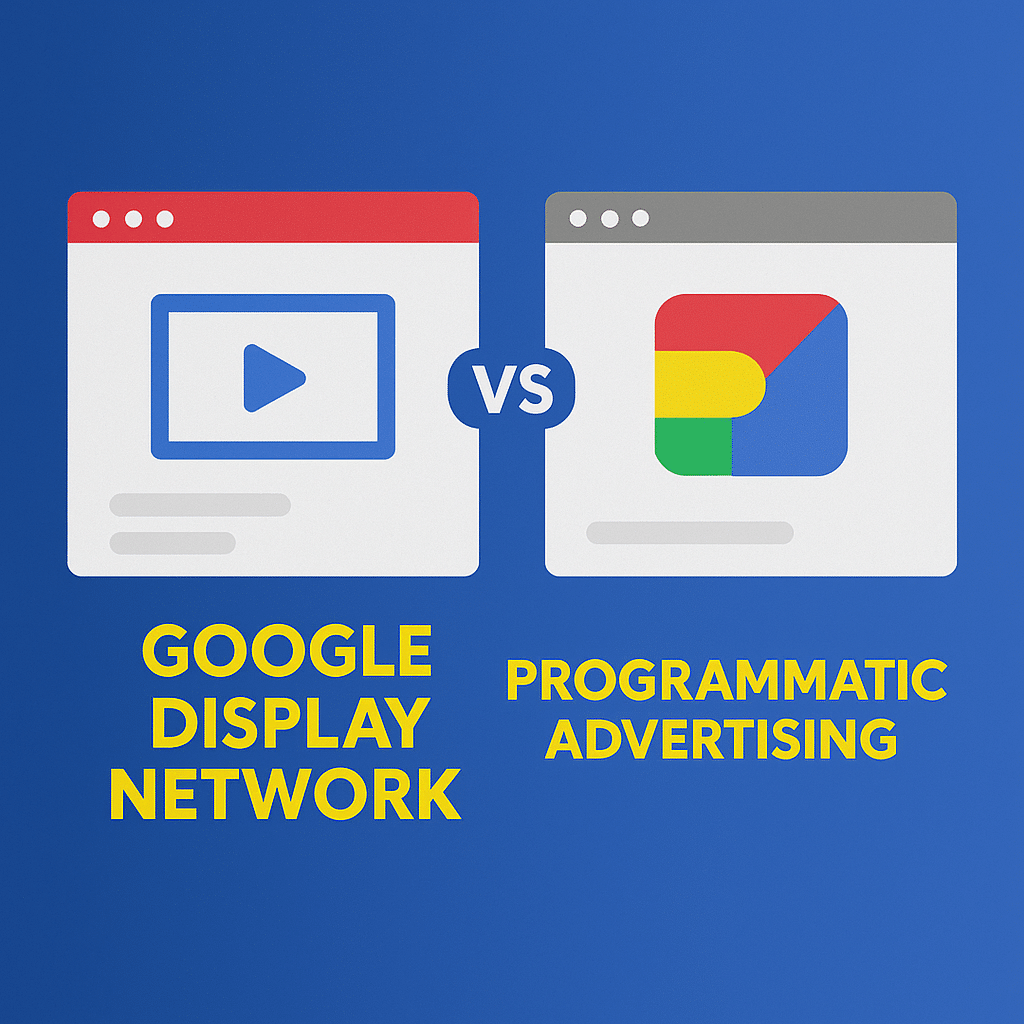
If you’ve ever wondered whether to use the Google Display Network (GDN) or “go programmatic,” you’re not alone. Both can deliver reach and results, but they differ in how you buy media, the breadth of inventory and channels, control and transparency, and the operational overhead required.
This guide breaks down those differences in practical terms and gives you a decision framework, with actionable tips whether you’re just starting or ready to scale.
Google Display Network (GDN)
Google’s own display ecosystem you buy through Google Ads. It includes millions of partner sites and apps, plus YouTube placements. It’s easy to launch, budget-friendly, and tightly integrated with Google’s automation, bidding, and reporting.
Programmatic advertising
A method of buying digital ad inventory across many ad exchanges and publishers using DSPs (demand-side platforms). It spans multiple formats and channels (display, native, video, CTV, audio, DOOH), enables private marketplace and guaranteed deals, and offers deeper controls at the cost of added complexity and typically platform fees.
How ad space are bought
| Attribute | GDN (Google Display Network) | Programmatic (Open Web) |
|---|---|---|
| Where you buy | Inside Google Ads | Through a DSP (e.g., The Trade Desk, DV360, StackAdapt, MediaMath) accessing multiple exchanges (AdX, Magnite, PubMatic, Xandr) |
| Targeting / Access | In-market, affinity, custom segments; placements; contextual categories | Broad exchange access; third-party data/DMPs; PMPs and programmatic guaranteed |
| Pricing & deals | CPC, CPM, or CPA; auctions within Google’s ecosystem | Mostly CPM via RTB; PMPs and programmatic guaranteed for premium supply |
| Optimization | Smart Bidding optimizes toward your goal (e.g., conversions, ROAS) | DSP algorithms; custom bid strategies; brand-safety controls |
| Measurement / Reporting | Centralized in Google Ads and GA4 | DSP reporting; often third-party verification (IAS, DoubleVerify), clean rooms, advanced attribution |
Inventory and reach
| Attribute | GDN (Google Display Network) | Programmatic (Open Web) |
|---|---|---|
| Ecosystem & reach | Breadth within Google’s ecosystem: millions of sites and apps plus YouTube | Wider array of publishers and exchanges, including premium supply via PMPs and direct deals |
| Speed & workflow | Fast coverage when you’re already in the Google Ads interface | Typically operated in a DSP; setup can be richer but adds workflow complexity |
| Premium & niche access | Limited by Google’s walled garden; some non-Google premium/niche inventory may be out of reach | Strong access to premium and niche inventory across exchanges and private deals |
| Flexibility & quality control | Standard controls inside Google’s stack | Greater flexibility to curate supply paths and avoid low-quality placements |
| Formats & channels | Strong for display and YouTube within Google | Better for formats/channels GDN doesn’t cover deeply (e.g., CTV at scale, audio, DOOH) |
Targeting and data use
| Attribute | GDN (Google Display Network) | Programmatic (Open Web) |
|---|---|---|
| Audience data & targeting | Strong native targeting: in-market, affinity, custom segments; robust remarketing; solid contextual | Mix of first-, second-, and third-party data; flexible audience building across channels/devices |
| First-party signals & remarketing | Leverages Google signals from Search/YouTube/Chrome; Remarketing and Customer Match are straightforward and powerful | CRM/CDP uploads, clean rooms, and advanced identity options; sophisticated cross-device logic |
| Contextual / semantic options | Contextual targeting available, though some content controls have been simplified in recent years | Rich contextual and semantic targeting across exchanges; test multiple data and context partners |
| Data onboarding & partners | Native Google integrations; simpler workflows inside Google Ads | Broad partner ecosystem for data onboarding and enrichment; ability to evaluate providers |
| Control vs complexity | Fewer knobs, faster activation inside one stack | More control and power, but greater responsibility for privacy compliance and data quality |
Formats and channels
| Attribute | GDN (Google Display Network) | Programmatic (Open Web) |
|---|---|---|
| Core formats | Display banners, responsive display, Discovery, YouTube video | Display, native, in-stream/out-stream video, CTV, digital audio/podcasts, DOOH |
| Experience | Native-like via responsive formats within Google’s partner network | Omnichannel experiences across exchanges, publishers, and environments |
| Advanced formats | YouTube video and Discovery within Google’s stack | Rich media and high-impact units via PMPs or creative tech partners |
| Creative flexibility | Automated/responsive assets optimized by Google | Broad support for rich media, custom units, and creative tech integrations |
| Best use | Efficient reach inside Google ecosystem | Best for omnichannel storytelling and scaled cross-channel reach |
Pricing models, fees, and budget implications
| Attribute | GDN (Google Display Network) | Programmatic (Open Web) |
|---|---|---|
| Pricing model | Supports CPC, CPM, and CPA bidding | Primarily CPM-based buying |
| Budget friendliness | Easy to start with small budgets and incremental tests | Often benefits from larger budgets to cover learning and data costs |
| Platform fees | Platform access is free; pay for media only | DSP/platform fees, minimums, and managed-service costs may apply |
| ROI & planning | Straightforward to test and scale within Google’s stack | ROI can be excellent, but plan budget for learning, data/verification, and creative testing—especially in higher-CPM channels like CTV or premium video |
Reporting, attribution, and frequency management
| Attribute | GDN (Google Display Network) | Programmatic (Open Web) |
|---|---|---|
| Analytics & integration | Clean integration with GA4 and Looker Studio; seamless for teams already running Search or YouTube | DSPs integrate with a wide analytics stack and BI tools |
| Attribution scope | Improving options, but largely within Google’s ecosystem | Cross-exchange and cross-channel attribution within the DSP |
| Reporting granularity | Standard Google Ads reporting with GA4 joins | Detailed reporting by exchange, site/app, creative, audience segment, and more |
| Frequency capping | Managed in Google’s stack per campaign and network | Unified caps across multiple channels and devices when using a single DSP |
| Advanced measurement | Native lift experiments are available, but ecosystem-bound | Commonly integrates with MMM, MTA, clean rooms, and formal lift studies |
Performance expectations
| Attribute | GDN (Google Display Network) | Programmatic (Open Web) |
|---|---|---|
| Click-through rate (CTR) | Generally low for display; performance hinges on creative quality, audience relevance, and placement quality | Generally low for display; likewise depends on creative, audience fit, and placement quality |
| CPA / ROAS | Can be very efficient for remarketing and for scaling to YouTube | Can unlock premium environments and new audiences; strong results require tighter QA and testing rigor |
| Time to results | Typically faster to launch and generate early learnings | More scalable control and reach once you invest the time and budget |
When to use Google Display Network vs Programmatic Ads
| Attribute (Scenario) | GDN (Google Display Network) | Programmatic (Open Web) |
|---|---|---|
| Early-stage, small budget, need quick learnings | Start with remarketing, custom intent/affinity, and tight contextual categories. Use responsive display for breadth; add YouTube for upper-funnel reach. | Not required at kickoff unless you have extra budget or specific inventory gaps. |
| Mid-stage, need to expand beyond Google inventory | Keep for efficient remarketing and YouTube scale. | Layer on via a DSP to reach premium publishers with PMPs, test native and out-stream video, and evaluate attention metrics. |
| Enterprise or brand with strict safety needs and omnichannel goals | Run alongside for incremental reach inside Google’s walled garden. | Lead with a DSP. Build allowlists, negotiate PMPs, add third-party verification, and use cross-channel frequency control. |
| Performance marketer anchored to Search/YouTube | Natural extension to leverage Google audience signals quickly. | Introduce as you pursue incremental reach and new formats without saturating Google’s network. |
GDN campaign setup
| Section | Recommendations |
|---|---|
| Structure | Separate prospecting, remarketing, and YouTube into distinct campaigns for clean budgets and learning. Use separate ad groups for audience vs contextual tests. |
| Targeting | Start with remarketing and Customer Match for efficiency. Add in-market and custom segments from high-intent keywords/URLs. Layer contextual categories; exclude irrelevant categories and placements early. |
| Creative | Use responsive display for scale/learning and upload image ads for stricter brand control. Test 3–5 concepts; vary messaging for prospecting vs remarketing. Add short-form YouTube to accelerate upper-funnel reach. |
| Controls | Maintain a living placement exclusion list; review automatic placements weekly. Set frequency caps to reduce fatigue. Use brand suitability for YouTube and sensitive content settings for display. |
| Optimization | Choose tCPA/tROAS if conversions are sufficient; otherwise use Maximize Conversions with a sensible cap. Optimize creative and landing pages together. Use GA4 audiences and conversion events consistently. |
Programmatic campaign setup
| Section | Recommendations |
|---|---|
| Foundation | Pick a DSP that fits needs (inventory breadth, CTV/audio, data partners, reporting/log exports, fees). Set up verification and safety (IAS/DV/MOAT), allowlists, app/site category blocks, and viewability/attention floors. |
| Data & audiences | Onboard first-party data compliantly; segment by lifecycle stage. Test contextual and semantic segments (not only audience data) as third-party cookies wane. Consider clean rooms or publisher IDs for privacy-preserving activation. |
| Supply strategy | Start with curated exchanges and test PMPs with priority publishers. Apply supply path optimization to remove low-quality/redundant paths. Continuously log and evaluate site/app performance, attention metrics, and fraud signals. |
| Creative | Build variants per channel: native for content environments, vertical video for mobile, 15–30s for CTV/audio companions. Test rich media and high-impact units in PMPs after baselines are set. |
| Measurement | Implement a unified cross-channel frequency strategy. Use incrementality tests (geo holdouts/PSA) for upper-funnel like CTV and audio. Align DSP reporting with BI and finance for accurate ROAS. |
Costs and budgeting tips
GDN
- Ideal for pilots and always-on remarketing. Start with modest daily budgets, then scale on observed CAC/ROAS.
- Use CPA/ROAS bidding when you have sufficient conversion volume; otherwise, warm up with Maximize Conversions or manual CPC/ECPC.
Programmatic
- Plan for platform fees, verification costs, and higher CPMs in premium environments.
- Enter with a minimum viable test budget that can produce statistically significant learnings per channel (e.g., allocate per format: display vs native vs video vs CTV).
- Consider managed-service support or an experienced agency if you lack in-house ops; the cost is frequently offset by avoiding waste.
DV360 vs GDN vs non-Google DSPs
| Option | What it is | When to use / Notes |
|---|---|---|
| GDN (Google Display Network) | Self-serve route in Google Ads to buy across Google’s display ecosystem | Best for quick pilots, remarketing, and teams already using Search/YouTube inside Google Ads |
| DV360 (Google’s enterprise DSP) | Google’s DSP for broader programmatic (open auction, PMPs, PG) with advanced controls and access to Google supply | Use when you want programmatic features while staying in Google’s stack; a practical bridge from GDN to full programmatic |
| Non-Google DSPs (e.g., The Trade Desk) | Independent DSPs with different data integrations, log-level access, and pricing models | Good for diversifying supply, accessing unique data/measurement, and avoiding single-vendor dependency; many mature advertisers run both Google (GDN/DV360) and a non-Google DSP |
Trends to factor into your choice
- Privacy and identity: Third-party cookies continue to deprecate. Invest in first-party data, consent management, contextual targeting, and privacy-safe measurement (clean rooms, modeled conversions).
- Retail media and commerce: Programmatic retail networks are surging, offering commerce-grade targeting and measurement; some are accessible only via specific DSPs.
- CTV and premium video: Expect higher CPMs but strong attention and incremental reach. Programmatic is typically the best route here.
- Attention metrics: Beyond viewability, attention signals (exposure time, interaction) are becoming key optimization levers, often easier to access in programmatic environments.
- Creative automation and DCO: DCO and modular testing pay off in both GDN and programmatic, with richer feeds/decisioning typically on programmatic.
Common pitfalls to avoid
- Treating “programmatic” as inherently superior: It’s more powerful, not automatically better; poor supply curation can underperform a well-run GDN campaign.
- Over-relying on automation without curation: On GDN or in a DSP, curate placements, refine audience logic, and review reports consistently.
- Ignoring frequency and creative fatigue: Cap intelligently and refresh assets regularly.
- Under-funding programmatic tests: Allocate enough budget to generate learnings per channel/segment.
Choosing Between Google Display Network and Programmatic Advertising
Choose GDN if:
- You want speed, simplicity, and low barrier to entry.
- Your focus is Display + YouTube inside Google’s ecosystem.
- You’re early stage, testing, or primarily a performance marketer extending from Search.
Choose programmatic if:
- You need omnichannel reach (native, CTV, audio, DOOH) and premium publishers.
- You require granular safety, transparency, and data controls.
- You can support platform fees and the operational rigor of DSP buying.
Choose both if:
- You want to maximize reach and resilience. Use GDN for efficient remarketing and incremental Google-inventory reach, and layer programmatic to diversify supply, unlock new channels, and scale brand-safe premium placements.
Conclusion
There isn’t a single “best” choice between GDN and programmatic. Choose based on goals, budget, and how much control you need. Use GDN for speed, simplicity, and tight integration with Search and YouTube. Go programmatic when you want omnichannel reach, premium inventory, and deeper transparency and brand-safety controls.
Many teams win by running both: keep GDN for efficient remarketing and incremental Google reach, then layer programmatic ads to diversify supply, add CTV/audio/DOOH, and unify frequency and safety. Judge success on contribution margin, MER, and incrementality so spend follows what truly grows profit.