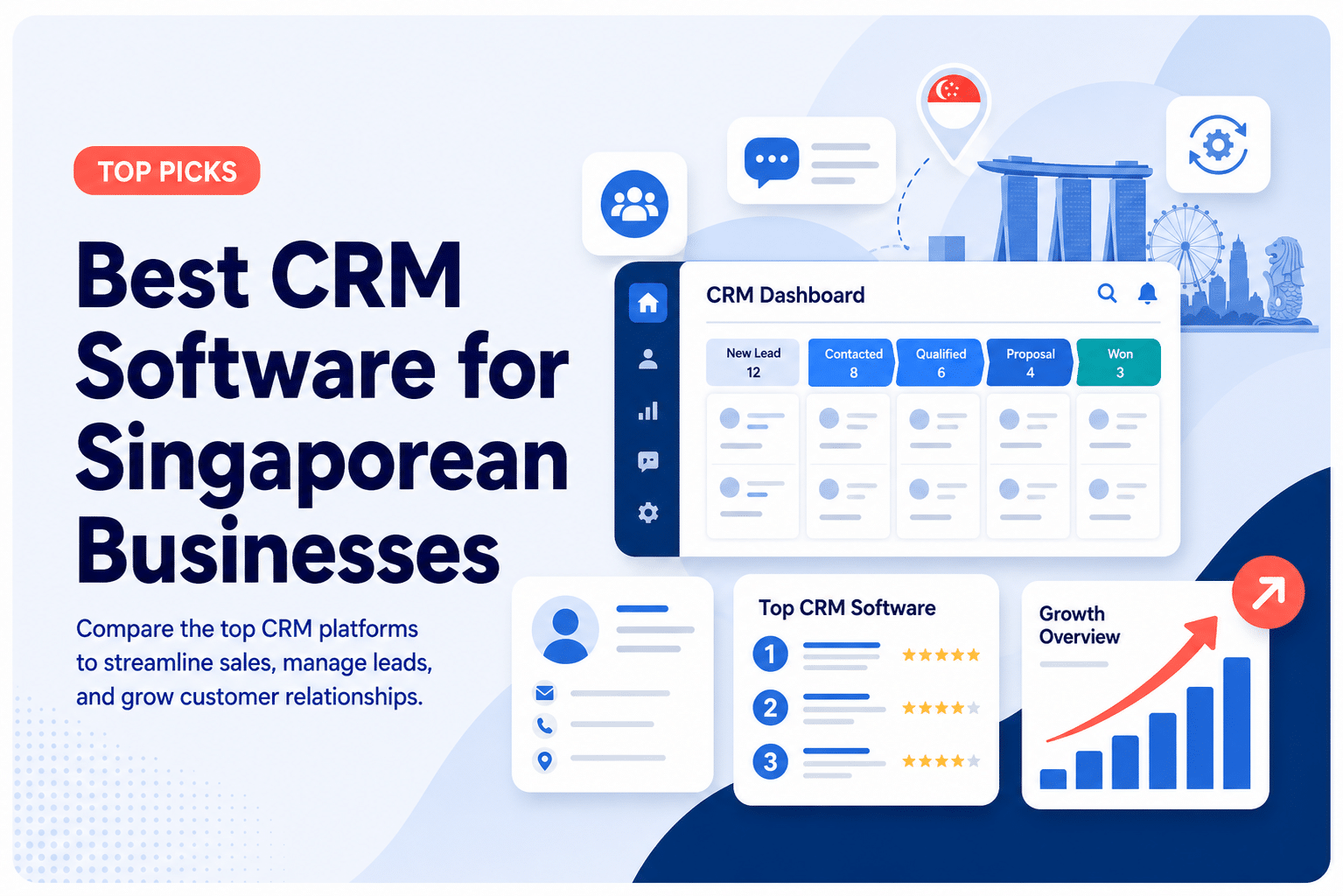
If you’ve ever lost a deal because a follow-up slipped through the cracks, your CRM isn’t doing its job.
Or worse, you don’t have one yet. CRM marketing in Singapore has moved well past basic contact management.
The right platform today tracks your pipeline, automates your follow-ups, scores your leads, and keeps your entire team working from the same playbook.
Here, you’ll find a breakdown of the key factors to consider before choosing a platform, honest reviews of the 10 best CRM software options for your business, and pricing details to help you make a decision.
Key Factors for Choosing a CRM in Singapore
1. Business Size and Scalability
What works for a five-person sales team looks nothing like what a 50-person operation needs, especially if you’re expanding across Southeast Asia.
Check tier limits carefully because many platforms lock critical features behind expensive upgrades that aren’t obvious at signup.
Scalability also means regional readiness.
If Malaysia or Indonesia is on your roadmap, confirm that the platform supports multi-currency and cross-border compliance.
You shouldn’t have to migrate your entire CRM just because your team doubled in size.
2. Integration with Your Existing Tech Stack
The best CRM solution for your Singapore business is the one that fits into your existing workflow, not the one that forces you to rebuild it.
Think about your email client, accounting software, and WhatsApp Business account before you even look at features.
Native integrations are always more reliable than third-party connectors.
Map out every tool your team uses daily, verify which integrations are included versus paid add-ons, and pay particular attention to WhatsApp since it’s a primary sales and service channel for most Singapore businesses.
3. Cloud-Based vs On-Premise Deployment
For most Singapore businesses, cloud-based CRM software is the right call. You get automatic updates, mobile access, and faster setup without server maintenance costs eating into your budget.
If you’re in healthcare or finance where data residency is non-negotiable, verify where your data is actually stored before signing.
Both Salesforce and Microsoft operate data centers in Singapore, which satisfies most PDPA residency requirements without the cost of managing your own infrastructure.
4. Local Support and Regional Compliance
PDPA compliance isn’t optional. Your CRM must support consent management, data access requests, and secure deletion.
So verify this upfront rather than discovering gaps after you’ve migrated your data.
Local support access matters more than most buyers anticipate.
When something breaks during your business hours, waiting eight hours for a US-based team isn’t a workable solution.
Vendors with APAC offices operate in your time zone, and PSG pre-approved platforms may qualify for up to 50% subsidy on software costs for Singapore SMEs.
5. Total Cost of Ownership (Not Just Subscription Price)
The per-user monthly price on the pricing page is not what you’ll actually pay.
Implementation, data migration, training, and essential add-ons all stack on top, and some platforms that look affordable at entry level get more expensive once you activate the features your team actually needs.
Before committing, ask each vendor for a total cost estimate that covers setup and integrations, then compare those real numbers across your shortlist.
The best CRM platform for your Singapore business delivers measurable value relative to what you spend on it, not just the lowest starting price.
1. HashMicro CRM

HashMicro is Singapore-headquartered, so their support team operates in your time zone and their solutions are built with the local market in mind.
Their CRM sits within a broader ERP ecosystem, connecting natively with HashMicro’s accounting, inventory, HR, and procurement modules.
If you want one platform for your entire operation instead of five tools that barely sync, that native integration is a real advantage.
Clients include Changi Airport Group, McDonald’s Singapore, and Singapore’s Ministry of Education, which signals the operational scale the platform can handle.
Pricing requires a direct demo request, but HashMicro is PSG-eligible, meaning qualifying SMEs may receive up to 50% subsidy on the software cost.
Top Features:
- Sales pipeline and lead management
- Real-time pipeline monitoring dashboard
- WhatsApp integration
- Lead quality scoring
- Automated reporting and sales activity tracking
- Meeting analysis and follow-up scheduling
- Native integration with HashMicro accounting, inventory, and HR modules
- Drag-and-drop configurable sales workflows
Pricing Plans: Custom pricing on request. PSG grant-eligible for qualifying Singapore SMEs.
Best For: Singapore SMEs and enterprises needing local ERP integration
2. HubSpot CRM
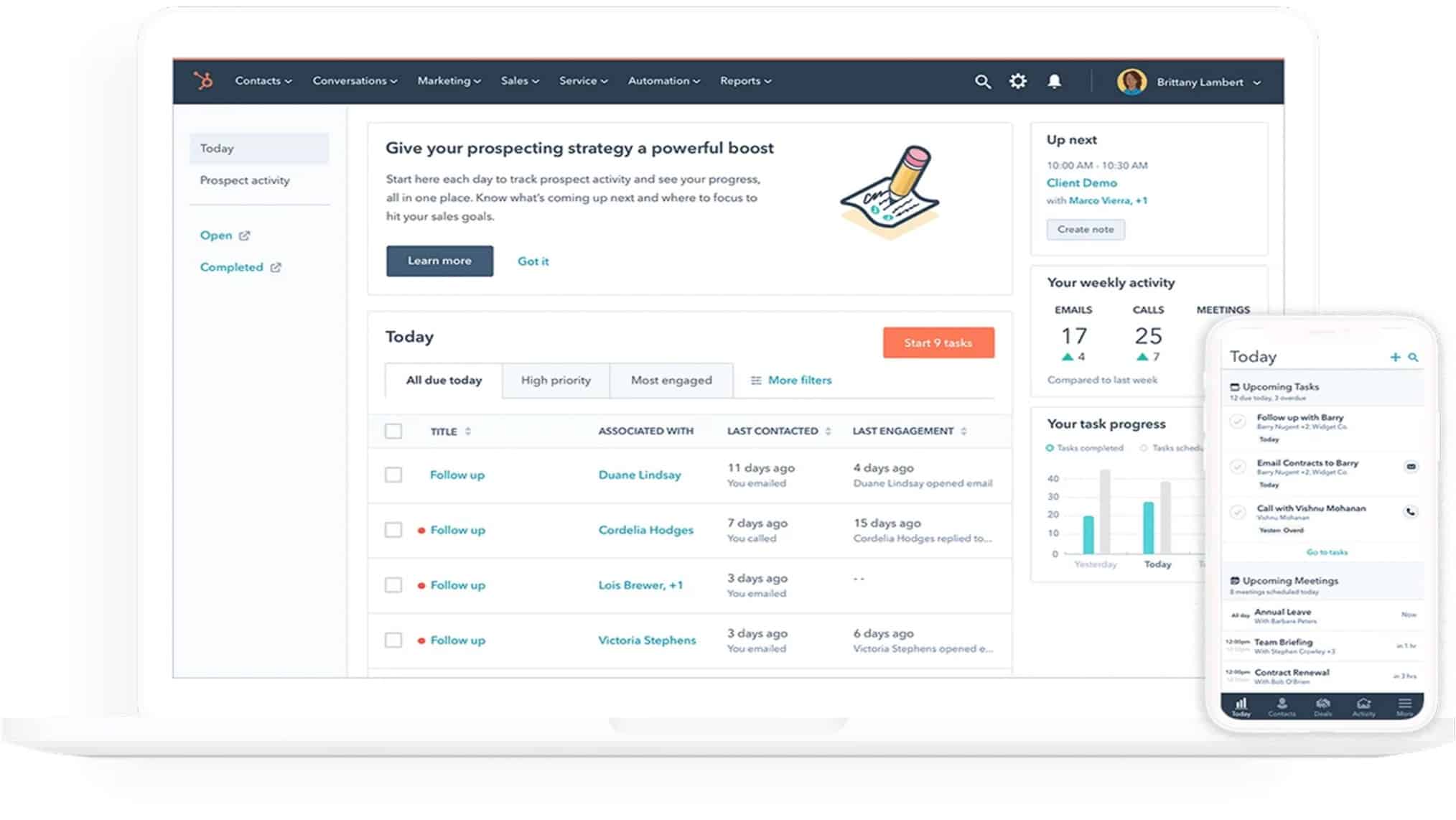
HubSpot’s free tier is the most genuinely functional free CRM on this list.
It covers contacts, deals, email, meeting scheduling, and basic reporting without a credit card.
For startups moving off spreadsheets, it removes the budget barrier entirely while giving you tools that actually work.
The moment you need email sequences, automation, or detailed reporting though, you’re moving into paid territory.
Map out which features you’ll need in the next six to twelve months before settling on the free plan, because the upgrade costs are worth knowing upfront.
Top Features:
- Contact and deal management
- Email marketing and sequences
- Live chat, forms, and meeting scheduler
- AI-powered email and content tools
- Sales pipeline tracking and reporting
- Stripe and PayNow-compatible payment processing
- Custom dashboards
- 1,000+ integrations including Gmail, Outlook, and Slack
Pricing Plans: Free plan available. Sales Hub Starter from approximately $20 USD/user/month. Professional and Enterprise tiers available at higher price points depending on Hub and contact volume.
Best For: Startups and marketing-led SMBs wanting an all-in-one platform
3. Salesforce Sales Cloud

Salesforce is the global standard for enterprise CRM, and it has both a Singapore office and a local data center, which matters for PDPA compliance and data performance.
Singapore Airlines runs on Salesforce, which gives you a real-world benchmark for the operational complexity it can handle.
The trade-off is cost and setup time.
Most businesses need professional services or a certified local partner to get Salesforce running properly, and Enterprise tier licensing is a significant investment.
If your sales process is complex enough to justify that, the platform delivers on its reputation.
Top Features:
- Lead, contact, account, and opportunity management
- AI-powered pipeline management and forecasting via Agentforce
- Sales automation and workflow builder
- Conversation intelligence and deal insights
- AppExchange marketplace with 3,000+ integrations
- Customizable dashboards and advanced reporting
- Mobile CRM app with offline functionality
- Singapore-based data center for local compliance
Pricing Plans: Free plan for up to 2 users. Starter Suite from $25 USD/user/month. Pro Suite from $100 USD/user/month. Enterprise from $175 USD/user/month. Unlimited from $350 USD/user/month.
Best For: Mid-sized to large enterprises with complex sales processes
4. Zoho CRM
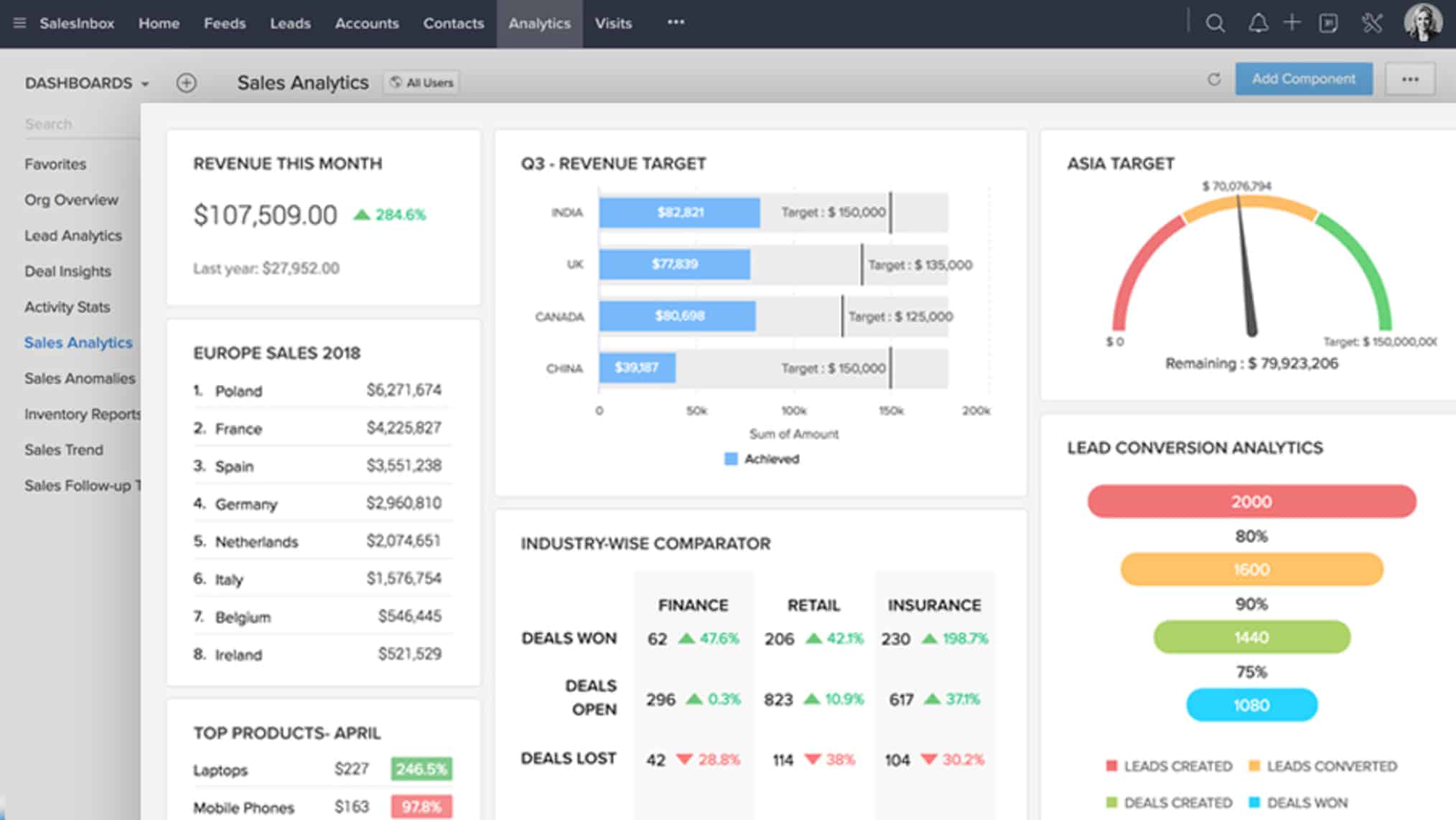
Zoho offers solid capability at a price point that doesn’t require a lengthy budget approval.
You get AI-powered lead scoring, multi-channel communication, workflow automation, and territory management at a fraction of what Salesforce or HubSpot’s paid tiers cost.
It works particularly well for Singapore SMBs that have outgrown spreadsheets but aren’t ready for enterprise complexity.
Zoho has local implementation partners in Singapore to help with onboarding, and the free plan supports up to three users as a starting point.
Top Features:
- AI sales assistant (Zia) for predictions and recommendations
- Workflow automation and blueprint process management
- Territory and quota management
- Multi-channel communication across email, social, phone, and chat
- CPQ for quote management
- Custom functions and low-code workflow builder
- Inventory management
- Customer portals and Google Ads integration
Pricing Plans: Free plan for up to 3 users. Standard from approximately $14 USD/user/month billed annually. Professional from $23 USD/user/month. Enterprise from $40 USD/user/month. Ultimate from $52 USD/user/month.
Best For: Budget-conscious SMBs needing solid automation without enterprise pricing
5. Pepper Cloud

Pepper Cloud is Singapore’s own CRM, built specifically for how local businesses actually communicate with customers.
WhatsApp isn’t treated as an add-on here. It’s central to the platform’s architecture.
The platform has a native WhatsApp Business API integration that lets your team manage leads, follow up, and close deals without leaving the CRM.
The AssistAI feature automates sales conversations across channels, while the multichannel inbox consolidates WhatsApp, Facebook, Instagram, and email into one view.
For Singapore SMBs where WhatsApp-first engagement is already how you operate, Pepper Cloud fits that workflow without forcing you to change it.
Top Features:
- WhatsApp CRM with native Business API integration
- AssistAI for automated conversation handling
- Multichannel inbox consolidating WhatsApp, Facebook, Instagram, and email
- Sales pipeline and deal management
- Lead capture via web forms and incoming messages
- Visual analytics dashboards
- Multi-layered data security
- Workflow automation for routine tasks
Pricing Plans: Contact Pepper Cloud directly for current pricing. PSG grant-eligible for qualifying Singapore SMEs.
Best For: Singapore SMBs prioritizing WhatsApp-first sales
6. Pipedrive

Pipedrive was built by salespeople, and the product reflects exactly that.
The pipeline view is one of the cleanest available, drag-and-drop deal management is intuitive, and the platform stays focused on moving deals forward rather than burying you in features you’ll never touch.
Spoiler: the add-ons add up fast.
If your team needs LeadBooster for lead generation or Campaigns for email marketing, factor those costs in during evaluation, not after.
Pipedrive restructured its plans in 2025 to Lite, Growth, Premium, and Ultimate, so review current tier details before committing.
Top Features:
- Visual sales pipeline management
- Lead and deal tracking
- Sales inbox and email sync with tracking
- AI Sales Assistant with personalized tips
- Sales automation and sequence building
- Revenue forecasting and reporting
- LeadBooster for lead generation (add-on)
- Email marketing via Campaigns (add-on)
- 500+ integrations via Pipedrive Marketplace
- Mobile CRM app for iOS and Android
Pricing Plans: No free plan. 14-day free trial available. Lite from $14 USD/seat/month billed annually. Growth from $39 USD/seat/month. Premium and Ultimate at higher price points.
Best For: Sales-focused SMBs wanting a clean pipeline-centric CRM
7. Freshsales (Freshworks)
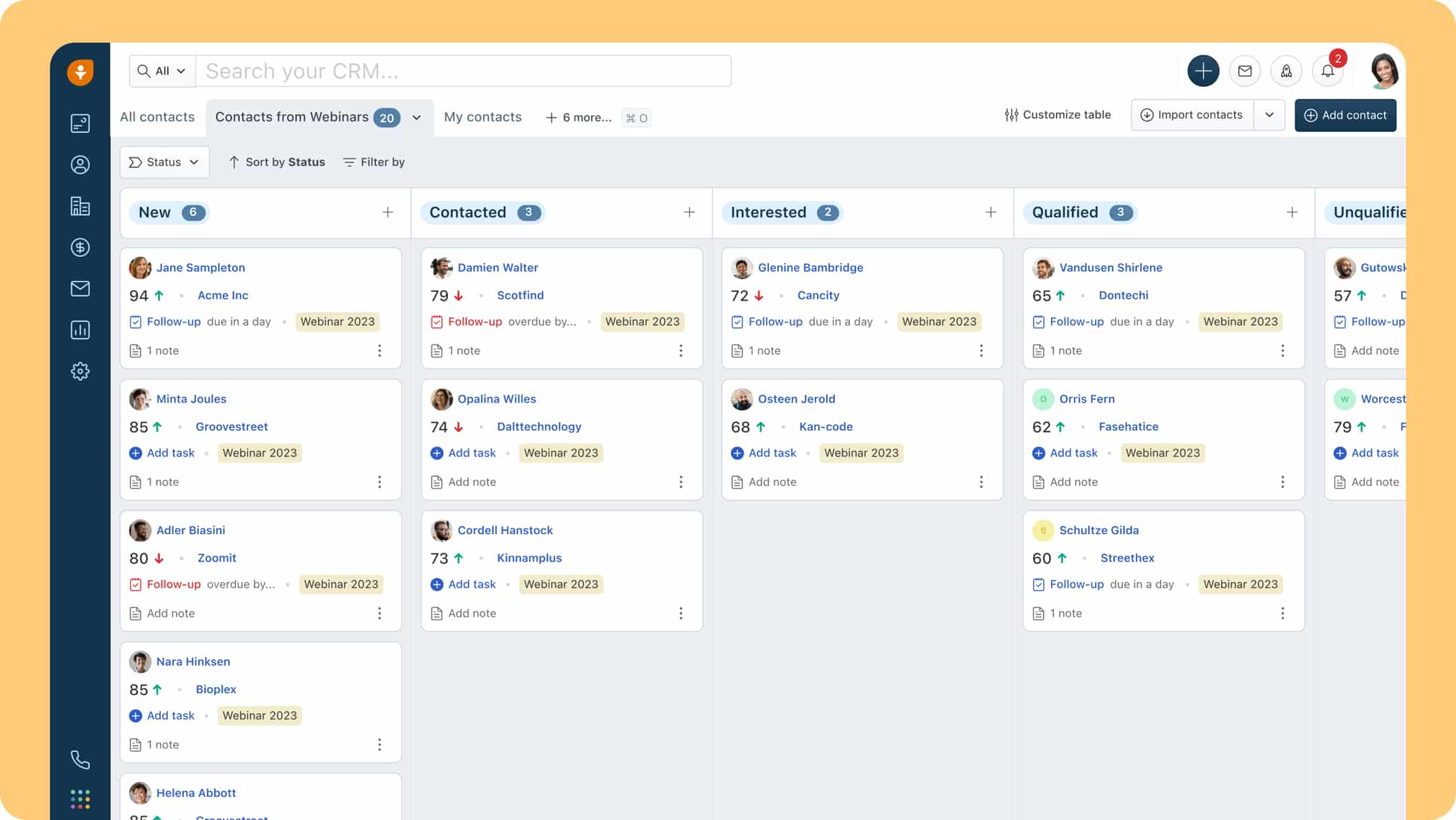
Freshsales competes hard on value. The Freddy AI layer handles lead scoring, deal insights, sales email generation, and forecasting, features you’d normally pay significantly more for on competing platforms.
At $9 USD per user per month on the Growth plan, it’s one of the more affordable entries into AI-powered CRM on this list.
Freddy AI isn’t locked exclusively behind the top tier either, which is worth noting.
You get meaningful AI functionality from the Pro plan onwards, and the free plan supports up to three users for teams just getting started.
Top Features:
- Freddy AI for lead scoring, deal insights, and email generation
- Built-in phone, chat, and email
- Contact lifecycle stage tracking
- Sales sequences and automation
- Multiple sales pipelines
- Territory and account hierarchy management
- Custom reports and dashboards
- Mobile app and Freshworks Marketplace integrations
Pricing Plans: Free plan for up to 3 users. Growth from $9 USD/user/month billed annually. Pro from $39 USD/user/month. Enterprise from $59 USD/user/month.
Best For: SMBs and mid-market teams wanting AI features at accessible price points
8. Odoo CRM

Odoo’s modular architecture is what makes it stand out. You start with the CRM module and add inventory, accounting, e-commerce, or HR as your business grows.
This means you’re building one connected system rather than patching together separate tools over time.
The CRM module covers pipeline management, lead enrichment, communication tracking, and reporting.
An open-source community version is available at no cost, while the paid Enterprise version supports both cloud and on-premise hosting.
Implementation complexity scales with the number of modules you activate, so budget for setup support accordingly.
Top Features:
- Visual sales pipeline with drag-and-drop
- Lead mining and enrichment
- Email integration and call logging
- Activity scheduling and reminders
- Revenue forecasting
- Customer portal access
- Modular integration with Odoo Inventory, Accounting, and HR
- Open-source community version available
Pricing Plans: Community version free. Odoo Online from approximately $11.90 USD/user/month for the first app. Additional modules priced separately.
Best For: Businesses consolidating multiple operations onto one modular platform
9. Monday Sales CRM

Monday.com started as a work management platform, and that background gives Monday Sales CRM something most dedicated CRMs simply don’t have:
A strong project and task management layer built natively into the product.
If your sales team also handles post-sale delivery or client onboarding, that overlap is genuinely useful.
The CRM covers contact and deal management, 2-way email integration, sales forecasting, AI automations, and an SDR agent that qualifies leads and books meetings.
The automation builder is one of the more intuitive available, though the cost-per-seat at Pro tier and above gets harder to justify for purely sales-focused teams.
Top Features:
- Visual pipeline with unlimited customization
- Contact, account, and deal management
- 2-way email integration with Gmail and Outlook
- Sales forecasting and analytics
- AI automations, AI writing, and SDR agent
- Email sequences and mass email sending
- Quotes and invoices
- Custom automation builder
- Google Calendar sync
- 200+ integrations
Pricing Plans: 14-day free trial available. Basic from $12 USD/seat/month billed annually. Standard from $17 USD/seat/month. Pro from $28 USD/seat/month. Ultimate via custom quote.
Best For: Teams managing both sales and post-sale project delivery
10. Microsoft Dynamics 365 Sales

If your business already runs on Microsoft, Dynamics 365 is the CRM that makes the most sense.
It connects natively with Teams, Outlook, SharePoint, Power BI, and Power Automate in ways that third-party CRMs can’t replicate.
For organizations already paying for Microsoft 365 licenses, the combined ecosystem will be very beneficial to their workflow.
The platform is enterprise-grade in both capability and price, so smaller businesses evaluating it purely as a standalone CRM will find more cost-efficient options on this list.
For Microsoft-first organizations that need deep cross-platform integration, it’s the most connected option available.
Top Features:
- Account, contact, lead, and opportunity management
- AI-powered sales insights and relationship intelligence
- Native integration with Microsoft Teams, Outlook, and SharePoint
- Power BI embedded analytics
- LinkedIn Sales Navigator integration
- Sales forecasting and pipeline management
- Mobile app with offline capability
- Power Automate for advanced workflow automation
Pricing Plans: Sales Professional from approximately $65 USD/user/month. Sales Enterprise from approximately $95 USD/user/month. Sales Premium from approximately $135 USD/user/month. Annual billing required.
Best For: Large enterprises running the Microsoft ecosystem
Your Next Move is One Decision Away
The right platform is one that fits your team size, integrates with your existing tools, stays PDPA-compliant, and delivers real value.
BUT knowing which CRM to pick is only half the equation. Getting it to work for your business, connecting it to your marketing strategy, and turning it into a genuine growth engine is where most businesses get stuck.
That’s exactly what the team at First Page Digital does every day. As Singapore’s leading digital marketing agency, First Page Digital helps businesses like yours build strategies that convert.
Right now, you can claim a FREE strategy call worth $2,000. Book yours before the spots run out.
Frequently Asked Questions
What is CRM software and why does your business need it?
CRM software keeps all your customer data, communication history, and deal activity in one place instead of scattered across emails and spreadsheets. For Singapore businesses managing customers across WhatsApp, email, and phone simultaneously, that centralization is what keeps your sales process consistent.
What is the best CRM software for small businesses in Singapore?
HubSpot, Freshsales, and Pepper Cloud are the strongest starting points for small businesses in Singapore. HubSpot and Freshsales both offer free plans with real functionality, while Pepper Cloud is purpose-built for WhatsApp-first engagement. Start with free trials and choose based on what fits your actual daily workflow.
What is the best cloud-based CRM software available today?
The answer depends on what you need it to do. Salesforce leads for enterprise capability, HubSpot for all-in-one marketing and sales, Zoho for value-to-feature ratio, and Pipedrive for clean pipeline management. All ten platforms on this list are cloud-based and include mobile access, automatic updates, and PDPA-aligned data handling.
How much does CRM software typically cost for a Singapore business?
Costs range from free entry-level plans to $9-$40 USD per user per month for SMB tiers, and $65-$175 USD or more for enterprise platforms. Singapore SMEs should also check PSG eligibility, since qualifying businesses can receive up to 50% subsidy on approved software costs.