If you buy Google reviews in Singapore and they’re caught, Google removes them, and it can also tell every customer who looks you up. It may show a warning that suspicious high-rated reviews were recently removed, and it can stop anyone posting new reviews for a while. On top of that, the Competition and Consumer Commission of Singapore (CCS) treats buying reviews as an unfair practice, and in September 2026 it made 45 businesses that bought them apologise in public for 6 months.
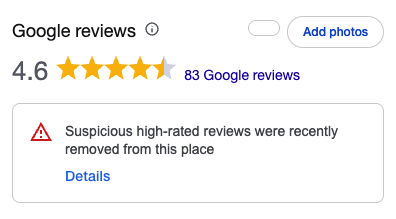
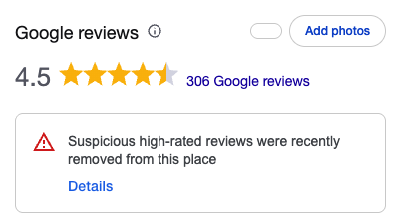
I came across two Singapore businesses (direct competitors of First Page Digital) showing that warning while I was looking through other profiles on Google Maps. Both warnings were up when I took the screenshots below in November 2026, and on one of the two, Google had also turned off new reviews. I’m not naming either business, because what matters is what their customers see first.
I think buying reviews has become a bad bet. When it’s caught, you can pay for it twice in public, with a warning on your Google profile and an apology on your own website and premises, and the reviews you paid for still don’t stay up.
TL;DR
- When Google removes suspicious high-rated reviews, it can show customers a warning on the profile, stop new reviews for a period, and hide the existing ones
- Google said in April 2026 that it blocked or removed more than 292 million policy-violating reviews worldwide in 2025
- In September 2026, CCS acted against Reputifly, which sold fake reviews to about 100 businesses through BuyReviewSG and GetReviewSG, and 45 of its customers agreed to remove them and apologise publicly for 6 months
- Two more customers refused CCS’s terms and are still being investigated, and a second phase covering the rest is under way
- If a business goes back on its undertaking, CCS says it will seek a court injunction, and ignoring an injunction can lead to a fine or jail
- Google bans any review that’s paid for, rewarded with a discount or gift, or collected only from happy customers, whoever arranges it
- The safe way to get more reviews is to ask every customer, make it easy for them, and reply to what they write
What Google Shows Customers When It Removes Fake Reviews
On both profiles, the warning sat right under the star rating, which is where most people look first. Google showed a red warning sign and the line “Suspicious high-rated reviews were recently removed from this place”, with a link to the details.
Both profiles also showed a second notice. It said Google had temporarily turned off posting reviews because of a recent increase in suspicious high-rated reviews, and that it had removed those reviews and updated the rating.
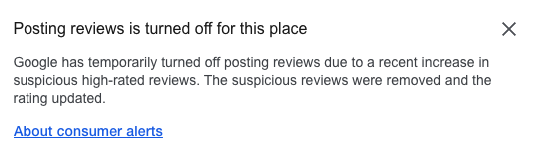
Google calls these consumer alerts. Its help page on them says that when it detects suspicious review activity, it may show a banner saying suspicious reviews were removed, stop people posting reviews or ratings for a period of time, and hide the business’s reviews for a while. It doesn’t say how long any of these last.
Google tells the owner as well. According to its page on Business Profile restrictions, it removes the fake reviews first, and it can then stop the profile getting new reviews, unpublish its existing reviews for a set time, or show the warning. It emails the owner before applying a restriction, and the owner can appeal.
In a post in April 2026, Google said it blocked or removed more than 292 million policy-violating reviews worldwide in 2025, took down more than 13 million fake Business Profiles, and stopped more than 782,000 accounts from posting. Those figures cover every country and every kind of breach, so they can’t tell you how many were bought reviews in Singapore, but they do show how much Google filters out.
I’ve seen businesses that bought reviews lose a batch of them, drop in rating, get the warning on their profile, and have new reviews turned off. Some have had their whole profile suspended. I think the warning does the most damage, because it sits right under the rating, so a customer who reads it starts to doubt the reviews that are left as well.
Reviews also matter more than they used to, because Google’s AI now answers from them. Ask Maps, Google’s Gemini-powered assistant in Maps, draws on reviews from more than 500 million contributors, and Marketing-Interactive reported it live in Singapore in August 2026. I’d count buying reviews as a form of black hat GEO now, since it fakes the evidence an AI answer relies on, and I expect Google to guard that evidence more closely, not less.
The Singapore Case: One Seller, About 100 Buyers
On 30 September 2026, CCS announced action against Julian Tung Yan Kai, the sole director of Reputifly, and 45 businesses that had bought fake reviews from him. Tung ran two websites, BuyReviewSG and GetReviewSG, and CCS found he had sold fake reviews to about 100 businesses, starting in 2023 or earlier. The Straits Times reported that it was CCS’s largest fake review investigation by the number of businesses involved.
The reviews went onto Google, Facebook, Tripadvisor, Carousell, Yelp, and Trustpilot, and the operation was built to avoid detection. Generative AI varied the writing style, added Singapore details, and slipped in natural-looking mistakes, and some reviews started with doubts before describing a good experience. A dashboard could even write new reviews from the details in a business’s real four- and five-star Google reviews.
Buyers could order packages to be posted over time, and a rating calculator told them how many five-star reviews they needed to reach the Google rating they wanted. People recruited on Telegram were paid to post the prepared reviews and told not to repeat wording. Tung also offered to replace reviews that platforms removed, and Mothership reported that the offer covered up to 30% of the reviews a business bought.
CCS split the case into two phases. The first covered Tung and 47 of his customers, and 45 of them admitted buying fake reviews and gave undertakings. The remaining 2 businesses refused CCS’s terms, so it’s still investigating them and has said it may take firmer action. The second phase, which covers his other customers and any other business that bought fake reviews from him, was still under way when the case was announced.
CCS had dealt with fake reviews before, but in its earlier cases the business wrote the reviews itself. In June 2024, it warned a furniture retailer over fake five-star reviews on its own website, and in July 2025, a car detailing business admitted posting fake reviews on Sgcarmart that it had written with ChatGPT. I think going after a seller is the bigger change, because once a seller is investigated, its customers are too, as these 45 businesses found.
What The 45 Businesses Had To Do
None of the 45 businesses was fined, but the penalty is a public one. Each agreed to stop buying or posting fake reviews, find and remove the ones about its business, report its progress to CCS, and tighten its compliance. Each also has to publish a prominent apology for 6 months on its website, on its official social media accounts, and at its physical premises or outlets.
Burma Social, a Singapore restaurant, posted a public apology after the announcement. Marketing-Interactive reported that it acknowledged its conduct was an unfair practice under the Consumer Protection (Fair Trading) Act, expressed regret, and said it had removed the reviews and taken steps to stop it happening again. CCS told The Straits Times that most of the businesses posted their apologies on 30 September, the day of the announcement.
Tung made similar commitments. He agreed to stop selling fake reviews, publish an apology on Reputifly’s website for 6 months, and donate what he earned from the service to a charity, without claiming a tax deduction. CCS didn’t act against the people he paid to post reviews, but it told The Straits Times it can act against people who repeatedly post fake reviews for businesses.
CCS told The Straits Times that if a business goes back on its undertaking, it will reopen the investigation and apply for a court injunction. If the business then ignores the injunction, CCS can start contempt of court proceedings, which can end in a fine or jail. It pointed to an earlier case where a nail salon chain’s managing director was jailed for repeatedly ignoring court orders.
In a letter to The Straits Times Forum on 5 October 2026, Benjamin Joshua Ong argued that fake reviews could also amount to fraud under the Penal Code, and that doctors, lawyers, and other regulated professionals could face disciplinary action as well. That’s one reader’s view rather than a ruling, and none of the reports on this case mention criminal charges.
Why Bought Reviews Don’t Stay Up
Even the seller expected removals, because a service that promises to replace removed reviews, as Tung’s did, is planning for some of them to go. Google has also said it can revisit reviews months after they were first posted, so a review that gets through on the day it’s posted isn’t safe afterwards.
Customers look for patterns too. When CASE president Melvin Yong welcomed CCS’s action, he told consumers to watch for reviews with similar wording and an unusually high number of five-star ratings in a short time, and to compare reviews across platforms. Tung’s customers could have their reviews posted bit by bit, and his posters were told not to repeat wording, which suggests he knew exactly what gets noticed.
I think that’s the trouble with buying reviews: you’re paying for something that only works as long as nobody looks closely, whether that’s Google, a regulator, or a customer comparing platforms. This year, all three have shown they’re looking.
The Offers Singapore Businesses Are Getting
Clients have told me about cold WhatsApp and Telegram messages offering packages of five-star reviews, and about other vendors who’ve included reviews in a package they were selling. My view is that any package promising a set number of five-star reviews is buying reviews, whoever sends the invoice and whatever the line item is called. Honest reviews can’t be promised in advance, because they depend on what your customers think.
Google’s fake engagement policy bans reviews paid for “directly or in kind”, which covers more than cash. It also bans offering discounts, free goods, or anything else in exchange for a review, asking only your happy customers, and reviews from anyone with a conflict of interest, such as current or former staff. CASE has raised the same concern about businesses offering discounts or free gifts for five-star ratings.
How To Get More Google Reviews Within The Rules
Asking for reviews is allowed, and it’s the only approach I’d recommend. Ask every customer, not just the ones you think are happy, offer nothing in return, and don’t tell people what to write. Since April 2026, Google’s policy has also said not to pressure customers while they’re on your premises or ask for specific content, including staff names, which I covered in our guide to Google Business Profile for Singapore restaurants.
Make it easy to leave one. A direct link in your follow-up message, or a QR code on the receipt, takes customers straight to the review form, and our free Google review link generator creates the link for you. Then reply to the reviews you get, including the bad ones, since I think a calm reply to a fair complaint does more for trust than another five-star review.
If you’ve already bought reviews, stop the package straight away. CCS has asked businesses that bought fake reviews to come forward voluntarily, and it says it will view their cooperation favourably if they do so before a formal investigation starts. I’m not a lawyer, though, so if you’re in that position, I’d get legal advice before you contact CCS.
Fake Google Reviews FAQs
Is buying Google reviews illegal in Singapore?
It’s against Singapore’s consumer protection law. Under the Consumer Protection (Fair Trading) Act, buying or posting fake reviews is an unfair practice because it misleads consumers. In September 2026, CCS made 45 businesses that bought them stop, remove them, and apologise publicly for 6 months, and it says it will seek a court injunction against any that go back on that. Ignoring an injunction can then lead to a fine or jail.
What does “suspicious high-rated reviews were recently removed” mean on Google?
It means Google detected suspicious high-rated reviews on the profile and removed them. Google shows the warning to customers as one of its consumer alerts, and it updates the rating once the reviews are gone. The warning doesn’t say who posted the reviews or whether the business paid for them, but I think most customers will read it as a warning about the business.
How long does Google turn off posting reviews for?
Google doesn’t say. Its help pages say only that it may stop people posting reviews for a period of time, and the notice I saw described the pause as temporary. The owner gets an email before a restriction is applied and can appeal it.
Can I offer a discount or freebie for a Google review?
No. Google’s fake engagement policy bans offering payment, discounts, free goods, or services in exchange for posting a review, and it says incentivised reviews will be removed. That applies even if you don’t ask for five stars. You can still ask every customer for an honest review, as long as you offer nothing for it.
What should I do if someone posts fake one-star reviews on my profile?
Report them to Google, and don’t pay anyone who offers to remove them. In June 2026, The Straits Times reported that Gain City’s showrooms were hit with a wave of one-star Google reviews, and that strangers then messaged staff on WhatsApp offering to remove them for payment, which led Gain City to make a police report. Google said in April 2026 that when it sees a sudden spike of fake reviews, it removes them, pauses new reviews, and alerts the owner.
Can an agency post reviews for my business?
No. An agency posting reviews for you, or paying others to, is still buying reviews, and Google’s policy treats a contractual relationship with the business as a conflict of interest. In the Reputifly case, the businesses that bought the reviews had to answer for them. An agency can help you ask real customers for reviews and reply to them, and that’s where I’d keep it.
References
- The Straits Times, “Competition watchdog acts against fake review provider, 45 businesses for fabricating online reviews”, 30 September 2026
- CCS, “CCS Takes Action Against 45 Businesses and a Fake Review Provider for Fabricating Online Reviews”, 30 September 2026
- Mothership, report on CCS’s action against 45 businesses, 30 September 2026
- Marketing-Interactive, “Burma Social apologises for fake reviews as CCS uncovers wider operation”, 1 October 2026
- The Straits Times Forum, “Posting fake reviews is not just an unfair practice; it is potentially criminal”, 5 October 2026
- The Straits Times, “Gain City flooded with negative 1-star Google reviews over 2 weeks in suspected scam”, 19 June 2026
- CCS, fake customer reviews on a furniture retailer’s website, 21 June 2024
- CCS, AI-generated fake reviews on Sgcarmart.com, 3 July 2025
- Google Maps Help, “Consumer Alerts”
- Google Business Profile Help, Business Profile restrictions
- Google Maps user-contributed content policy, fake engagement
- Google, “New ways we’re protecting businesses on Maps”, 16 April 2026
- Google, “New ways AI helps keep business information trustworthy”, 7 April 2025
- Google, Ask Maps launch, 12 March 2026
- Marketing-Interactive, Ask Maps in Singapore, 12 August 2026
Information above was checked on 24 November 2026.