Automated SEO platforms promise to do an SEO team’s work on a subscription, finding keywords, writing and publishing articles, fixing pages, and building links, often for around US$100 a month. They’re genuinely useful for the mechanical parts of SEO. Google doesn’t penalise AI writing on its own. The bigger risks are pages published at scale with nothing added, which its spam policies target directly, and the paid links some of these tools sell.
This comparison covers seven of them, from a Shopify blog writer at under US$10 a month to a full SEO suite, and the table below sets them side by side. We’ve also run tools like these on our own test websites, with their link exchanges switched on, so I’ve included what happened there. When clients ask me about these tools, it’s usually one of four questions, and the FAQs at the end answer each of them.
I should say that First Page sells SEO services, and some of these tools sell themselves as a cheaper alternative to an agency, so I have a stake in the answer. That’s why every price, quote, and score below comes from the vendors’ own pages, Google’s documentation, or public review sites, and you can check each one yourself.
TL;DR
- Google doesn’t penalise content for being written by AI, but it treats many pages made “without adding value for users” as scaled content abuse, however they’re made
- On our own test websites, tools like these raised traffic without any penalty, even with their link exchanges on, but unevenly, with lower-competition niche topics doing best
- Their most underrated use is speed, because publishing at volume quickly shows you in Search Console which topics deserve more work
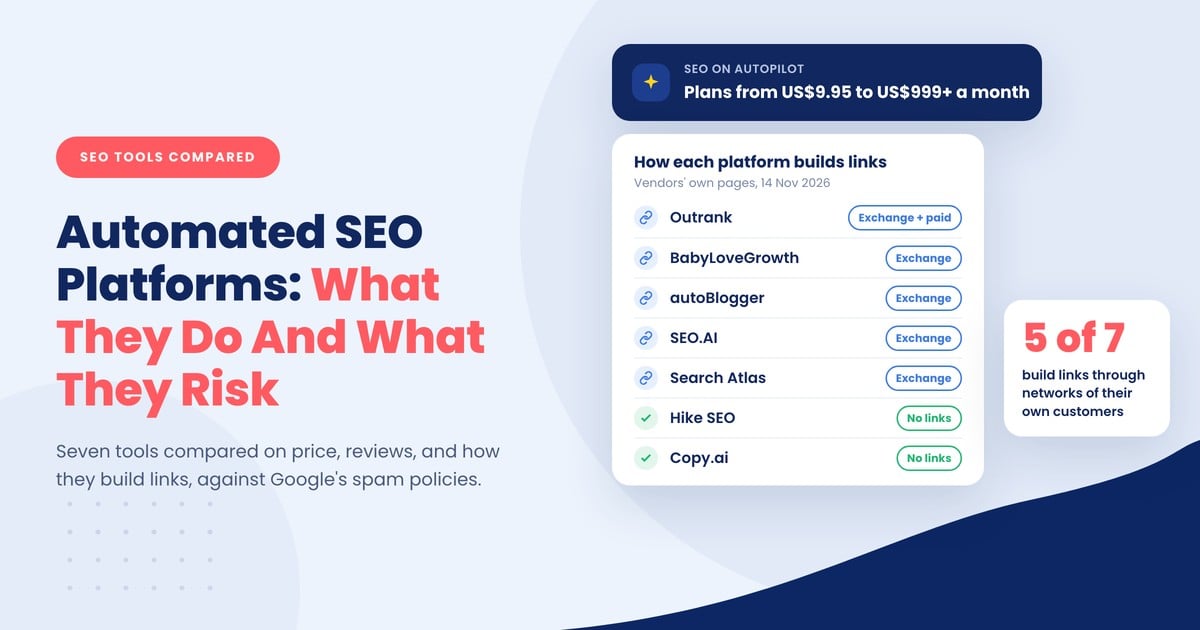
- Five of the seven platforms build links through networks of their own customers, which did no harm on our test sites, though that’s a small sample and Google’s link spam policy still lists link exchanges among its examples
- Outrank also sells link placements that it says carry “no nofollow”, and Search Atlas sells AI-generated pages on cloud domains that link back to you
- Search Atlas’s own help centre says AI crawlers don’t see the fixes its script injects, and Hike SEO applies its changes the same way
- They’re useful for keyword research, first drafts, technical audits, and tracking how AI answers mention you, as long as a person reviews what goes live and checks the links the tool places
The Seven Platforms At A Glance
| Platform | What it is | From (a month) | Builds links? | Publishes or changes your site by default? | Trustpilot | My risk rating |
| Outrank | Autopilot articles and links | US$99 | Exchange, plus paid placements as add-ons | Yes, with optional preview | 3.9 (104 reviews) | Medium, or high with paid placements |
| BabyLoveGrowth | Autopilot articles and links | US$99 | Exchange | Yes | Rating withdrawn | Medium |
| autoBlogger | Autopilot articles for Shopify | US$9.95 | Exchange, opt-in | Yes | Shopify App Store: 5.0 (100 reviews) | Medium |
| SEO.AI | AI SEO agent | US$149 | Exchange | Your choice of auto-publish, drafts, or review | 2.3 (23 reviews) | Medium |
| Search Atlas | SEO suite with automated fixes | US$99 | Optional exchange and AI-generated cloud pages | Yes, with an optional approval mode | 3.8 (352 reviews) | Medium, or high with Cloud Stacks |
| Hike SEO | AI SEO assistant for small businesses | US$149 | No | Yes, through a script, with a monthly review | 4.5 (56 reviews) | Medium |
| Copy.ai | AI writing and workflow platform | US$29 | No | No | 1.8 (196 reviews) | Low, depending on how it’s used |
My risk rating is an opinion, high where a tool sells links without a nofollow or sponsored tag, or pages made to link to you. It’s medium where a tool publishes or changes your site without review by default, runs a customer link exchange, or keeps changes only while its script runs. Exchanges sit at medium because they did no harm on our test sites, but I can’t vouch for them at scale. Prices are each vendor’s lowest plan on 14 November 2026.
What Google Actually Penalises
Google settled the AI question in February 2023, when it said that “appropriate use of AI or automation is not against our guidelines“. What it penalises is content made “with the primary purpose of manipulating ranking”, and since March 2024 that has had a name, scaled content abuse. Google’s spam policies define it as “many pages … generated for the primary purpose of manipulating search rankings and not helping users”, and add “no matter how it’s created”.
That puts the weight on review rather than on who or what did the writing. Google’s guidance on generative AI content, updated on 1 October 2026, says “it is critical to manually factcheck and review all AI-generated content for accuracy and trustworthiness before publishing”, and that includes titles, meta descriptions, and structured data.
AI text can still rank, too. In a study of about 150,000 top-10 pages from June 2026, pages a detector scored as entirely AI made up 5.3% of top-three results, as SEJ reported. The study was run by Ahrefs, which sells SEO software including AI content tools.
Most of these platforms also build links, and Google’s link spam examples include “excessive link exchanges (‘Link to me and I’ll link to you’)” and “using automated programs or services to create links to your site”, as well as “exchanging money for links” unless the link carries a nofollow or sponsored attribute. Since May 2026, the same policies also cover “attempting to manipulate generative AI responses in Google Search”.
Google says it finds violations “through automated systems and, as needed, human review”, and that sites breaking the rules “may rank lower in results or not appear in results at all”. It has also been busier this year. Its Search Status Dashboard lists four spam updates in 2026, in March, June, August, and September, against one in all of 2025.
What Happened When We Tested Them
We’ve tried automated SEO tools like these on our own test websites, and none of those sites picked up an algorithmic or manual penalty, even with the tools’ link features switched on. Traffic generally went up, but not consistently across every site or every page, and the articles on lower-competition niche topics seemed to perform best.
My read is that these platforms use quantity to make up for the quality of any one page. If a tool publishes every day, the hit rate eventually means some of those pages bring the site traffic, even though plenty of others don’t.
What I think is underrated is how quickly that volume gives you data. Once the articles were live, we used Search Console to sort them into winners and losers.
For the winners, we made small tweaks to personalise the content and added call-to-action modules. For the losers, we checked whether there was enough search interest to justify a custom rewrite, and whether any of them overlapped enough with other weak articles to combine into one stronger page.
Those link features were mainly the exchanges, and none of them swapped links one-to-one between two sites. Links were passed around each tool’s network instead, which is part of why they seemed safe to me. Most came from sites in the same niche but in other countries, since we couldn’t get matches from the test sites’ own country, and I’m not sure the matching considers location at all.
The links still looked sensible for each site’s topic, and we saw no negative impact from them. That’s within a small sample, though, and an exchange is only as safe as the links it places, which I can’t judge without seeing it at scale.
Even without a penalty, we were never comfortable with the pace of posting. The whole time, we were worried about two things: a scaled content abuse penalty, or the site’s overall quality slipping when a core update rolled out. Those were test sites, so we could live with that risk, but on a site a business depends on, I wouldn’t publish at that rate without someone reviewing each article first.
Autopilot Content With Built-In Links
These three write articles and publish them to your site on a schedule, and each one also connects you to a network of other customers’ sites for links.
Outrank
Outrank costs US$99 a month, or US$999 a year, for 30 articles a month that it researches, writes, illustrates, and publishes automatically to WordPress, Webflow, Shopify, and other platforms. You can preview each article up to seven days before it goes live, and 90 articles a month is a US$160 add-on. Human editing is sold separately at US$1,399 a month, which tells me where the real cost of good content still sits.
On the base plan, Outrank says you earn the credits for your own links “by hosting a relevant link in your own articles”, so it works as an exchange between customers. Its backlink add-ons, from US$199 to US$899 a month, are where I’d be careful, because they buy placements on other blogs, and Outrank pays those blogs “$1 per DR point” per article.
On its backlinks page, Outrank says your link sits “with no nofollow” and is “the only paid link in the article”, and it offers “first place in listicle articles”. Set next to Google’s policy, I think that’s close to the examples of paid links and automated link services, and Outrank’s own terms seem to recognise the risk. They say links publish with “no manual preview or approval step”, and customers who use backlink building agree to “indemnify and hold us harmless from any related penalties”.
Its “+10 DR in 60 days or your money back” offer only applies if backlink generation stays on, so you can’t have the guarantee without the links. Outrank has 3.9 out of 5 from 104 reviews on Trustpilot. I’d consider it for a new site that needs a steady blog, with every article previewed, the paid add-ons left off, and a regular check of the links the exchange places, since you can’t approve them first.
BabyLoveGrowth
BabyLoveGrowth charges US$99 a month for 30 articles, or US$399 for 120 articles in up to four languages, and publishes them to your site automatically. It also tracks how AI platforms answer a set of prompts about your business, which is useful, and its Scale plan adds a dedicated specialist.
Its links come from what its own FAQ calls a “backlink exchange”. Members “automatically exchange backlinks with each other”, you earn credits “whenever one of your articles gives a link to a partner site”, and its terms limit the network to paying subscribers. That makes it a credit system rather than a direct swap between two sites, which is the kind of network that did no harm on our test sites.
The FAQ says exchanging is safe “as long as the sites are real”, but Google’s policy names excessive link exchanges without that exception. BabyLoveGrowth’s pages also don’t explain how to switch the exchange off, which would matter if it ever placed links you didn’t want.
Its 90-day money-back offer refunds you only if your “traffic or Domain Rating doesn’t improve”, and not if either one did. Domain Rating is Ahrefs’ measure of a site’s backlinks, so the network’s own links can move it, and I’d read the offer as a promise about links rather than about customers.
It also runs “Reddit & Quora agents” that suggest comments “that naturally mention your brand” for you to post. On Trustpilot, its rating is unavailable because, in Trustpilot’s words, “this company has been offering incentives for reviews“. Before signing up, I’d ask how to pause the exchange and whether articles can wait for review before they publish.
autoBlogger
autoBlogger works only on Shopify and is the cheapest of the seven, at US$9.95 a month for one post a week, US$19.95 for three, and US$29.95 for one a day, each with a 14-day trial. It writes posts around your products, links to them, and publishes on a schedule, and it has 5.0 out of 5 from 100 reviews on the Shopify App Store.
Its Backlinks Program is opt-in. If you join, a link to your store goes “at the end of other autoBlogger’s blogs”, and “in return, their links may be shared on your site”. You “may not remove the back-links without prior consent”, and autoBlogger “does not keep a record of the backlinks that have been created for your store”, which would make a clean-up harder if you ever needed one.
Your link is shared across other stores’ blogs rather than swapped with one store, so it works like the other networks, though I’d ask what it would place on my blog before joining. With posts kept to a pace you can actually read, it’s a cheap way for a store to publish product-led articles, as long as someone adds what the AI can’t know, such as sizing advice, stock, and real photos.
AI SEO Agents And Suites
These three sell themselves as an SEO team in software, covering strategy, content, and fixes, and two of them change your existing pages through a script that runs in the browser.
SEO.AI
SEO.AI costs US$149 a month for one site in one language, or US$299 for up to three, with a seven-day trial. Its pricing page says “What an SEO agency charges $1,000 for, we deliver for $149”, and the plan covers content planning, writing and publishing pages and articles, building Google Ads campaigns, and backlinks.
You can publish automatically, save posts as drafts, or review them in the platform, and SEO.AI says its specialists spot-check the writing. The backlinks come from an “automatic link exchange“, where you “exchange backlinks with relevant websites in the network”, and SEO.AI says each one “passes link equity”. Its pages don’t say how many links you give or receive, or whether your own posts carry links to other members, and that’s what I’d want to know before switching it on.
Its claims are hard to square, too. The About page says customers “are guaranteed better results”, while the terms say “there shall be no refunds” except where the terms or the law require. It has 2.3 out of 5 from 23 reviews on an unclaimed Trustpilot profile. For an owner with no time for SEO, I’d use it with drafts on, and keep the exchange on only if I could see the links it places.
Search Atlas
Search Atlas is a full SEO suite, with rank tracking, site audits, content tools, Google Business Profile management, and tracking of how AI platforms mention you. Plans cost US$99, US$199, or US$399 a month, and agency plans start from US$999. They run on credits, there’s a seven-day trial, and refunds are limited to 48 hours after purchase with under 10% of the quota used, under a policy that begins “Search Atlas has a no-refund policy”.
Its automation layer, OTTO, fixes titles, meta descriptions, schema, alt text, and links, and by default it “deploys fixes on its own once the pixel is connected“, with an approval mode if you’d rather sign off first. The pixel injects those fixes with JavaScript, which Googlebot runs. However, Search Atlas’s own help centre says “AI crawlers and non-JS bots only see edge-rendered content, not JS-injected fixes”, and the edge version needs a Cloudflare connection.
The fixes also depend on OTTO staying on, because when it’s turned off, the same help article says “your site reverts to its pre-fix state”. So I’d treat OTTO’s changes as a layer on top of the site rather than part of it, and copy anything important into the CMS.
Search Atlas sells link products as well. Its WILDFIRE system works “on an exchange ratio where outbound links you provide to topically aligned sites are reciprocated with inbound links from authoritative domains within the network“, and its Cloud Stacks “create AI-generated web pages and publish them across multiple high-authority cloud domains“, each linking back to you, for US$15 a stack.
For WILDFIRE, Search Atlas says you “can review proposed exchanges in your dashboard and decline matches”, which is the control I’d want from any exchange. I’d skip Cloud Stacks, though, because AI-generated pages made to link to you are close to Google’s example of using automated services to create links.
It has 3.8 out of 5 from 352 reviews on Trustpilot. I think it suits an in-house team or an agency that wants audits, tracking, and AI visibility in one place, with OTTO in approval mode and Cloud Stacks left alone.
Hike SEO
Hike SEO is aimed at small businesses. Its assistant, Kit, plans your SEO, makes monthly fixes to your pages, writes monthly blog content, and looks after your Google Business Profile and directory listings. It costs US$149 a month for one site, or US$299 for up to three, with 40% off if you pay yearly. There’s no trial, though Hike offers a 14-day money-back guarantee.
I’d call it the most cautious of the six tools built for SEO, because it doesn’t build links, and Hike says its work needs only “10 minutes a month to review and approve”. It does change your pages through a script, though. Kit “applies every SEO improvement directly to your site using Hike’s Onsite Optimiser”, and after you cancel, the changes stay only as long as you “keep our javascript snippet (onsite optimizer) on your site”.
Hike doesn’t say whether AI crawlers see those changes, and since several AI fetchers don’t run JavaScript, I’d assume they don’t. It has 4.5 out of 5 from 56 reviews on Trustpilot. For a local business that wants guided basics, I think it’s a reasonable choice, as long as the titles, headings, and copy that matter most are also written into the site itself.
The Outlier: Copy.ai
Copy.ai isn’t really an SEO platform any more. It sells itself as an AI platform for sales and marketing teams, and SEO is one of many jobs its workflows can do, combining research and writing to produce an SEO article. The only price it shows is US$29 a month, or US$24 billed yearly, for its chat plan, while workflow plans, including bulk runs and API access, go through its sales team.
It doesn’t track rankings or build links, so the risk depends entirely on how it’s used. Its pricing page shows the scale it works at, with a client “driving accurate content generation across 100,000+ product review catalog sites”. With nobody editing the output, it could make the kind of pages Google’s scaled content policy describes, but for drafts a person improves, it’s simply a writing tool. It has 1.8 out of 5 from 196 reviews on Trustpilot.
Do These Tools Help With GEO And AEO?
Partly. Generative engine optimisation (GEO) and answer engine optimisation (AEO) still rest on clear content that answers real questions, and these tools can help produce it. Google’s own guide to AI features says “optimizing for generative AI search is optimizing for the search experience, and thus still SEO”, but it also warns that “a high quantity of pages doesn’t make a website higher quality”.
Some of what’s sold as AI visibility won’t reach AI at all. Search Atlas says AI crawlers don’t see the fixes its pixel injects, Hike SEO uses the same kind of script, and as our article on JavaScript and AI answers explains, ChatGPT, Claude, and Gemini read only the HTML when they fetched pages themselves in tests this year.
Two features aim straight at the sources AI cites, and both worry me. Outrank offers first place in listicles, and our study of AI citations in Singapore found that listicles made up about one in eight citations between October and November 2026. However, Lily Ray reported in February 2026 that sites with hundreds of self-promotional lists lost 29–49% of their visibility, and Google’s guide says “seeking inauthentic ‘mentions’ across the web isn’t as helpful as it might seem”.
BabyLoveGrowth’s Reddit suggestions raise a different problem. Its own docs tell you to “edit every draft” and follow each subreddit’s rules, which helps, but comments written to work a brand into a thread can drift towards the manipulation described in our article on white hat and black hat GEO. They’re also chasing a source that’s lost ground, because for the 28 Singapore brands in our Reddit study, ChatGPT cited Reddit in 11.4% of answers in July 2026 and 1.1% in September.
The part I’d actually pay for is tracking. Search Atlas and BabyLoveGrowth both check how AI platforms answer prompts about your business, which shows you what AI says about you, even though no tool can promise to change it. Outrank puts it plainly on its own site: asked whether it can guarantee that ChatGPT will recommend a brand, it says “No, and you should be wary of anyone who does.”
How I’d Use An Automated SEO Tool Safely
If you do use one, these habits keep most of the risk out:
- Check what the link features place. If you join an exchange, look at the links it adds to your site and the sites linking back, and don’t buy placements unless the link carries a nofollow or sponsored attribute, because paid links are where Google’s policy is clearest
- Publish to drafts. Read every post before it goes live and fact-check it, as Google’s own guidance asks
- Add what only you know. Your prices, stock, photos, customers’ questions, and your own view are what make a page more than a summary of what already ranks
- Publish only as fast as you can review. Thirty unread articles a month is how a blog drifts towards the “many pages without adding value” that Google describes
- Let Search Console decide what’s next. Personalise the pages that win and add a clear call to action, then rewrite or merge the ones that don’t, so weak pages don’t pile up
- Put important fixes into the site itself. If a tool changes titles or copy through a script, copy the ones that matter into your CMS, so AI crawlers can see them and they survive if you cancel
- Check Search Console regularly. Look at the Manual actions report and at your traffic around each spam update, and if something appears, our guide to Google manual actions covers what to do
What I Can’t Tell You
The details of each platform come from its own pages and terms, Google’s documentation, and public review sites as of 14 November 2026, and prices and features change often. Our own tests ran on test websites rather than on sites a business relies on, so the lack of penalties there doesn’t tell you how a business site would fare through a core update.
The exchanges did no harm on our test sites, and no public report ties these networks to a Google penalty yet. However, that’s a small sample, a network’s safety depends on what it places across all its members, and Google rarely confirms individual cases, so I can’t say how they hold up at scale. The review scores rest on 23 to 352 reviews each, and they reflect billing and support as much as results.
Automated SEO Platform FAQs
Can an automated SEO tool replace an SEO agency?
It can replace some of the hours, but not the judgement. These tools are good at producing drafts, fixes, and reports quickly, but deciding what’s worth publishing, adding what only the business knows, and saying no to risky links still takes a person. Even Outrank charges US$99 a month for 30 AI articles, but US$1,399 a month for human editors to review them.
Is AI-generated content bad for SEO?
No, not on its own. Google has said since February 2023 that appropriate use of AI isn’t against its guidelines. What it treats as spam is many pages made to manipulate rankings without adding value for users, however they’re written, and its current guidance says to fact-check and review all AI content before publishing. Our article on whether Google penalises AI content goes into more detail.
Do automated SEO tools actually increase traffic?
They can, but not evenly. On our own test websites, traffic generally went up without any penalty, but the gains weren’t consistent across sites or pages, and articles on lower-competition niche topics did best. I think that’s because daily publishing works on a hit rate, where enough pages land to bring in traffic even though many don’t, so the real value comes from improving the winners and rewriting or merging the rest.
Are backlink exchanges safe?
The ones we tried seemed safe, within a small sample. They didn’t swap links one-to-one between two sites but passed them around the network, and on our test sites they did no harm and the links looked sensible, even though most came from overseas. Still, safety depends on the links a network places, which I can’t judge without seeing it at scale. Google’s link spam policy also lists excessive link exchanges and automated link services among its examples.
Will an automated SEO platform get my business into ChatGPT or AI Overviews?
Not reliably, and no one can guarantee it. Clear content that answers real questions can help, but fixes injected by a script may never reach AI crawlers, and Google’s spam policies now cover attempts to manipulate its generative AI answers. Even Outrank, asked whether it can guarantee a ChatGPT recommendation, answers “No, and you should be wary of anyone who does.”
Can I use an automated SEO tool alongside an agency?
Yes, for research, drafts, audits, and tracking, which is where these tools are strongest. I’d keep two decisions with a person, though: what gets published, and where links come from. If the tool publishes without review, or places links nobody checks, it can create the problems your SEO work then has to fix.
What should I do if my site gets a manual action after using one?
Fix the cause before you ask Google to review it. That usually means removing or improving the pages the tool mass-produced, switching off any link exchange, getting the exchanged links removed where you can, and disavowing the ones you can’t. Then submit a reconsideration request in Search Console explaining what you changed, as our guide to Google manual actions describes.
References
- Google: Spam policies for Google web search, updated August 2026
- Google: Guidance on using generative AI content, updated October 2026
- Google Search Central: Google Search’s guidance about AI-generated content, February 2023
- Google: Optimizing your website for generative AI features on Google Search
- Google Search Status Dashboard: Ranking incident history
- Search Engine Journal: Google search results still rank heavily AI-flagged pages, July 2026
- Search Engine Journal, Lily Ray: Is Google cracking down on self-promotional listicles? February 2026
- Outrank: Pricing
- Outrank: Backlinks
- Outrank: Marketplace for publishers
- Outrank: Terms of use, updated June 2025
- Outrank: Get mentioned by LLMs
- BabyLoveGrowth: Pricing
- BabyLoveGrowth: Backlinks
- BabyLoveGrowth: Terms of use
- autoBlogger: Pricing and features
- autoBlogger: Backlinks Program
- Shopify App Store: autoBlogger
- SEO.AI: Pricing
- SEO.AI: Home page
- SEO.AI: About
- SEO.AI: Terms
- Search Atlas: Pricing
- Search Atlas: Refund policy
- Search Atlas: OTTO Pixel
- Search Atlas Help Center: OTTO setup, functionality, and deployment
- Search Atlas Help Center: Understanding the WILDFIRE link-building system
- Search Atlas Help Center: How it works, Cloud Stacks, October 2026
- Hike SEO: Pricing
- Copy.ai: Pricing
- Trustpilot: Outrank, BabyLoveGrowth, SEO.AI, Search Atlas, Hike SEO, and Copy.ai
Information above was checked on 14 November 2026.