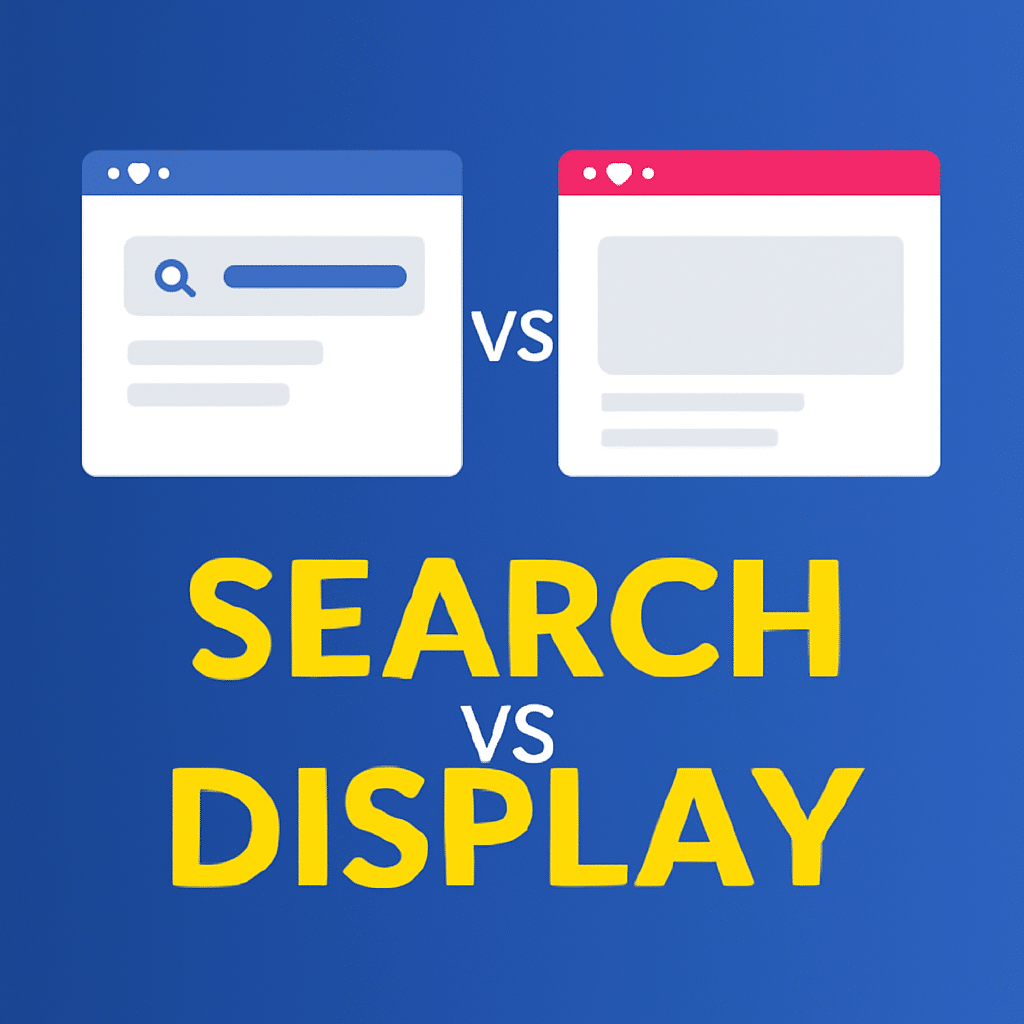
Google Search Ads and Google Display Ads are two powerful tools that serve distinct but complementary roles in the marketing funnel. Google Search Ads capture high-intent users actively searching for solutions, making them ideal for bottom-of-the-funnel conversions. In contrast, Google Display Ads are used to build awareness, generate interest, and nurture leads, excelling at top-of-the-funnel engagement and mid-funnel remarketing. Together, these ad formats offer a comprehensive approach that can drive both immediate results and long-term growth for your business.
Google Search Ads
Google Search Ads appear when users type a specific query into Google’s search bar. They are primarily driven by keywords and user intent. By focusing on relevant search terms, you can place your ads directly in front of users actively looking for what you offer.
- Best For: Immediate needs, bottom-funnel intent, and smaller budgets requiring cost efficiency.
- Bidding Model: Typically bought on Cost Per Click (CPC), with Ad Rank determining placement based on bid and ad quality.
- Targeting: Primarily keyword-driven, but audience signals can enhance targeting.
Google Display Ads
Google Display Ads appear across the Google Display Network (GDN), which spans over 2 million websites and reaches 90%+ of internet users worldwide. These ads can be visual (image, video) and are often used for broad reach and brand visibility.
Best For: Building awareness, nurturing consideration, and remarketing.
Bidding Model: Available in Cost Per Thousand Impressions (CPM) or Cost Per Click (CPC). Creative quality and viewability are key performance drivers.
Targeting: Based on audience signals (in-market, affinity, custom segments), contextual factors, and placements.
Google Search Ads Vs Google Display Ads
| Dimension | Google Search Ads | Google Display Ads |
|---|---|---|
| Targeting | Keywords, user intent, device, location, and schedule | Audience signals (in-market, affinity, remarketing), contextual signals, placements |
| Ad Format | Text-based ads | Visual ads (images, banners, videos) |
| Best For | Immediate intent, bottom-funnel conversions | Awareness, consideration, remarketing |
| Bidding Model | Pay-per-click (CPC), cost per conversion (CPA) | Cost per thousand impressions (CPM), cost per click (CPC) |
| Ad Placement | Appears on Google Search results pages | Appears on Google Display Network (2M+ websites, apps, and YouTube) |
| Reach | Limited to search intent and active queries | Broad, with the ability to reach users across websites, apps, and platforms |
| Conversion Likelihood | High – Captures high intent traffic | Lower – Primarily used for awareness, with assisted conversions |
| Creative Control | Limited to text ads and extensions | Rich media (images, videos, banners) with more creative flexibility |
| Cost Efficiency | More expensive, especially for high-competition keywords | Generally lower CPC and CPM, but often lower CTR and conversion rates |
| Impact on Brand Awareness | Indirect impact through high-visibility SERP placement | Direct impact through visual storytelling and brand recall |
| Attribution | Strong direct attribution (last-click) | Often requires assisted conversion analysis due to view-through attribution |
| Optimization | Optimized through keyword match types, bid strategies | Optimized through audience targeting, placements, and creatives |
| Usage in Funnel | Bottom-funnel: Capturing demand from active searchers | Top and mid-funnel: Building awareness and nurturing leads |
| Ad Fatigue | Low risk of fatigue, as ads are shown based on search intent | Higher risk of fatigue if frequency caps and creative rotations are not managed properly |
| Best For | Immediate leads/sales, time-sensitive services | Brand building, broad reach, and remarketing |
Pros and Cons of each Channel
| Ad Type | Pros | Cons |
|---|---|---|
| Search Ads | – Captures explicit user intent – High likelihood of direct response – Tight control over queries using match types and negative keywords – Clear path from the ad to a relevant landing page |
– High CPC on competitive keywords – Limited visual appeal and engagement – Traffic volume is limited by search demand in your category |
| Display Ads | – Massive reach and frequency – Great for brand recall and engagement – Rich creative options – Images and video can tell a more engaging story – Excellent for remarketing and mid-funnel education |
– Generally lower click-through rates (CTR) and conversion rates (CVR) – Brand safety is crucial; placement and content quality must be managed – Last-click attribution may understate the full impact without assisted or view-through analysis |
Performance Expectations of each Channel
| Ad Type | Search Ads | Display Ads |
|---|---|---|
| Overview | High conversion rates due to capturing demand from users actively searching. | Lower CTRs and conversions, but essential for building awareness and remarketing. |
| Conversion Rates | Generally high due to the high intent of searchers. | Lower conversion rates, but they nurture leads and support brand recall. |
| Cost | Higher CPC due to competition for popular keywords. | Generally lower CPC and CPM, but results in lower CTR. |
| ROI | High ROI if targeting is precise and landing pages are optimized. | ROI can be strong over time, especially in assisting conversions. |
| Best For | Bottom-of-the-funnel conversions, when users are close to a decision. | Top and mid-funnel stages, brand awareness, and remarketing efforts. |
| Reach | Limited by search demand within your category. | Massive reach across the Google Display Network, allowing broad visibility. |
| Effect on Brand | Direct impact by capturing high-intent users. | Indirect impact by creating brand awareness and assisting future conversions. |
| Optimized Funnel | Best for immediate action, capturing demand at the moment. | Best for long-term engagement, helping move users down the funnel. |
| Limitation | Limited by the volume of searches for relevant terms. | Needs to be combined with remarketing for better performance. |
| Interaction | Direct response with clear path to conversion (click to purchase). | Often part of a multi-channel strategy, leading to conversions via remarketing and search. |
How to Choose a Channel
| Dimension | Search Ads | Display Ads |
|---|---|---|
| Objective and Demand State | Use for immediate leads or sales from people who are already looking for your product or service. | Ideal for creating demand, raising awareness, or nurturing consideration. |
| Budget, Timing, and Creative | **Tight Budget, Urgent Needs**: Prioritize Search Ads. | **Strong Creative Assets, Growth Goals**: Add Display Ads for prospecting and remarketing. |
| Sales Cycle | **Short, Transactional Offers**: Focus on Search Ads for capturing immediate intent. | **Longer, Considered Purchases**: Combine Display Ads for education and repeated exposure, and Search Ads for capturing spikes in intent. |
2024–2025 Updates You Should Factor In
Demand Gen Has Matured:
Demand Gen, now integrated with Google’s Display Network (opt-in), offers more control, helping you target visual mid-funnel surfaces across YouTube, Gmail, and Discover.
Performance Max:
Performance Max, which serves across Search, Shopping, YouTube, and Display, continues to evolve. While it’s great for scalability, its lack of transparency at the query/placement level makes it ideal only once you have clean conversion tracking and solid Search coverage.
Privacy & Consent:
As privacy laws evolve, Consent Mode and other privacy-related tools impact remarketing and conversion modeling. Make sure your consent setup is in place to ensure proper bidding and reporting.
Targeting, Controls, and Brand Safety
Search Ads:
- Match Types: Use exact match for must-win terms, phrase match for close variants, and broad match for discovery with solid negative keywords.
- Geo & Schedule: Focus on serviceable areas and business hours to optimize ad relevance.
Display Ads:
- Audience Strategy: Start with Customer Match and remarketing, then expand to in-market, affinity, and custom segments.
- Contextual Strategy: Use topics, contextual keywords, and managed placements. Set frequency caps to avoid audience fatigue.
- Brand Safety: Implement content exclusions and monitor placement quality for suitable brand alignment.
Bidding and Budgeting by Funnel Stage
Search Ads:
- Start with: Maximize Conversions or Maximize Conversion Value to collect initial data.
- Shift to: Target CPA (tCPA) or Target ROAS (tROAS) once stable conversion volumes are reached.
Display Ads:
- Prospecting: Begin with CPC or CPM, and test different audience signals like in-market and custom segments.
- Remarketing: Transition to tCPA for more efficient conversions once you have a sufficient data pool.
Creative and Landing Page Guidance
Search Ads:
- Craft diverse headlines and descriptions, aligning them with the keywords in each ad group.
- Ensure ad relevance with clear value propositions (e.g., price, speed, guarantees).
- Leverage sitelinks and other ad extensions for enhanced visibility.
Display Ads:
- Create multiple sizes and versions (static or animated) to maximize reach.
- Keep the typography large and legible, with a clear CTA.
- For remarketing, focus on urgency and product-specific reminders.
Measurement Guidance
Define success based on the funnel stage you’re targeting. For Search Ads, focus on CPA/ROAS, qualified leads, and sales volume. For Display Ads, track reach, engaged sessions, assisted conversions, and brand search lift.
Conclusion
To maximize your marketing impact in 2025, consider integrating both Google Search Ads and Display Ads into a full-funnel strategy. Search Ads will help you capture high-intent traffic, while Display Ads nurture leads, build awareness, and support remarketing. By optimizing both, you’ll create a sustainable and scalable marketing approach.
If you want an experienced team to set this up, calibrate the metrics that matter, and keep your funnel improving month after month, partner with First Page Digital’s Google Ads agency team. From strategy and build to creative testing and measurement, we help you turn Google Ads into predictable revenue.