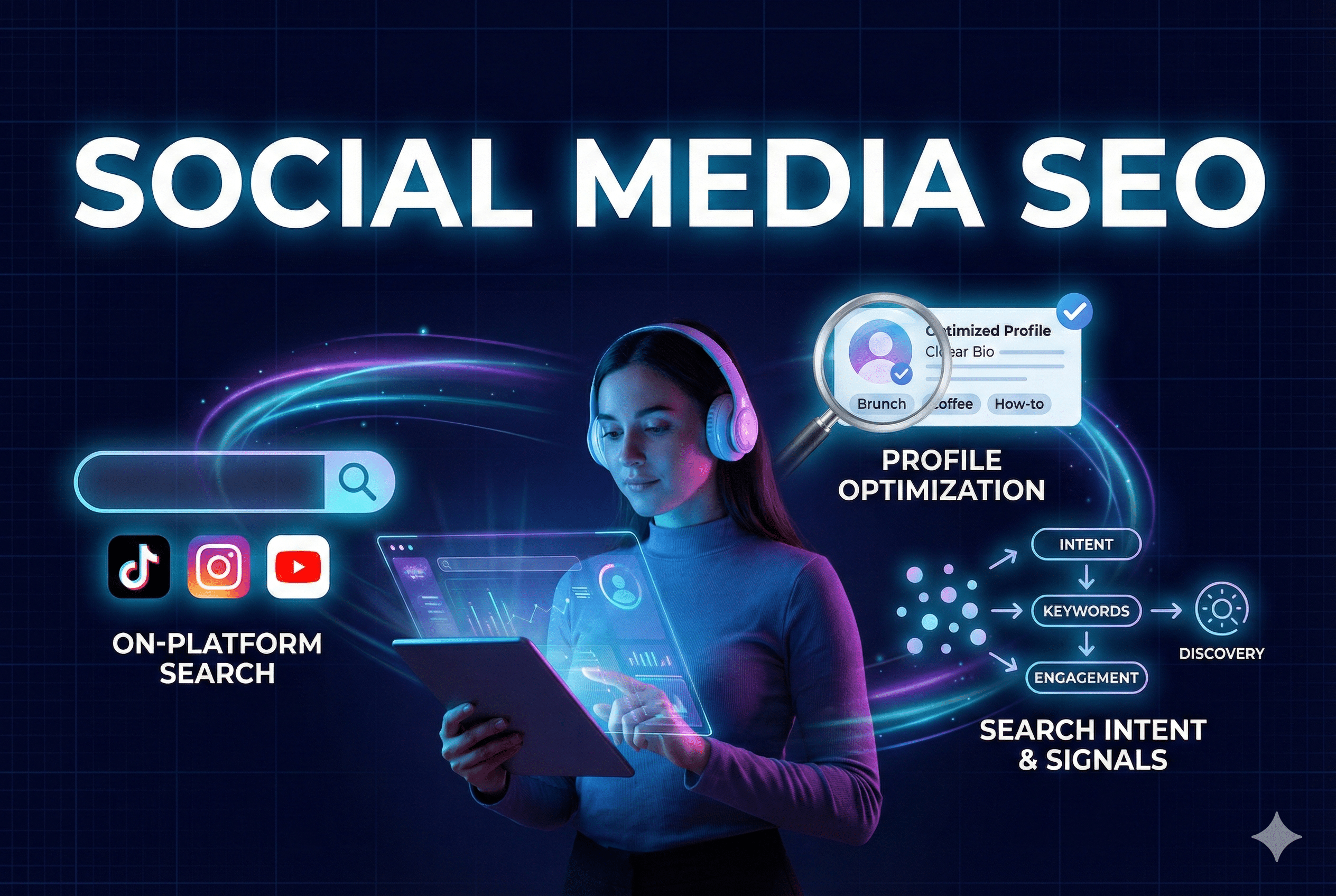
Social media SEO is the practice of optimising your social profiles and posts so people can find you through search inside social platforms.
That means you are not just chasing reach through the feed. You are building content that shows up when someone types a question into TikTok, Instagram, YouTube, Pinterest, or LinkedIn.
I treat it the same way I treat traditional SEO. I start with intent, then I make the platform signals obvious, then I publish consistently until the platform understands what I do and who I serve.
Social SEO vs the algorithm
These are not the same thing.
- Social SEO is when you rank because someone searched for a keyword or phrase.
- The algorithm is when you get pushed to people who did not search, but might still care.
Here is the trap: if you only optimise for the feed, your results are unpredictable. One post spikes, then your traffic disappears. Search-led content tends to compound because it keeps getting discovered.
Social SEO vs traditional SEO
Traditional SEO is mainly about how Google interprets your website. Social SEO is about how platforms interpret your profile and content.
However, they influence each other. When your social profiles are clean, consistent, and credible, they often take up more space on branded searches. When your social content answers real questions, it can drive clicks, brand searches, and sometimes even backlinks.
What social media SEO is not
- It is not stuffing captions with keywords until they read like garbage.
- It is not posting 30 hashtags and hoping something sticks.
- It is not swapping your bio link every week and then wondering why tracking is messy.
- It is not copying Google SEO tactics directly onto TikTok. Each platform reads content differently.
The simple rule I follow
If a stranger searched for the phrase you are targeting, would your post clearly answer it in the first 3 seconds, the first 2 lines of text, and the on-screen visuals?
If the answer is no, you are not doing social SEO yet. You are just publishing.
Why social SEO matters now
Social SEO matters because search behaviour has moved. People still use Google, but they also use TikTok, Instagram, YouTube, Pinterest, and LinkedIn to find answers, ideas, and recommendations.
That shift changes how you win attention. If you only rely on the feed, you are renting distribution. If you build search-led content, you are creating entry points that keep bringing new people in.
People are searching inside social platforms like they are search engines
On TikTok, users search for tutorials, product reviews, and quick comparisons. On Instagram, they look for places, services, and inspiration. On YouTube, they want deeper guides and step-by-step walkthroughs. On Pinterest, the intent is often planning, saving, and buying. On LinkedIn, it is research, credibility checks, and professional learning.
The important point is this. These searches are not random. They are high intent. Someone who types a query is already telling you what they want. Your job is to meet them there.
Search-led content is more stable than “viral” distribution
Viral posts feel good, but they are unreliable. A single spike does not build a pipeline. Search-led posts tend to have a longer discovery window because the content keeps getting pulled up when people search for the same problem.
This is why I like social SEO for businesses that need consistent leads. It does not replace creative content. It gives your creative content a structure that can compound.
Social content can show up outside the platform too
Your social profiles often appear on Google when someone searches your brand. That is free SERP real estate, and it is also defensive. If you do not control your brand results, someone else will.
Some social posts can also appear in search engines, especially public content. You should not build your entire plan on that. Still, it is an extra upside when you publish content that matches real queries and stays publicly accessible.
The real advantage: you can win earlier in the decision journey
Traditional SEO often captures demand once it is already mature. Social search captures demand while people are still exploring. They search “best”, “how to”, “review”, and “worth it” questions before they are ready to buy.
If you show up at that stage, you shape the shortlist. That is the game.
How social SEO works: the 3-lane model
If you want social SEO to work consistently, you need to stop treating it like one thing. It is actually three different visibility lanes that reinforce each other.
When teams struggle, it is usually because they are doing tactics without knowing which lane they are trying to win.
Lane 1: On-platform rankings
This is the obvious one. You want your posts and profiles to show up when someone searches inside a platform.
Each network has its own indexing signals, but the pattern is similar:
- The platform reads your profile fields to understand what you are about.
- It reads your post text to match queries with content.
- It uses behavioural signals to decide if your result deserves to stay visible.
In practice, that means your keywords need to appear in places the platform can interpret easily. Captions matter. On-screen text matters. Audio and subtitles matter for video. Alt text matters for images. Then the post needs to satisfy the searcher, so saves, watch time, rewatches, and comments become part of the ranking story.
Lane 2: Off-platform SERP presence
This lane is about what happens when someone searches on Google or Bing and your social profiles show up.
For most brands, the biggest win here is branded search coverage. When someone searches your business name, you want your official Instagram, LinkedIn, YouTube, and other profiles to appear clearly and consistently. That builds trust fast.
It also acts as defensive SEO. If you leave gaps, directories, third-party reviews, random forum threads, or outdated listings can take the space instead. You cannot always control that, but you can reduce the risk by keeping your owned profiles strong and coherent.
Lane 3: Traffic and authority effects
This is where social SEO becomes commercially useful.
When your posts rank for real queries, they drive clicks, profile visits, and follows. Some of that turns into website visits and conversions, especially when you use clean tracking and consistent link strategy.
There is also a secondary effect. Discoverable social content gets shared, referenced, and reused. Over time, that can lead to mentions, collaborations, and links. I do not rely on it as a guarantee. However, it is a real compounding benefit when the content is genuinely useful.
How to use this model without overcomplicating it
For every piece of content, I ask one question first: which lane is this designed to win?
- If it is Lane 1, I build around a search query and make the indexing signals obvious.
- If it is Lane 2, I focus on profile completeness, consistency, and credibility.
- If it is Lane 3, I make the path to conversion clear and measurable.
Once you decide the lane, your content decisions become easier. Your results also become easier to diagnose, because you know what success should look like.
Keyword research for social platforms (not search engines)
This is where most teams get it wrong.
They take a list of Google keywords, then force them into captions. The result reads awkwardly, and it rarely ranks. Social search has different intent patterns, and the language people use is often more conversational.
If you want to rank inside platforms, you need platform-native keywords. That means you research the way your audience actually searches there.
Step 1: Start with the platform search bar
I begin with the simplest method because it is usually the most accurate.
- Type your topic into the platform search bar.
- Record the autosuggestions.
- Repeat with variations like “best”, “how to”, “near me”, “for beginners”, “price”, “vs”, and “review”.
Those suggestions are not random. They are a direct reflection of real searches and demand.
Step 2: Steal phrasing from your audience
Next, I look for wording patterns in the places where people talk naturally:
- Comments under high-performing posts in your niche
- Questions in DMs and replies
- FAQ-style questions that keep showing up
- Competitor posts that consistently pull saves and shares
This gives you language that sounds human. It also gives you content angles that are already proven to matter.
Step 3: Use tools, but only to scale what you already found
Tools are useful for expanding and grouping keywords. They are not useful if you skip the platform reality check.
Here is how I use tools properly:
- I take my seed phrases from the platform search bar.
- I run them through keyword tools to find related variations and clusters.
- I validate the final list back inside the platform by searching and checking what is ranking.
If the tool suggests a phrase nobody uses on-platform, I drop it. I am not here to optimise for spreadsheets. I am here to get discovered.
Step 4: Build content pillars (keyword buckets)
Once I have the keyword list, I group it into 3 to 6 pillars.
A pillar is a theme you can publish repeatedly. It tells the platform what you are about, and it tells the audience what they can rely on you for.
For example, a social SEO pillar set for an agency might look like this:
- Social SEO basics and how it works
- TikTok and Instagram discoverability
- YouTube SEO and video search
- Local discovery and “near me” intent
- Measurement, reporting, and attribution
Every post should map cleanly to one pillar. If you keep jumping topics, you dilute relevance signals. You also confuse the audience.
Step 5: Choose keywords by intent, not volume
High volume keywords are often vague. Vague keywords attract low-quality traffic.
Instead, I prioritise phrases with clear intent. They usually look like this:
- “how to” queries
- “best” and comparison queries
- role-based or situation-based queries (“for small teams”, “for beginners”, “for mums”)
- problem-first queries (“why is my reach dropping”, “how to get more saves”)
These are easier to satisfy because the searcher is telling you exactly what they want. When you satisfy them, the platform sees the behavioural signals and rewards you.
My final filter before I create anything
I ask: can I answer this query clearly within the format of the platform?
If the query needs a 10-minute explanation, it belongs on YouTube. If it can be answered with a quick demonstration or checklist, it belongs on TikTok and Reels. If it is something people want to save and reference later, it belongs in a carousel or a Pinterest-style visual.
Keyword research is not just about picking words. It is about picking the right promise, on the right platform, in the right format.
Profile SEO: optimise every field that can rank
If your profile is weak, your content has to work harder.
Platforms use profile information to understand what your account represents. People also use it as a credibility check. So even if you rank for a keyword, a messy profile can kill the click, the follow, and the conversion.
I treat profiles like landing pages. They need to be clear, consistent, and built around the same topics I want to be discovered for.
Start with the two fields that matter most
- Handle/username: keep it clean and recognisable. If you add a keyword, it must still look like a real brand handle.
- Name field: this is often searchable. Use it to clarify what you do, not to stuff random keywords.
Example: “First Page Digital” is clear. “First Page Digital SEO Agency” is also clear. “First Page Digital SEO SEM PPC Social Growth Marketing” is not.
Write a bio that answers three questions fast
Most bios fail because they try to sound clever instead of useful. I keep it simple:
- What do you do? (service or category)
- Who is it for? (audience or industry)
- What outcome do you drive? (benefit or result)
If local matters, I also add where you operate. That helps with local discovery and reduces confusion.
Use categories and business fields properly
On platforms that allow categories, tags, or business fields, fill them in. Do not pick a trendy category. Pick the one that is closest to how your audience searches.
These fields are not just decoration. They help the platform classify you. They also help users decide if you are relevant.
Keep your link strategy stable
Constantly changing your bio link is a common mistake. It breaks tracking, and it weakens the association between your profile and your core website destination.
If you need multiple destinations, use a stable hub link. Then update the destinations inside the hub. That way, your main profile URL stays consistent, and you still get flexibility.
Clean up trust signals
Search visibility is useless if people do not trust you. So I make sure the basic credibility signals are in place:
- A clear profile image that matches your brand across platforms
- Consistent naming and messaging on every network
- Contact details where relevant (email, phone, address)
- Highlights, pinned posts, or featured sections that show your best proof quickly
Optimise for the “search click” moment
When someone finds you through search, they usually do two things in the first few seconds:
- They scan your name and bio to see if you match what they searched.
- They scan your recent posts to see if you consistently talk about that topic.
This is why profile SEO is not a one-time checklist. Your profile and your content pillars need to match. If they do not, you might still get impressions, but you will lose the follow and the trust.
My quick profile checklist
- Handle is clean and consistent everywhere
- Name field includes a clear descriptor where it helps
- Bio states what you do, who it is for, and the outcome
- Category and business fields are filled in and accurate
- Link strategy is stable and trackable
- Pinned or featured content proves relevance fast
Once the profile is solid, your content has a better chance of ranking and converting. Without it, you are leaking value at the exact moment discovery happens.
Post SEO checklist (use this for every post)
If your profile is the foundation, your posts are the proof.
Platforms need to understand what a post is about. People also need to understand it instantly. So I optimise posts for two things at the same time: indexing and comprehension.
This is the checklist I follow for every piece of content. It applies across platforms, but the weighting changes depending on whether you are posting video, images, or text.
1) Pick one keyword cluster per post
One post should answer one main search intent. If you try to rank for five topics at once, you will rank for none.
I choose one primary keyword, then I pick 3 to 6 supporting phrases that mean the same thing or sit closely beside it. These supporting phrases show up naturally in the script, caption, and on-screen text.
2) Write the caption like a direct answer
Captions are not just fluff. They are an indexing input.
I place the primary keyword early, but I do it in a human way. Then I add context and steps. If it reads awkwardly, I rewrite it. Ranking is pointless if nobody engages.
- Use clear wording and short sentences.
- Use connectors like “so”, “because”, “however”, and “instead” to keep flow natural.
- Make the value obvious in the first two lines, because many platforms truncate.
3) Use hashtags like categories, not decoration
Hashtags should reinforce the topic. They should not be a random list of popular tags.
I usually stick to 3 to 5 hashtags:
- 1 to 2 category hashtags (your niche)
- 1 intent hashtag (the problem or goal)
- 1 to 2 supporting hashtags (tools, audience type, or location if relevant)
If a hashtag does not match what the post is about, remove it. Irrelevant tags can dilute relevance and confuse indexing.
4) Make the topic visible in the creative
On many platforms, the creative is not just visual. It is also readable.
For video and carousels, I make sure the keyword shows up in at least one of these:
- On-screen headline text
- Subtitles or captions
- Spoken audio, which becomes transcript signals
This is especially important for TikTok and Reels. If the platform cannot confidently classify the content, it will not rank it reliably.
5) Say the keyword out loud for video
For short-form video, spoken keywords matter because transcripts and auto-captions often feed into how the platform understands your content.
I do not force it. I simply write scripts that sound natural and still include the phrase once or twice. Then I let the subtitles reinforce it.
6) Add alt text for images and carousels
Alt text is a small field that most teams ignore. That is exactly why it is worth doing properly.
I write alt text to describe what is literally in the image. I avoid stuffing. If the post is about a specific topic, I include the relevant descriptors naturally.
Good alt text also improves accessibility. That is not just a nice-to-have. It is part of building a brand that is usable for more people.
7) Align the CTA with the search intent
The CTA should match what the searcher is trying to do next.
- If the intent is learning, the CTA can be “Save this” or “Follow for more.”
- If the intent is comparison, the CTA can be “Comment your situation and I’ll recommend.”
- If the intent is purchase-ready, the CTA can be “Check the link in bio” or “DM for a quote.”
When the CTA matches intent, engagement rises. When engagement rises, rankings tend to hold longer.
8) Watch the behavioural signals that keep you ranking
Social search is not only about keywords. It is also about performance.
After publishing, I look at:
- Retention and rewatches for video
- Saves and shares for educational content
- Profile visits from the post
- Comments that show the post answered the question
- Clicks and conversions if the content is meant to drive action
If the post ranks but drops quickly, the content probably did not satisfy the query. If the post never ranks, the indexing signals are likely unclear, or the keyword is too broad for your current authority.
My minimum viable checklist
If you want a simple version you can apply quickly, use this:
- One clear intent per post
- Keyword appears naturally in caption and creative
- 3 to 5 relevant hashtags
- Subtitles or readable on-screen text for video
- Alt text for images
- CTA matches the searcher’s next step
Do this consistently, and the platform starts to understand your niche. Once that happens, ranking becomes a system, not a lucky event.
Platform playbooks (what to do differently by network)
The biggest mistake I see is treating every platform like it indexes content the same way.
Yes, the fundamentals carry across. Keywords, clarity, and engagement still matter. However, each platform has its own “reading habits”. So if you want rankings that stick, you need a platform-specific approach.
Instagram SEO
Instagram discovery is a mix of keyword matching and behavioural signals. So you need to make your topic obvious, then earn saves and shares.
- Optimise the name field with a clear descriptor. This is one of the fastest wins for discoverability.
- Write captions that answer the query, and put the main phrase early. Then expand with steps, examples, or context.
- Use 3 to 5 hashtags that reinforce the topic. Avoid dumping a long list, because it usually dilutes relevance.
- Use alt text for posts that need context, especially carousels.
- Prioritise saves by creating checklists, swipeable frameworks, and “do this first” content.
If you are serious about Instagram search, carousels are underrated. They are naturally saveable, so they often hold rankings longer than one-off memes.
TikTok SEO
TikTok is extremely search-led now, but it is also ruthless about satisfaction. If you do not answer the query quickly, your ranking will not last.
- Say the keyword out loud. TikTok reads audio and captions, so spoken phrasing helps classification.
- Put the keyword in on-screen text within the first second. Make it readable, not tiny.
- Keep the caption clear. You do not need a long essay. You need clean intent alignment.
- Use focused hashtags. Pick relevance over trend.
- Open with the answer, then explain. Do not build slow intros that waste the first three seconds.
If you want a simple format that works, do this: hook with the exact query, give the answer in one sentence, then give three steps.
YouTube SEO
YouTube behaves closest to traditional search. It rewards relevance, but it also heavily rewards retention and watch time.
- Use long-tail titles that match real queries. “How to…” and “Best…” formats work because the intent is obvious.
- Front-load the description. Put the main topic in the first two lines, then expand naturally.
- Use chapters when you have a multi-step guide. It improves usability and helps YouTube understand structure.
- Enable captions and make sure your spoken content matches the topic you are targeting.
- Win retention by removing filler. If the viewer searched for an answer, give it fast, then go deeper.
If you are choosing one platform for compounding search traffic, YouTube is usually the strongest long-term bet.
Pinterest SEO
Pinterest is a planning engine. People search, save, and come back later. So your goal is not just clicks. Your goal is being saved into the right boards.
- Think in boards first. Board titles and descriptions act like category pages, so name them with real search phrases.
- Write Pin titles and descriptions that match intent. Keep them descriptive and straightforward.
- Design for clarity. Strong visuals with readable text overlays perform better in search and saves.
- Stay consistent. Pinterest rewards accounts that publish within a clear niche.
If your content is instructional, visual, or checklist-driven, Pinterest can quietly become a major discovery channel.
LinkedIn SEO
LinkedIn search is often professional intent. People are looking for expertise, answers, and credible viewpoints. So you need clarity and substance.
- Complete every profile and Page section. This is extra indexable space, so do not waste it.
- Use keyword-led positioning in your headline, About, and featured sections. Keep it readable.
- Write posts that match real workplace questions. Frameworks, breakdowns, and lessons perform well.
- Avoid spam patterns. Too many hashtags and forced keyword repetition can hurt distribution.
On LinkedIn, credibility is part of ranking. People will not engage with content that feels like it was written purely for “SEO”.
Facebook SEO
Facebook still matters for local discovery and brand validation, especially for businesses with physical locations.
- Fill in business details like category, services, address, and opening hours.
- Use location pages if you have multiple outlets. This improves findability for local intent.
- Keep your Page consistent with your other profiles. Mismatched info creates distrust fast.
Facebook is not where I would bet on rankings for broad informational keywords. However, it is strong for local and brand verification.
X (Twitter) SEO
X is different. It is fast, short, and often newsy. That said, public posts can still show up in web search, and search inside the platform can still drive discovery.
- Use precise phrasing. You do not have room for fluff, so your keywords need to be tight.
- Write for clarity. If someone searches a phrase, your post should read like a direct answer or strong point of view.
- Build threads for depth when needed. More context usually performs better than isolated one-liners.
How I choose the primary platform
If you want a practical decision rule, use this:
- Fast discovery and trends: TikTok, Instagram Reels
- Compounding search traffic: YouTube, Pinterest
- B2B authority and trust: LinkedIn, YouTube
- Local validation: Instagram, Facebook
Once you choose the primary platform, you can repurpose intelligently. You do not copy and paste. You rebuild the packaging so the indexing signals and user behaviour match the platform you are posting on.
Traditional SEO tactics social media teams should steal
Social SEO feels new, but the winning principles are not.
Traditional SEO has been doing intent mapping, content structuring, and compounding distribution for years. Social teams can borrow the parts that work, then adapt them to platform behaviour.
1) Topic clusters, not random posts
In traditional SEO, you do not publish one article on a topic and then disappear. You build clusters around a theme until Google sees you as relevant.
Social works the same way. If you want to rank for “social media SEO”, you cannot post about it once a quarter. You need a cluster:
- definition and misconceptions
- keyword research workflow
- platform-specific tactics
- measurement and reporting
- case studies and examples
- common mistakes and fixes
When you publish clusters, two things happen. The platform learns your niche faster. Also, viewers start to trust that you are the account for that topic.
2) Repurposing like an SEO content machine
SEO teams rarely create one asset and stop. They break it into multiple formats to cover more long-tail searches.
I do the same with social, but I repurpose based on intent, not laziness.
Here is a repurposing system that actually makes sense:
- One long YouTube video targets the main “how to” keyword.
- Three short clips target sub-questions from the same topic.
- One Instagram carousel turns the process into a saveable checklist.
- One LinkedIn post turns the same idea into a framework and opinion.
- One Pinterest pin or idea pin packages the steps visually.
This is how you multiply discovery surfaces without bloating your workload. You are not creating more ideas. You are packaging the same idea for different search behaviours.
3) Update, do not just publish
Traditional SEO wins by updating content that already has traction. Social teams often ignore this because posts feel “done” once published.
That is a missed opportunity.
Here is what I update on social:
- Pinned posts, so new profile visitors see the best search-led content first.
- Captions for clarity, especially if the post starts ranking for a phrase you did not expect.
- Cover text and thumbnails on videos, because they affect clicks in search results.
- Alt text and accessibility fields, especially for evergreen posts.
You cannot fully rewrite history on social like you can with blog posts. Still, you can improve the packaging for content that is already earning impressions.
4) Internal linking, but in social form
SEO uses internal links to guide crawlers and users. Social does not have internal links the same way, but it does have navigation.
You can create “internal linking” through:
- pinned posts that act as category entry points
- highlights or featured sections that group content by topic
- series playlists on YouTube
- consistent captions that point to related posts (“I covered X in my last post, go check it”)
This keeps people moving through your cluster. It also increases the chance that someone saves multiple pieces, which is a strong signal that your content matches intent.
5) Use search intent to decide the format
SEO teams choose landing pages based on intent. Social teams should do the same.
- If the query is a quick fix, short-form video works.
- If the query is step-by-step, long-form video or carousels work.
- If the query is comparison, lists, tables, and “this vs that” formats work.
- If the query is local, location tags, proof content, and maps-style information matter.
Most “low performance” content is not actually bad. It is often just packaged in the wrong format for the search intent.
6) Track what matters, not vanity numbers
Traditional SEO is obsessed with rankings and conversions. Social teams often get stuck on views and likes.
If your goal is discoverability through search, the metrics you should care about look more like this:
- search impressions and search-driven views (where the platform shows it)
- profile visits from the post
- saves and shares for evergreen topics
- retention and rewatches for video
- link clicks and conversions with UTMs
Likes are not useless, but they are not the best signal of satisfaction. Saves, watch time, and follow-through actions are usually more predictive of long-term ranking.
Advanced tactics and emerging trends
Once you have the basics running, advanced tactics are not about doing more. They are about doing the right things earlier than everyone else.
This section is where teams usually split into two groups. The first group chases every new feature and gets distracted. The second group ignores trends and falls behind. You want the middle path. Use trends that change discovery, and ignore the rest.
1) Optimise for voice-style searches
People do not always type like SEO tools suggest. They often search in full sentences, especially on TikTok and YouTube.
So I build content around conversational phrasing:
- “How do I…”
- “What is the best way to…”
- “Why is my…”
- “Is it worth…”
This also improves your hooks. If you open with the exact question, you match the intent immediately, and you keep the viewer longer.
2) Use social listening as demand research
Most keyword research tells you what people searched yesterday. Social listening tells you what people are about to care about next.
I use it to find:
- recurring complaints that signal unmet demand
- new terminology that has not entered mainstream SEO yet
- misconceptions that you can correct with a simple explainer
- competitor weaknesses people mention openly
Then I turn those into search-led content before the topic becomes saturated.
3) Treat sentiment like a ranking multiplier
Search visibility is not only about matching words. It is also about how people respond to your content and brand.
If your posts trigger negative replies, low retention, or dismissive comments, you may still get impressions, but you will struggle to hold rankings.
So I build in credibility signals:
- specific examples, not vague claims
- clear steps and proof points
- screenshots or demos when possible
- balanced takes when the topic is nuanced
This improves engagement quality, which helps distribution and search stability.
4) AI-assisted optimisation, used properly
AI can speed up social SEO. It can also create generic content that nobody saves.
I use AI for support work, not the core thinking:
- cluster keywords into pillars and subtopics
- generate caption variations for the same intent
- draft alt text quickly, then I edit for accuracy
- repurpose long content into short scripts and carousel bullets
I do not use AI to invent insights. If you publish bland, recycled content, the platform may still index it, but people will not engage. Then it will not rank.
5) Social commerce search is becoming its own SEO layer
On platforms that support shopping, people search inside product catalogs. That creates a new surface you can optimise.
If you sell products, you should treat product listings like mini landing pages:
- use clear product names that match how people search
- include key attributes (size, material, use case, compatibility)
- avoid internal codes and vague naming
This is boring work, but it has direct impact. If your product naming does not match search language, you will lose to competitors even if your creative is better.
6) Build “evergreen search assets” inside your social accounts
Most brands post and move on. The smarter move is building assets designed to rank for months.
Examples of evergreen assets:
- a pinned “start here” post for your core topic
- a recurring series that answers one query type each week
- a YouTube playlist that covers a full keyword cluster end to end
- a carousel library of checklists and frameworks
These assets turn your profile into a searchable resource. Then when a new post ranks, it does not just get views. It pushes people into a structured content system.
What I do next after implementing advanced tactics
I run a monthly review where I look for two things:
- Which queries are bringing in the highest quality profile visitors?
- Which posts have stable retention and saves, but are not yet ranking strongly?
The first tells me what to scale. The second tells me what to repackage and push harder. That is how you keep compounding without burning the team out.
Social SEO strategies in action (2 worked examples)
If you want social SEO to work, you need examples you can copy. Theory is cheap. Execution is what ranks.
Below are two practical scenarios. I am keeping them simple on purpose, so you can apply the same structure to your own business.
Example 1: A Singapore café (Instagram + TikTok)
Goal: Show up for high-intent local searches, then turn discovery into bookings and walk-ins.
Main search intent to target: “best brunch”, “café near me”, “coffee near me”, “date café”, “work-friendly café”, plus location modifiers like neighbourhood names.
Step 1: Profile setup
- Name field includes a descriptor: “Brunch Café” or “Specialty Coffee” if accurate.
- Bio states: what you serve, what makes you different, and where you are.
- Location and opening hours are correct and consistent.
- One stable booking link or WhatsApp link, with tracking if possible.
- Pinned posts: “What to order”, “How to get a table”, “Best time to visit”.
Step 2: Keyword cluster and content pillars
- Pillar 1: What to order (signature dishes, drinks, set menus)
- Pillar 2: Practical info (how to get there, parking, MRT, peak hours)
- Pillar 3: Vibe and use cases (date spot, family-friendly, laptop-friendly)
- Pillar 4: Proof (reviews, UGC, behind-the-scenes, ingredient stories)
Step 3: Content plan that ranks
- Reel/TikTok: “What to order at [Café Name]” with on-screen dish names, subtitles, and clear pricing cues.
- Carousel: “Brunch at [Neighbourhood]: 5 things to know before you go” with a save-first layout.
- Short video: “How to get a table fast at [Café Name]” with steps and best visit windows.
- UGC stitch/duet: react to a customer review and add context, because it builds trust and improves conversion after search discovery.
Step 4: The ranking signals you should push
- Saves on carousels and menus
- Completion rate on “how to” videos
- Comments that include local intent (“Is this near Tiong Bahru?”, “Do you have halal options?”)
- Profile visits and link clicks from posts that rank for “near me” intent
Step 5: What I would measure
- Profile visits from search-led posts
- Link clicks or WhatsApp taps
- Bookings and walk-in mentions (“found you on TikTok/IG”)
- Top queries driving discovery (where the platform shows it)
Example 2: A B2B SaaS company (LinkedIn + YouTube)
Goal: Own problem-led searches, build credibility, and convert discovery into demos.
Main search intent to target: “how to reduce reporting time”, “workflow automation for [role]”, “best tool for [use case]”, “how to build [process]”, plus integration-specific queries.
Step 1: Positioning and profile setup
- LinkedIn headline and About section use clear problem and outcome language.
- Featured section includes: one case study, one “start here” explainer, one demo CTA.
- YouTube channel About section matches the same topics and keywords.
- One stable demo link with UTMs, plus a dedicated landing page for social traffic.
Step 2: Build a keyword cluster that matches B2B intent
- Cluster A: Role-based workflows (finance, ops, HR, sales)
- Cluster B: Process improvements (reporting, approvals, handovers)
- Cluster C: Tool comparisons and alternatives
- Cluster D: Implementation, onboarding, and integrations
Step 3: The YouTube plan (compounding search traffic)
- Publish one “how to” video per cluster, with long-tail titles that match queries.
- Front-load the answer in the first 30 seconds, then go deeper with steps and examples.
- Add chapters so viewers can jump to the part they care about.
- Cut 3 to 5 short clips from each video and repurpose them into LinkedIn posts.
Step 4: The LinkedIn plan (credibility and conversion)
- One post per week that answers a workplace question using a clear framework.
- One post per week that shows proof: a mini case study, data point, or customer quote.
- One post per week that handles objections: pricing logic, security, onboarding time, ROI.
Step 5: The conversion path
Search-led discovery does not convert if the path is fuzzy. So I make the next step obvious:
- Pin a “Start here” post that explains who the product is for.
- Use a dedicated demo landing page so tracking is clean.
- Use UTMs on every profile and featured link.
Step 6: What I would measure
- YouTube search views and retention
- LinkedIn profile views and connection requests from target roles
- Landing page conversion rate from social UTMs
- Which query clusters produce the highest demo-to-close rate
The point of both examples
You do not “do social SEO” by sprinkling keywords. You do it by choosing a search intent, building content around it, and creating a clear next step. Then you repeat it until you own a cluster.
Common pitfalls and how I fix them
Social SEO fails for predictable reasons. Most of them are not technical. They are execution habits that quietly ruin your relevance signals.
Here are the mistakes I see most often, and what I do to fix them.
Pitfall 1: Treating social SEO like “add keywords and hope”
If you build the post first, then sprinkle keywords in later, the content usually ends up vague. It might get views, but it rarely ranks for anything specific.
Fix: Start from the query, then build the post around it.
- Use the exact phrasing people search.
- Open with the question or intent.
- Answer it quickly, then expand.
Pitfall 2: Posting random topics and confusing the platform
Platforms try to understand what your account is about. If you jump from niche content to unrelated memes to personal updates, you dilute your topical signals.
Fix: Use pillars, and stick to them.
- Choose 3 to 6 pillars you want to be known for.
- Map every post to one pillar before you publish.
- If a post does not fit, either drop it or reframe it to fit.
Pitfall 3: Keyword stuffing and spam patterns
Stuffing keywords into captions and adding dozens of hashtags makes content look automated. Even worse, it often harms engagement because people can tell it is unnatural.
Fix: One keyword cluster per post, and keep it human.
- Put the keyword early, but naturally.
- Use 3 to 5 hashtags that match the topic.
- Write captions like you are explaining something to a real person.
Pitfall 4: Making the creative vague
You can have a perfect caption and still fail if the video or image does not clearly match the search intent.
Fix: Make the topic readable.
- Add a clear on-screen headline for video and carousels.
- Use subtitles, because they improve comprehension and indexing signals.
- Show the thing you are talking about. Do not rely on abstract visuals.
Pitfall 5: Weak profiles that kill the click
Even when a post ranks, people will check your profile. If they cannot tell what you do, they will bounce. If your brand looks inconsistent, they will not trust you.
Fix: Treat the profile like a landing page.
- Use a clear name descriptor and bio positioning.
- Keep your link stable and trackable.
- Pin posts that prove relevance quickly.
Pitfall 6: No measurement, so nothing compounds
Some teams judge success by likes. Others look only at total views. Neither tells you if you are winning search intent.
Fix: Track search-led signals and iterate weekly.
- Profile visits from posts that are meant to rank
- Saves and shares for evergreen content
- Retention and rewatches for video
- Clicks and conversions tracked with UTMs
If a post ranks but drops fast, it usually means the content did not satisfy the query. If it never ranks, your indexing signals are unclear, or the keyword is too broad for your current authority. Either way, you have a clear next step.
Pitfall 7: Expecting instant results
Social search can move faster than Google, but it is not magic. If you are new in a niche, the platform needs repeated proof that you are relevant.
Fix: Commit to a cluster.
- Pick one theme and publish around it consistently for 4 to 8 weeks.
- Repackage what performs instead of constantly changing topics.
- Build the habit of making your content searchable first, then creative second.
Once you remove these pitfalls, social SEO becomes predictable. You stop relying on luck, and you start building a system that keeps producing discovery.
Conclusion
Social media SEO is not complicated. It is just disciplined.
You pick a query your audience actually searches. Then you build the content around that intent. After that, you make the topic obvious through captions, on-screen text, subtitles, and clean hashtags. Finally, you publish consistently until the platform understands what you own.
If you want one simple rule to follow, use this: clarity beats creativity when the goal is search discovery. You can still be creative, but you cannot be vague.
Also, do not overthink the “SEO” part. You are not trying to trick an algorithm. You are trying to help a real person find the right answer faster. When you do that, the performance signals usually follow.
If you want this executed properly across both channels, we can help. Explore our First Page SEO services if you want stronger organic search performance, or work with our social media agency team if you want discoverability and conversion driven through social.