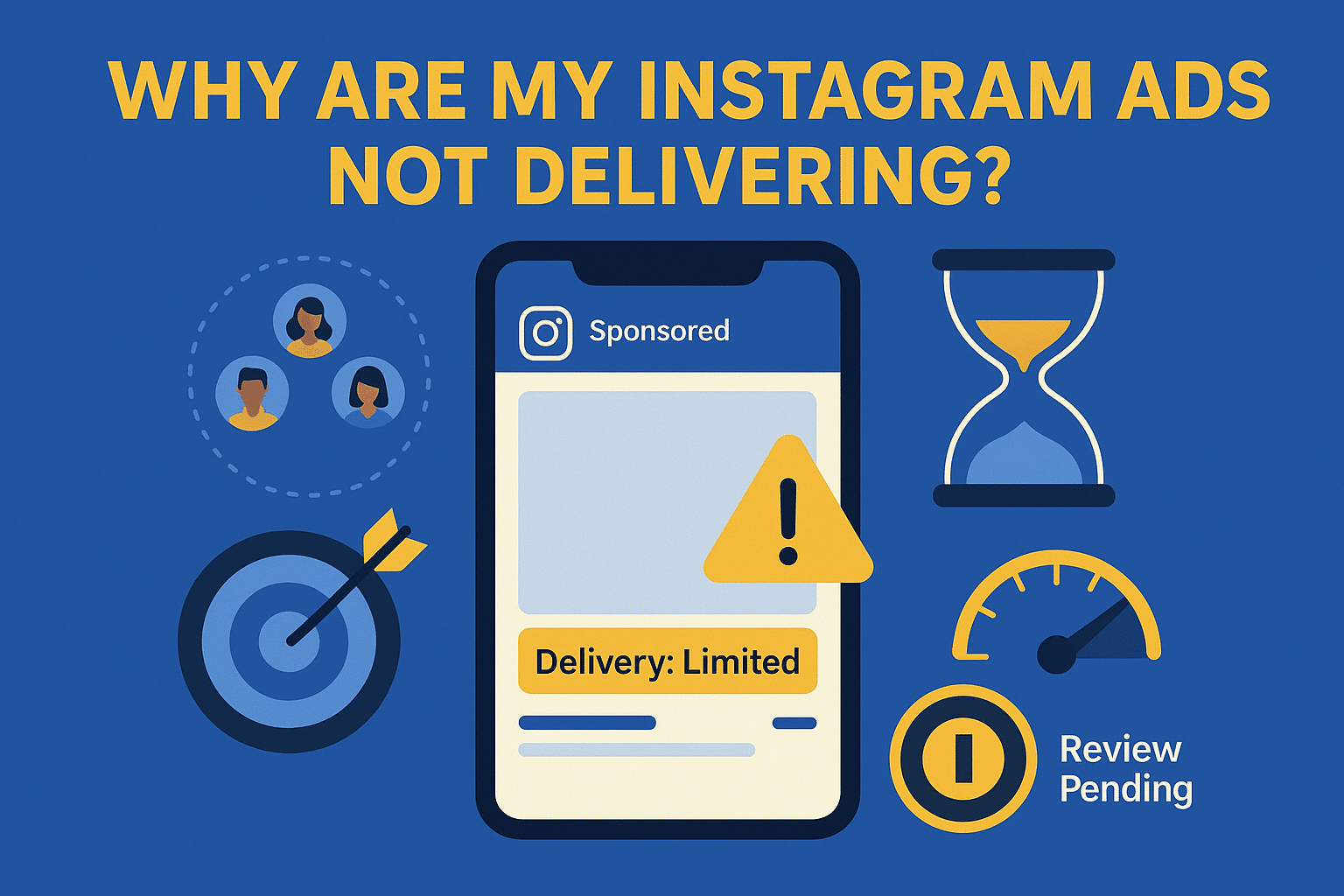
If your Instagram ads are active but not delivering, it can be frustrating, especially when everything seems set up correctly. However, most delivery issues are rooted in a few common factors, and understanding what to check first can save you time and optimize your results. The key is to approach troubleshooting systematically: start with the basics: check your policy status and billing, then move to the more nuanced areas like audience size and bidding strategy.
In this article, I’ll walk you through the exact steps to diagnose why your Instagram ads might not be delivering, and how to quickly resolve them. Whether it’s fixing ad approval issues, adjusting your targeting, or refining your bidding strategy, this guide provides a clear playbook for getting your campaigns back on track. Let’s dive in.
Quick diagnosis checklist
- Status: In review, Rejected, or Approved but limited?
- Billing: Any failed payments or an Account Spending Limit set?
- Budget math: Enough budget to reach your optimization goal?
- Bidding: Using caps that are too tight to win auctions?
- Audience: Too narrow or overlapping with other ad sets?
- Learning: Resetting learning with frequent edits?
- Creative and placements: Specs correct for Feed, Stories, Reels?
- Schedule and time zone: Running inside the flight window?
- Platform: Any known outages today?
Top Reasons Instagram Ads Are Not Delivering and How to Fix Them
| Issue | Why it happens | Fix |
|---|---|---|
| 1) Stuck in review or policy limited | Ads under review or flagged for subtle policy issues will not deliver or will deliver with limits. | – Check Delivery and Policy in Ads Manager, request review if needed. – Align copy and landing page with policies, avoid personal attributes and misleading claims. – Keep landing pages fast and consistent with the ad. |
| 2) Billing issues and account limits | Failed charges or an account spending limit can halt delivery even when campaigns look active. | – Clear failed payments in Billing and Payment Settings. – Remove or raise Account Spending Limit. – Verify primary payment method is valid and not expiring soon. |
| 3) Budget too low for your goal | Insufficient volume prevents learning and stalls delivery for your optimization event. | – Aim for ~50 optimization events per week per ad set. – If not feasible, optimize for a higher volume event or broaden audience. – Raise daily budget to match expected CPMs and CPCs in your niche. |
| 4) Bid or cost caps too tight | Aggressive caps lose auctions and can lead to zero impressions. | – Start with Highest Volume to set a baseline CPA. – If using caps, begin loose and tighten in small steps after stable delivery. – Avoid frequent bid changes during learning. |
| 5) Audience too narrow or overlapping | Tiny audiences and overlapping ad sets reduce eligible inventory and suppress delivery. | – Broaden targeting or enable Advantage+ audience expansion. – Consolidate similar ad sets to reduce overlap. – Exclude engaged or recent converters from prospecting where relevant. |
| 6) Learning phase never completes | Frequent edits reset learning and cause inconsistent delivery. | – Avoid daily edits to budget, bids, creative, or targeting. – Batch changes and keep adjustments within ~20%. – Let each ad set stabilize before testing the next variable. |
| 7) Creative or placement misfits | Wrong aspect ratios or durations limit inventory or fail placement checks. | – Build separate creatives for Feed, Stories, and Reels. – Use vertical 9:16 for Stories and Reels, keep on-screen text minimal. – Preview each placement in Ads Manager before publishing. |
| 8) Wrong objective or optimization event | Optimizing for a rare event limits delivery and slows learning. | – Match objective to funnel stage, start with higher volume events. – Implement conversion API and verify event setup and prioritization. – Confirm the selected optimization event fires on your site or app. |
| 9) Schedule and time zone errors | Ads cannot serve outside the flight window or when account time zone is misaligned. | – Double check ad set schedule and account time zone. – Use lifetime budgets only with correct schedules. – Ensure start/end dates are in the future and active hours cover your market. |
| 10) Platform or UI glitches | Promote flow limitations and occasional outages can stall delivery. | – Build in Ads Manager, not the app’s Promote flow. – If stuck after 24–48 hours, duplicate the ad set and republish. – Check Meta Status for incidents before deep troubleshooting. |
Quick Steps To Take
Follow these in order. Each step takes minutes and clears the most common blockers.
1) Policy and review
- In Ads Manager, check the Delivery and Policy columns. Open the tooltip to see the exact reason. If you disagree, request another review.
- Facebook Business
- If copy or landing page is the issue, remove personal attributes, avoid exaggerated claims, and keep the landing page consistent with the ad.
- Instapage
- Tip: Many advertisers report slow or stuck reviews; rechecking status in Ads Manager is faster than editing the ad repeatedly.
2) Billing
- Go to Billing. Clear failed charges and confirm your primary payment method.
- Remove or raise the Account Spending Limit if you’ve hit it.
3) Budget math
- Can this ad set reach about 50 optimization events in 7 days? If not, raise budget, broaden targeting, or switch to a higher-volume event.
4) Bidding
- Switch to Highest Volume to establish a baseline and restore delivery. Remove tight bid/cost caps temporarily.
5) Audience
- Broaden targeting and reduce overlap. Consolidate redundant ad sets that chase the same people.
- If needed, turn on Advantage+ audience expansion to add inventory.
6) Creative and placements
- Match specs to placements: Feed 1:1 or 4:5; Stories/Reels 9:16 vertical. Preview each placement before publishing.
7) Schedule / time zone
- Confirm the ad set is inside its active window and the account time zone matches your plan. Lifetime budgets allow scheduling; make sure it’s set correctly.
8) Rebuild if still stuck
- Duplicate the ad set (or recreate in Ads Manager instead of the in-app Promote flow) and republish. Check Meta’s status pages if you suspect an outage.
Budget sizing quick guide for Instagram ads
Use this quick math to set realistic budgets that keep delivery stable and data meaningful. Underfunded ad sets rarely exit the learning phase.
Prospecting with conversion optimization
If you’re optimizing for purchases, start with the math behind the goal.
Step 1: Estimate your click and conversion volume
- Expected CPC: $1–$2
- Site conversion rate: 2–4%
To generate 25–50 purchases per week (enough for Meta’s learning system):
- You’ll need roughly 1,250–2,500 clicks per week.
- At $1–$2 CPC, that equals $1,250–$5,000 per week, or about $180–$715 per day.
Step 2: Adjust if that’s too high
- If that spend is unrealistic:
- Optimize for a higher-volume event such as Add-to-Cart or View-Content until delivery stabilizes.
- Scale up gradually: raise budgets 15–20% at a time once the ad set consistently exits the learning phase.
- Broaden your audience slightly to reduce CPC and increase event volume.
Step 3: Revisit conversion optimization
- Once your ad set achieves steady Add-to-Cart or View-Content volume, switch optimization back to Purchase.
- You’ll have stronger signal data and better delivery efficiency.
More tips from real-world use
Avoid mid day edits
- Edits reset learning and cause swings.
- Batch changes once daily during off peak hours in your target time zone.
- Keep budget moves within 15 to 20 percent to preserve stability.
Limit concurrent tests
- Test one major variable at a time: audience, creative, or bid strategy.
- Run a clear control vs one challenger.
- Hold tests for at least 3 to 5 days or until you have enough events to compare.
Use a creative first approach
- New, high quality creatives often restore delivery without more budget.
- Produce formats for each placement: 1:1 or 4:5 for Feed, 9:16 for Stories and Reels.
- Front load the hook in the first 2 seconds. Keep on screen text minimal.
Monitor audience saturation
- Watch frequency and unique reach by ad set. Rising frequency with flat reach signals fatigue.
- Rotate fresh creatives or broaden targeting when frequency climbs.
- Exclude recent engagers from prospecting if they cap out quickly.
Frequently Asked Questions
Why is my Instagram ad approved but not delivering?
Likely causes: cost/bid caps are too tight, budget too low for the optimization event, audience is too small or overlapping, or a billing/spending-limit issue. Start by switching to Highest Volume bidding, increasing budget to hit enough events, broadening the audience, and checking Billing for failed payments or an Account Spending Limit.
Why are my Instagram ads not spending any money?
Check for account-level caps and payment failures first, then look for setup constraints: ultra-narrow targeting, restrictive schedules, or manual bid/cost caps that can’t win auctions. Fix by clearing failed charges, removing or raising the Account Spending Limit, broadening targeting, running ads “all the time” while you test, and using Highest Volume until delivery stabilizes.
How long should I wait before I worry?
If an ad is still in review after ~24 hours or shows zero impressions for several hours in a healthy account, run the quick triage (billing, budget, bidding, audience) and consider duplicating the ad set and republishing.
Should I use the Promote button?
Use Ads Manager for full control, better diagnostics, and fewer configuration mistakes. Many delivery fixes—bidding method, caps, schedules, audience overlap, spending limits—are only clear and adjustable in Ads Manager.
Conclusion
Instagram ad delivery issues usually come down to five areas: policy, billing, budget, bidding, and audience setup. Start by confirming your ads are approved and active, payments are clear, and budgets are large enough to generate consistent conversion events. Then review bidding strategy, targeting width, and creative formats to give the algorithm enough data to learn and optimize.
If you’re still seeing slow or inconsistent delivery, rebuild the campaign in Ads Manager rather than the Promote flow. A clean setup often fixes silent blockers that limit spend.
For businesses ready to improve campaign performance with expert support, visit First Page Digital Singapore’s Instagram marketing services. Their team can help design, launch, and scale campaigns that meet Meta’s delivery standards while driving measurable results.