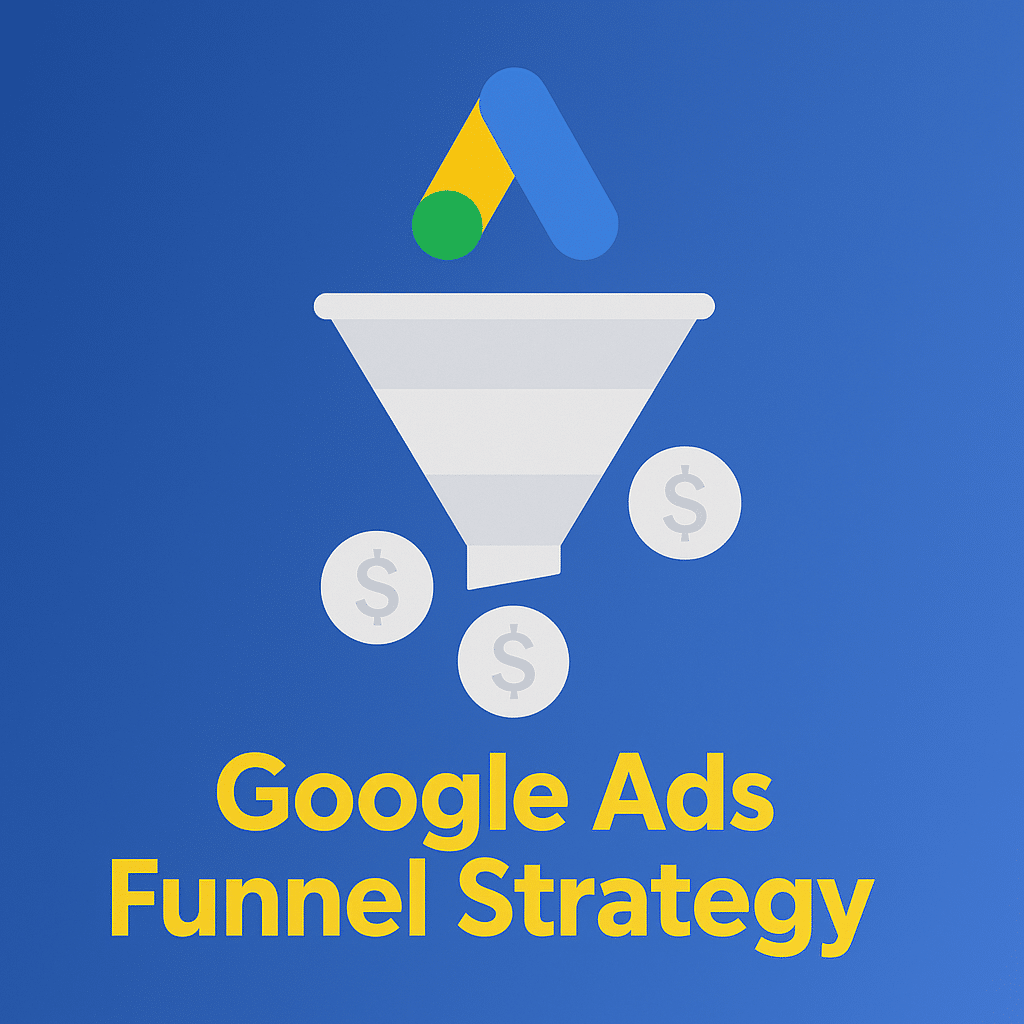
A full-funnel Google Ads strategy aligns your campaigns, creatives, bidding, audiences, and KPIs to each stage of the customer journey, so you can scale efficiently without eroding ROAS or lead quality. This guide gives you a practical roadmap to implement TOFU (awareness), MOFU (consideration), and BOFU (decision), plus retention, with example builds for ecommerce and lead gen, a 90-day rollout plan, and a checklist to avoid common pitfalls.
Why You Need a Funnel in Google Ads
Search captures existing demand, but it does not create it. If you rely solely on bottom-of-funnel (BOFU) search, you’re limiting your growth potential. BOFU is essential for converting those already actively searching for your product or service, but it doesn’t help expand your customer base or drive awareness.
To foster sustainable growth without unnecessarily spiking your cost per acquisition (CPA) or compromising your return on ad spend (ROAS), you need to strategically balance top-of-funnel (TOFU) and middle-of-funnel (MOFU) strategies. TOFU helps introduce your brand to new potential customers, while MOFU nurtures interest and builds relationships. Together, they prepare prospects for BOFU, ensuring your demand capture efforts don’t plateau.
Many practitioners recommend starting with a BOFU-first approach: fully fund demand capture, allowing you to stabilize your campaigns and achieve consistent results. Once you have a solid foundation and your economics are stable, you can then scale up TOFU and MOFU efforts to drive new leads, build brand awareness, and support long-term growth.
How Google Ads Fits Each Stage
| Stage | Platform & Strategy | Audience Targeting |
|---|---|---|
| TOFU | YouTube (in-stream and in-feed), Display, Demand Gen (Discovery’s evolution across YouTube/Discover/Gmail) | Affinity, demographics, life events, topics, broad lookalikes/similar segments; exclude converters and current customers. |
| MOFU | Search, Shopping (often via Performance Max for ecommerce), YouTube/Display/Demand Gen remarketing | In-market and custom intent audiences based on queries and site behavior; segmented remarketing (recency, depth of engagement). |
| BOFU | High-intent Search (brand, exact non-brand, competitor), Shopping/PMax, strong remarketing/RLSA | Remarketing lists (cart/lead abandoners, product/pricing viewers), Customer Match, and RLSA layered over high-intent keywords. |
| Retention | Customer Match and remarketing to increase repeat purchase, LTV, and expansion | Customer Match for 30/90/180-day buyers, high-AOV segments, product/category purchasers for cross-sell. |
Keywords and Messaging by Stage
| Stage | Keyword Types | Messaging Focus |
|---|---|---|
| TOFU (Awareness) | Category terms, “how-to” queries, pain/problem statements, educational intent | Introduce brand point of view and value; teach, don’t sell |
| MOFU (Consideration) | Generic solution and comparison terms | Highlight differentiators; use reviews, case studies, FAQs to reduce friction |
| BOFU (Decision) | Exact product/service, branded, geo-modified, high-intent (“buy”, “pricing”, “quote”, “near me”) | Lean on price, offers, urgency, guarantees, and trust proof |
Bidding by Stage
| Stage | Primary Bidding Approach | Notes & Optimization Tips |
|---|---|---|
| TOFU (Awareness) | Optimize for awareness and engagement using CPM, CPV, and VTR goals | Focus on qualified reach and view quality; build audiences. Avoid aggressive conversion bidding until you have reliable signal. |
| MOFU (Consideration) | Start with Max Conversions or eCPC to build volume | Shift to tCPA/tROAS once daily conversions are stable; use audience layering and remarketing to improve efficiency. |
| BOFU (Decision) | Use tCPA/tROAS or Max Conversions where signal is dense | Segment brand vs non-brand vs competitor for control. For ecommerce, PMax can power MOFU/BOFU; pair with Search for transparency and control. |
Stage-Specific KPIs and Optimisation Loops
| Stage | Primary KPIs / Metrics | Optimisation Focus |
|---|---|---|
| TOFU (Awareness) | Reach, CPM, VTR/engaged views, CTR, new user % | Optimise creative hooks, video lengths, and audience mixes for efficient reach and engagement |
| MOFU (Consideration) | Engaged sessions, product views, add-to-cart, content downloads, assisted conversions | Prune low-quality audiences and creatives; improve landing page clarity and next steps |
| BOFU (Decision) | Conversions, CPA/CPL, ROAS, CVR, revenue | Watch branded vs non-brand performance, impression share, and remarketing contribution; tighten bids and budgets to highest yield |
Budget Allocation
| Phase | BOFU | MOFU | TOFU |
|---|---|---|---|
| Phase 1 (stability) | 70% | 25% | 5% |
| Phase 2 (scale) | 50% | 35% | 15% |
| Phase 3 (mature) | 40% | 40% | 20% |
Competitive categories or low awareness may require pulling TOFU forward. Established brands can bias MOFU/BOFU.
Example Funnel Builds
Ecommerce
| Stage | Channels | Audiences | Creative | KPIs |
|---|---|---|---|---|
| TOFU (Awareness) | YouTube in-stream/in-feed, Demand Gen, Display contextual | Affinity, topics, life events; exclude site visitors and buyers | Product-in-context, UGC, category explainer, trust logos | Reach, CPM, VTR, CTR, new user % |
| MOFU (Consideration) | Performance Max, Search non-brand with in-market/custom intent, YouTube/Display remarketing to product/pricing viewers and cart abandoners | Segmented remarketing (3/7/14/30/60 days), high-margin category segments | Benefits, comparison tables, reviews, price anchors | Product views, add-to-carts, assisted conversions, CVR by audience |
| BOFU (Decision) | Brand + exact Search, PMax for high intent, Standard Shopping where control is needed, RLSA overlays | High-intent users via keywords and lists; cart and lead abandoners | Price, promos, shipping/returns, urgency, trust badges, inventory/stock | ROAS, CPA, revenue, CVR, impression share lost to rank or budget |
Retention
- Channels: Customer Match, PMax asset groups for new arrivals, remarketing.
- KPIs: Repeat purchase rate, AOV, LTV.
Lead Gen/B2B
| Stage | Channels | Creative | KPIs |
|---|---|---|---|
| TOFU (Awareness) | YouTube, Demand Gen, Display content placements | Thought leadership, problem-framing, brand point of view | Reach, VTR, CTR, content engagement |
| MOFU (Consideration) | Search on solution and comparison terms; remarketing to pricing/case study viewers and engaged sessions; webinar/whitepaper offers | Webinar and whitepaper offers; comparison proof and benefit-led copy | MQLs, form completion rate, assisted conversions, demo requests |
| BOFU (Decision) | Brand + competitor Search; RLSA on non-brand high intent; high-converting landing pages with low form friction | Proof, ROI, urgency, objection handling, SLAs | SQLs, CPL, cost per opportunity, pipeline, win rate |
Retention/Expansion
- Channels: Customer Match for upsell/cross-sell and events; product usage content remarketing.
- KPIs: Expansion revenue, churn, reactivation cost.
Creative Sequencing and Frequency
- Sequence messaging: educate (TOFU) → prove/compare (MOFU) → push to act (BOFU).
- Cap TOFU frequency to avoid fatigue; increase for high-intent remarketing windows (3/7/14 days) with tailored creative.
PMax, Search, and Control
- PMax excels at aggregating Shopping demand and remarketing, but Search still provides control over bids, queries, and messaging—run both.
- Feed quality drives PMax: optimize titles, attributes, images, GTIN, price competitiveness, and schema.
- Use asset groups by category, margin tier, or audience signal. Add audience signals to guide but not restrict PMax targeting.
Measurement and Attribution
- Define conversion actions by stage. Don’t optimize BOFU to MOFU micro-conversions; observe them for diagnosis.
- Use GA4 audiences and conversion value rules to weight new customers and high-margin outcomes.
- Expect assisted and view-through impact from TOFU/MOFU. If possible, run brand lift or holdouts to quantify incremental impact.
Common Pitfalls
- Expecting Search to create demand without TOFU support.
- Applying identical KPIs and bidding across all stages.
- Launching TOFU without creative rigor, budget, or a measurement plan.
- Overlapping audiences that cause self-competition between stages.
- Neglecting remarketing segmentation (recency, depth, product) and creative personalization.
- 90-Day BOFU-First Rollout
Actionable Plan For Creating A Google Ads Funnel Strategy
| Phase | Build | Bidding | Targets |
|---|---|---|---|
| Weeks 1–4: Stabilize Demand Capture | Brand + exact non-brand Search; PMax for ecommerce; core remarketing lists (all visitors, product/pricing viewers, cart/lead abandoners); Customer Match ingestion | Max Conversions → tCPA/tROAS when daily conversions stabilize; add price/promo/sitelinks | Hit CPA/ROAS goals; strong impression share; clean baseline |
| Weeks 5–8: Nurture Consideration | Expand non-brand (phrase + new exacts); add MOFU remarketing (YouTube/Display/Demand Gen); in-market/custom intent audiences in Search | Test tCPA/tROAS on MOFU; engagement bidding for video retargeting | Grow assisted conversion share; increase CVR on non-brand with RLSA; expand quality remarketing pools |
| Weeks 9–12: Create Demand | TOFU YouTube and Demand Gen to affinity/topics; exclude recent site visitors/converters | Optimize for reach/engagement (CPM/CPV); test hooks, lengths (6s/15s/30s), UGC vs polished | Efficient CPM/CPV and higher VTR; uplift in brand search; remarketing list growth; more assisted conversions |
Governance and Hygiene Checklist
| Pillar | What to Set Up | Key Actions & Tips |
|---|---|---|
| Tracking | GA4 + Google Ads conversion tags; enhanced conversions; server-side (if available) | Validate tag firing and deduplication; map primary conversions vs. assists; pass values and user consent; test across devices/browsers |
| Audiences | Maintain 7/14/30/60/90/180-day lists; segment by content depth (product, pricing, cart, demo) | Layer RLSA/Customer Match; exclude recent converters; refresh membership durations; build high-intent sublists (cart/demos) |
| Feed & LPs | Clean product feeds (titles, attributes, images, GTIN); fast, focused landing pages | Fix disapprovals; enrich attributes; compress images; surface trust signals (reviews, security, returns); reduce form friction |
| Exclusions | Negative keywords; low-quality placements (irrelevant mobile apps/kids content); audience exclusions to prevent overlap | Use shared negative lists; placement exclusions; cap frequency; exclude cross-stage audiences to protect tests and budgets |
| Reporting | Dashboard by stage: budget, reach, conversions, CPA/ROAS, assisted conversions, brand search trend, remarketing pool growth | Track by campaign and stage; compare new vs. returning users; monitor impression share; annotate tests; alert on KPI deltas |
Conclusion
A full-funnel Google Ads program turns scattered tactics into a cohesive engine for growth. When each stage is intentional:
- TOFU to build qualified awareness
- MOFU to educate and reduce friction
- BOFU to convert demand, and retention to lift LTV
You scale without sacrificing ROAS or lead quality. Moreover, by pairing clear stage-specific KPIs with the right bidding models and audiences, you create fast feedback loops that keep spend efficient and results compounding.
If you want an experienced team to set this up, calibrate the metrics that matter, and keep your funnel improving month after month, partner with First Page Digital’s Google Ads agency team. From strategy and build to creative testing and measurement, we help you turn Google Ads into predictable revenue.