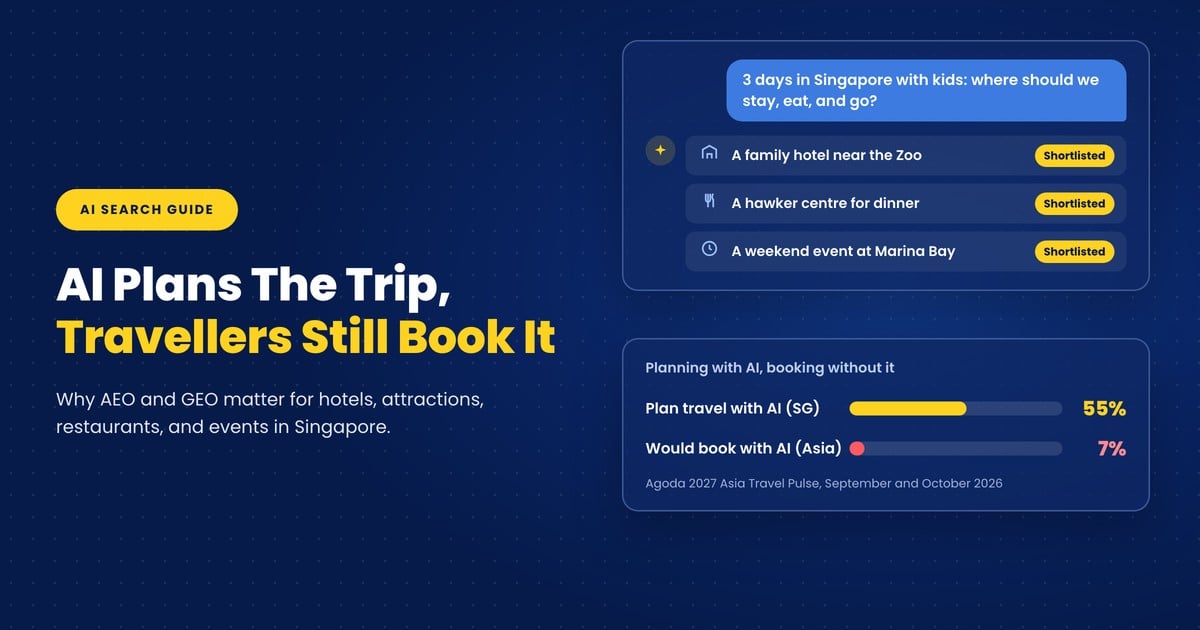
More than half of Singapore travellers now plan their trips with AI, but few would let it make the booking, and that’s why AEO and GEO matter to hotels, attractions, restaurants, and events. In Agoda’s latest survey, 55% of Singapore respondents said they currently use AI to plan their travels, yet across Asia only 7% would use it to make bookings. Answer engine optimisation (AEO) and generative engine optimisation (GEO) are about getting onto the shortlist AI hands travellers, with your details right.
The Singapore Tourism Board (STB) has said it will run workshops on generative engine optimisation for tourism businesses in the second half of 2026. First Page sells AEO and GEO services, so I’m not a neutral party here, and nor are most of the companies behind the studies below, which sell travel bookings, travel technology, or consulting.
TL;DR
- 55% of Singapore respondents and 53% of Asian travellers currently use AI to plan their travels, up from 33% across Asia a year earlier, according to Agoda
- Only 7% of Asian travellers would use AI to make bookings, and 57% would rather book a hotel themselves, so AI shapes the shortlist more than it takes the booking
- Google’s AI Mode can now book restaurants in Singapore, and Meta’s Muse agent launched here with partners such as Agoda, Klook, and Trip.com, though its partner features are still rolling out
- Travellers from Taiwan, Vietnam, and South Korea plan with AI even more than Singaporeans do
- AI answers about hotels and restaurants draw on review sites, food guides, social media, and Google’s business data, as well as brands’ own websites
How Many Travellers Plan With AI Now
Agoda, the online travel agency, surveyed 3,395 people in 11 Asian markets in September and October 2026 for its 2027 Asia Travel Pulse, and 55% of Singapore respondents said they currently use AI to plan their travels. Across Asia, the figure rose to 53% from 33% a year earlier, and it went up in every market Agoda could compare. Agoda launched its own AI assistant in September 2026, so it has an interest in the trend.
IATA, the airline industry’s trade association, asked air passengers too. In its 2026 Global Passenger Survey, published in October, 49% of travellers worldwide had used AI for travel planning, rising to 57% in Asia-Pacific, which is a regional figure rather than a Singapore one.
Amadeus, which sells travel technology, found a much lower figure in June 2025, when 20% of 500 Singapore leisure travellers said they used generative AI, up from 11% the year before. I’d read that as a narrower question asked more than a year earlier, rather than a sign that Agoda’s figure is wrong.
Most of what travellers use it for is the early work. Asked how they’d use AI to plan a trip, Asian travellers in Agoda’s survey most often picked building an itinerary (64%), getting ideas (45%), comparing hotels or flights (44%), and shortlisting destinations (41%), while making bookings came near the bottom, at 7%.
Where AI Stops: The Booking
CNA Luxury summed it up in September 2026: “discovery may be moving to machines, but trust is moving much more slowly.” In Agoda’s survey, 6% of Asian travellers would trust an AI agent to book completely, 23% would let it book a hotel with their final review, and 57% would rather book themselves.
In the US, McKinsey and Skift Research found that 71% of travellers were comfortable letting AI generate ideas and 67% letting it narrow options, but only 16% had used an AI tool to book anything travel-related, in a survey published in September 2026. Their conclusion is the one I’d take, that “visibility in AI responses is the near-term commercial priority.”
Travellers still want to book through a platform or brand they trust. In Expedia’s survey of more than 5,700 adults in the US, UK, and India in March 2026, 68% preferred to book with a trusted travel brand over an AI chatbot, even when AI booking was available. Expedia and Agoda both sell bookings, so they’d naturally like that answer, but I haven’t seen a study that points the other way.
So for a hotel, attraction, or restaurant, I think AI has become the place where travellers decide who’s worth a closer look. If you’re not on the shortlist AI gives them, they go to Agoda, Klook, or a competitor’s site to book someone else, and you never see the question that cost you the booking.
What Changed In Singapore This Year
AI booking has started to arrive here, in narrow forms. Since April 2026, Google’s AI Mode can book restaurants in Singapore, searching reservation platforms for a table that fits the time, cuisine, party size, or even the vibe you ask for. Booking hotels inside AI Mode is still limited to the US, in English.
Then on 27 October 2026, Meta’s Muse agent launched in Singapore with partners including Agoda, Klook, Trip.com, Singapore Airlines, and Grab, covering travel and dining among other things. Meta says the partner features will roll out progressively, and there’s no usage data yet, so it’s too early to say how many people will book this way, but the platforms travellers already book through are getting ready for AI to do the comparing.
STB plans to prepare the industry for this. Its AI Playbook for Tourism, announced in May 2026, says STB will run workshops with industry partners on prompt engineering and generative engine optimisation in the second half of the year, alongside the tools and data resources in its Tcube Centre of Excellence.
Visitors Coming To Singapore Plan With AI Too
For hotels and attractions, many of the travellers who matter most are visitors, and in several markets they plan with AI more than Singaporeans do. This is how current use of AI for travel planning compared across the markets in Agoda’s survey, in September and October 2026.
| Market | Currently use AI to plan travel |
| Taiwan | 63% |
| Vietnam | 63% |
| South Korea | 60% |
| Singapore | 55% |
| India | 53% |
| Malaysia | 53% |
| Hong Kong | 51% |
| Japan | 48% |
| Philippines | 47% |
| Thailand | 45% |
| Indonesia | 33% |
So if a good share of your guests come from Taiwan, Vietnam, or South Korea, most of them may be planning their stay with AI before they ever reach your website. I’d check what AI says about you in the languages they use, not just in English.
Food is one of the main reasons Asian travellers go anywhere, with culinary experiences and cultural exploration tied as the top reasons to travel in 2027, at 54% each. Booking.com’s global survey from 2025 also found that restaurant recommendations were among the most common uses of AI, both when planning a trip (36%) and during it (40%), although Booking.com sells travel, and that survey is now 18 months old.
Events draw visitors as well. Attending events was a reason to travel for 19% of Asian travellers in Agoda’s survey, and in Klook’s June 2026 survey of younger travellers across Asia-Pacific, 73% said they’d visit a lesser-known city for a unique local event, festival, or activity. If your event’s dates, venue, and tickets only live in an Instagram post, AI may or may not pick them up, so a page on your own site with those details is the safer bet.
What AI Reads When It Recommends A Hotel Or Restaurant
Most studies of what AI cites for travel come from the US and Europe. In 4,000 Google AI Mode answers about hotels in eight of those cities in February 2026, consultant Nicolas Sitter found that hotel websites earned 21.2% of citations and Tripadvisor 16.5%, while OTAs took 17.3%. In a separate study, he found the places on ChatGPT’s hotel maps came from Google Places 88.8% of the time, which suggests your Google Business Profile feeds ChatGPT as well as Google, at least for hotel searches.
Our own data covers restaurants in Singapore. We track AI answers for 198 Singapore brands through WorkDuo, a platform that sells this kind of tracking, and for the restaurant and catering brands among them, that means ChatGPT and Google AI Overviews. These are the third-party sources cited most often for those brands between 9 October and 7 November 2026, as a share of AI answers that cite each one at least once.
| Industry | Social | Food guides and media | Bookings, reviews, and venues |
| Restaurants and bars (3 brands, 8,984 answers) | Facebook 15.3%, Instagram 9.7%, Lemon8 6.9% | Where To Eat 11.3%, Honeycombers 6.7%, Seth Lui 5.8%, Michelin 5.2% | FoodLine 12.1%, Chope 6.7%, Tripadvisor 6.2%, Venuerific 5.2% |
| Catering (4 brands, 7,679 answers) | Facebook 12.2%, Instagram 6.9%, Reddit 6.8% | Four “best caterer” list sites at 10.1–14.1% each, Honeycombers 8.7%, Where To Eat 8.5% | Bridely 12.9% |
The clearest pattern is how much AI leans on social media for food in Singapore. Facebook is cited more than any other third-party source for the restaurants we track, so the menus, hours, and events you post there are part of what AI reads about you. Local food guides and “best of” lists matter a lot too, especially for caterers, and I think booking and venue platforms like Chope and Venuerific appear because AI looks for somewhere to send people to book.
These figures come from the prompts we track for a handful of brands, three restaurant brands and four caterers, so they show which kinds of sources matter for Singapore F&B better than they show exact shares. I don’t have comparable Singapore figures for hotels or attractions to share yet.
What Travel, F&B, And Events Brands Can Do
Most of the work is making sure the facts AI quotes about you are complete, consistent, and easy to find. These are the steps I’d start with:
- Complete your Google Business Profile: categories, hours, menu, attributes, and photos, since Google’s AI draws on it, and so did ChatGPT’s hotel maps in one study (I’ve covered the restaurant setup in Google Business Profile for restaurants in Singapore)
- Put the facts guests ask about on your own website: price ranges, opening hours, how to get there, what’s included, and booking or cancellation rules, written as text rather than locked in PDFs or images
- Earn reviews where AI looks: Google, Tripadvisor, and the booking and review sites your guests use, since AI cites them, and real reviews were also the top thing that would make travellers in Agoda’s survey trust an AI travel assistant more
- Get covered in the guides AI reads: local food and travel media, and the “best of” lists for your category, which come up far more for F&B than for most industries in our data
- Keep your social profiles current: Facebook and Instagram are among the most-cited third-party sources for the restaurants we track, so out-of-date hours or menus there can end up in AI answers
- Check AI in your guests’ markets: ask ChatGPT, Gemini, and Google’s AI Mode what your guests ask, such as “rooftop bars near Marina Bay” or “things to do in Singapore with kids”, and note whether you’re named and whether the details are right
AI platforms still report very little to brands, as I’ve covered in why AEO and GEO still matter when AI sends under 1% of traffic, so you won’t get a clean revenue figure for any of this yet. But with more than half of Singapore travellers already planning this way, I think waiting for better data means letting AI build its shortlists without you.
Frequently Asked Questions
How many Singapore travellers use AI to plan trips?
More than half. In Agoda’s survey of September and October 2026, 55% of Singapore respondents said they currently use AI to plan their travels, against 53% across Asia. IATA found 57% of air passengers in Asia-Pacific had used AI for travel planning in its 2026 Global Passenger Survey, though that’s a regional figure, not a Singapore one.
Do travellers book hotels through ChatGPT?
Rarely, so far. Only 7% of Asian travellers in Agoda’s 2026 survey would use AI to make bookings, and 57% would rather book a hotel themselves. In the US, McKinsey and Skift Research found 16% had used an AI tool to book anything travel-related, and in Expedia’s survey across the US, UK, and India, 66% said they wouldn’t trust an AI assistant to book anything on their behalf.
Does AEO help restaurants in Singapore?
I think so, and more so since Google’s AI Mode started booking restaurants here in April 2026. For the Singapore restaurant brands we track, Facebook, food guides such as Where To Eat, and booking and review platforms such as Chope and Tripadvisor are among the most-cited sources in AI answers. Google’s AI also draws on your Business Profile, so a complete profile and a website with clear menus and hours both feed what AI says.
What sources does AI use to recommend hotels?
Review sites, OTAs, Google’s own data, and hotels’ own websites. In Nicolas Sitter’s February 2026 study of Google AI Mode in eight US and European cities, hotel websites earned 21.2% of citations, Tripadvisor 16.5%, and OTAs 17.3%. ChatGPT’s hotel maps drew on Google Places 88.8% of the time in a separate study, and I haven’t found a comparable study for Singapore.
What is the Singapore Tourism Board doing about AI search?
It has said it will train the industry. STB’s AI Playbook for Tourism, announced in May 2026, includes workshops with industry partners on prompt engineering and generative engine optimisation in the second half of 2026. Tourism businesses can also use the tools and data resources in STB’s Tcube Centre of Excellence.
References
- Agoda: 2027 Asia Travel Pulse, November 2026
- IATA: 2026 Global Passenger Survey, October 2026
- IATA: 2026 Global Passenger Survey highlights, October 2026
- Amadeus: Singapore travellers embrace biometric gateways, October 2025
- CNA Luxury: AI can plan your holiday, but would you trust it to book the trip?, September 2026
- Skift: Winning hearts in an age of infinite travel choices (McKinsey and Skift Research), September 2026
- Hospitality Net: Expedia Group’s AI trust gap research, April 2026
- 9to5Google: AI Mode restaurant booking expands, April 2026
- TechCrunch: Google’s AI Mode can now help book hotels, August 2026
- Meta: Muse is now available in Singapore, October 2026
- TTR Weekly: STB floats AI playbook and Tcube centre, May 2026
- Booking.com: Global AI Sentiment Report, July 2025
- Klook: Travel Pulse 2026, July 2026
- Nicolas Sitter: Google AI Mode hotel study 2026
- Nicolas Sitter: ChatGPT hotel data sources study
- WorkDuo: AI search visibility platform
AI citation figures come from WorkDuo for 9 October to 7 November 2026. The other sources described were checked on 14 November 2026.